
 Back
Back





IN THE HIGH COURT OF JUDICATURE AT MADRAS
V. LAKSHMINARAYANAN, J.
Dr.Mohamed Meeran – Appellant
Versus
The Tamil Nadu Waqf Board – Respondent
C.R.P.(NPD).No.1617 of 2023 & C.M.P.No.10521 of 2023
Decided on : 10-06-2024
| Table of Content |
|---|
| 1. civil revision petition and management of waqfs (Para 1 , 4 , 5 , 6 , 7 , 8 , 9 , 10 , 11) |
| 2. arguments over election validity and management (Para 16 , 17 , 18 , 19 , 20 , 21 , 22 , 23) |
| 3. court's observations on waqf management (Para 24 , 25 , 26 , 28) |
| 4. legal analysis of election right and ad hoc committee's limitations. (Para 30) |
| 5. bifurcation of election results not permitted (Para 34 , 47 , 48) |
| 6. final decision on waqf management and election (Para 59 , 60 , 61 , 62) |
ORDER :
V. LAKSHMINARAYANAN, J.
1. This civil revision petition arises against an order passed by the learned Waqf Tribunal at Chennai in O.A.No.25 of 2022 dated 02.01.2023. By the said order, the learned Waqf Tribunal came to the conclusion that the said O.A. is liable to be dismissed and accordingly dismissed the same. Invoking the powers vested under Proviso to Section 83 (9) of the WAQF ACT 1995, the present civil revision petition has come up before me.
2. Notice regarding admission had been ordered on 12.06.2023. Mr.Haja Mohideen Gisthi entered appearance for the respondents 1 and 2 and Mr.L.Gavaskar appeared for respondents 3 to 9.
3. I have heard Mr.E.Mohammed Abbas in support of this revision and the two counsels named above opposing it.
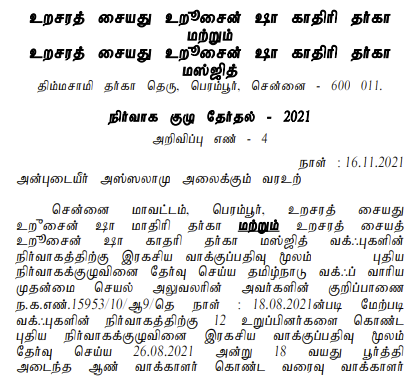
4. The fact relating to the dispute is very limited. There are two Waqfs which were surveyed and notified by the State of Tamil Nadu. One is Hazarath Syed Hussain Sha Khadiri @ Dimmasami Dargah and the other is Hazarath Syed Hussain Sha Khadiri @ Dimmasami Darghah Mosque. Both the Waqfs were surveyed and were given survey numbers viz., G.S.No.235/Chennai and G.S.No.236/Chennai respectively.
5. On the request of Mr.Haja Mohideen Gisthi, the files relating to both the Waqfs were placed before me. A perusal of the files as well as the orders and the petition reveals that the Waqf Tribunal cum I Assistant City Civil Judge at Chennai by an order dated 20.12.2007 had directed the Tamil Nadu Waqf Board to take over direct management of both the Waqfs. The Tamil Nadu Waqf Board accordingly passed a resolution in item No.80/2008 on28.05.2008, taking both the Waqfs under its direct management.
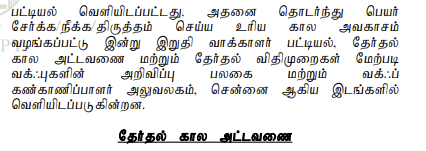
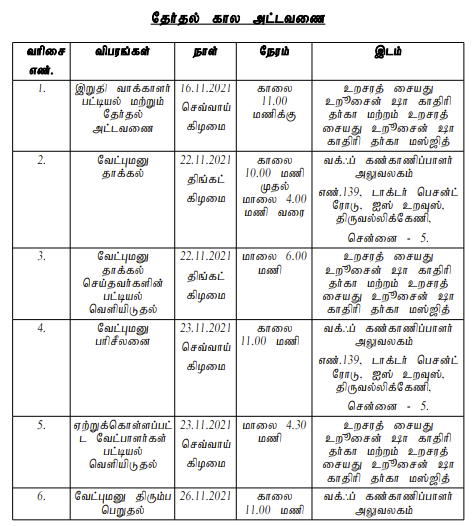
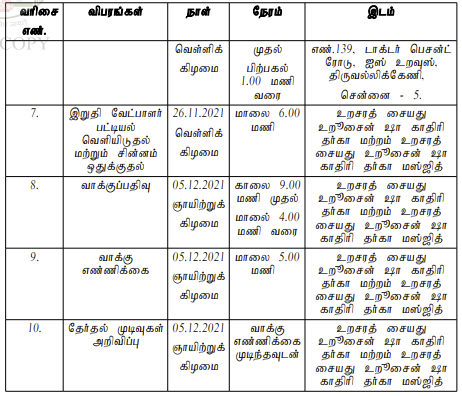
6. The Waqf Board appointed the Superintendent of Waqfs, Chennai, as the executive officer and further directed him to hold elections for both the Waqfs together. Accordingly, elections were held following the secret ballot procedure and the committee headed by Jana Mohamed Abibulla assumed office for a period of three years from 2013 to 2016.
7. It is relevant to refer to the proforma report which has been filed by the Waqf Board before the Waqf Tribunal at Chennai. As per the proforma report, the appointment of Mutawallis to both the institutions was by way of “nomination by the local Jamathars”. By the efflux of time, as the Mussallis increased in number, the Waqf Board has decided the nomination of members would be concluded by way of conducting election by secret ballot. On this tactic, the committee of Jana Mohamed Abibullah had been appointed for the aforesaid Waqfs. This process of election seems to have been followed for the subsequent years as well
8. For the year 2017, after the expiry of appointment of Jana Mohamed Abibullah, when the elections were called for afresh, sufficient number of nominations were not made to fill the office of the committee. Therefore, the Waqf Board yet again brought the committees of both the Waqfs under direct management by way of a resolution in Item 97/2018 dated 28.08.2018. The Waqf Board, by this resolution, further ordered election/selection of eligible persons for the management of both the Durgah as well as the Mosque.
9. One Janath R.Syed Yacoob Sahib, when the Waqfs were under the direct management of the Board, requested that a committee be appointed in order to conduct the litigations which had arisen on account of encroachments on the Waqf property. The Waqf Board, taking into consideration this situation dehors the proforma, appointed an ad hoc committee. This ad hoc committee

AI
The Waqf Board cannot bifurcate results from common elections for multiple Waqfs; elected committees hold vested management rights despite the existence of ad hoc committees.


The Waqf Board has the authority to remove a Mutawalli under the Waqf Act and appoint an Executive Officer in the interest of the Waqf, affirming the integrity of procedural statutory provisions.

Elections for Wakf institution management are mandated when multiple panels request leadership, emphasizing adherence to regulations over administrative convenience.
The court reaffirmed the necessity for the Waqf Board to address complaints swiftly regarding trustees and upheld the process for appeal against removals, ensuring adherence to statutory provisions.
Direct management of a Wakf is permissible when no governing body exists due to expired terms, necessitating timely elections per amended governance rules.

The Chairman of the Waqf Board has the authority to appoint a new Management Committee post supersession based on the provisions of the Waqf Act.



An indispensable Tool for Legal Professionals, Endorsed by Various High Court and Judicial Officers
Please visit our Training & Support
Center or Contact Us for assistance

Scan Me!
India’s Legal research and Law Firm App, Download now!


For Daily Legal Updates, Join us on :



 Back to top


