Back
Back





2024 Supreme(Mad) 2655
BEFORE THE MADURAI BENCH OF MADRAS HIGH COURT
SUNDER MOHAN, J.
R. Yovan S/o Rajamani - Appellant
Versus
Vijaya D/o Selvanayagam - Respondent
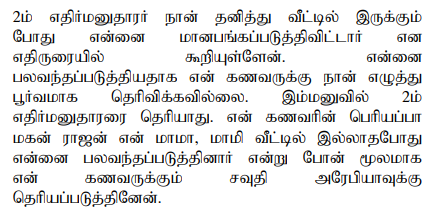
C.M.A. (MD) No. 201 of 2010
Decided On : 25-09-2024
For the Appellant : R. Joseph Thankaraj
For the Respondent: M.P. Senthil
The court reaffirmed that consistent evidence and admissions are critical in substantiating claims of adultery for divorce under the Indian Divorce Act, particularly when a marriage has irretrievably broken down.
Headnote:(A) Indian Divorce Act, 1869 - Section 10 - Divorce proceedings - The appellant sought a divorce on grounds of adultery, citing a letter as evidence of the first respondent's infidelity - The Trial Court dismissed the petition, stating no grounds for divorce were made out. However, the evidence presented supported the appellant's claims. (Paras 2 and 9)
(B) Evidence - The importance of witness consistency and written admissions in establishing grounds for divorce. (Paras 4 and 9)
(C) Separation - The court noted that the marriage had irretrievably broken down since 1995. (Paras 9)
Facts of the case:
The appellant and the first respondent were married on 21.01.1991, had two children, and faced marital discord due to alleged adultery by the first respondent with another individual. The Trial Court dismissed the appellant's petition for divorce.
Findings of Court:
The court found that the appellant had established grounds for divorce and recognized the irretrievable breakdown of marriage since 1995.
Issues: Whether the evidence was sufficient to grant a decree of divorce on the grounds of adultery?
Ratio Decidendi: The appellant's evidence was deemed more probable and established the ground for divorce despite contradictions in the first respondent's claims.
Result: Appeal allowed, decree of dissolution of marriage granted.
| Table of Content |
|---|
| 1. background of the divorce petition (Para 1 , 2) |
| 2. arguments from both parties (Para 3 , 4) |
| 3. court's evaluation of evidence (Para 6 , 7 , 8) |
| 4. grounds for granting divorce (Para 9) |
| 5. conclusion of the appeal (Para 10) |
JUDGMENT :
SUNDER MOHAN, J.
1. The husband, aggrieved by the dismissal of his petition for divorce, has filed this appeal.
2. The facts leading to the filing of this appeal are as follows:
(a) The appellant and the first respondent got married on 21.01.1991, as per the Indian Christian Marriage Act, 1872.
(b) Out of the wedlock, a child was born on 10.12.1991.
(c) Thereafter, the appellant went abroad and returned to his native place on 17.11.1994.
(d) Another child was born on 30.05.1995.
(e) The appellant, according to him, came to know about the illegal relationship of the first respondent with the second respondent herein.
(f) Hence, the appellant filed a petition for divorce under Section 10 of the Indian DIVORCE ACT , 1869.
(g) The first respondent filed a counter denying all the allegations and stating that she was always willing to live with the appellant and that, in fact, the act of the appellant amounted to the desertion, and hence, the appellant is not entitled to the decree of divorce under Section 10 of the Indian DIVORCE ACT , 1869.
(h) The Trial Court, after considering the evidence on record, dismissed the petition for divorce, stating that no ground was made out for the grant of divorce.
3. The learned counsel for the appellant submitted that the Trial Court had not considered the evidence on record in proper perspective and that the evidence of P.W.1 to P.W.3 and the documents, especially Ex.A2, would show that the first respondent had admitted her relationship with the second respondent, and therefore, the Trial Court ought not to have dismissed the petition filed for divorce.
4. The learned counsel for the first respondent, per contra, submitted that the letter (Ex.A2) relied on by the appellant would clearly show that the first respondent had not admitted to any illegal relationship but had complained about the second respondent's illegal act of forcible sexual intercourse, and therefore, based on the said letter (Ex.A2), the adultery of the first respondent cannot be presumed.
5. Though notice has been served to the second respondent, none has entered appearance.
6. The only point for consideration in the instant appeal is whether the appellant is entitled to a decree of divorce on the ground of adultery.
7. The evidence produced on the side of the appellant would show that the appellant and the first respondent were living together in India till December, 1991, and thereafter, the appellant had left India and returned to his native place on 17.11.1994. According to the appellant, it was during this period of separation that the first respondent developed a relationship with the second respondent. When the appellant questioned the first respondent about this relationship, differences of opinion arose between both of them. The father of the first respondent and other elders in the family attempted to pacify the appellant and brought the first respondent along with them. The first respondent also brought a letter seeking an apology from the appellant. In her deposition, the first respondent had denied writing such letter.
8. She had specifically denied writing another letter (Ex.A2). The first respondent, however, had admitted in the cross-examination that on a particular occasion, one Rajan had forcible sexual intercourse with her and that she had complained about the same to the appellant. The admission made by the first respondent in her cross-examination is corroborated by the contents in Ex.A2, even though the first respondent denied having written such a letter. On a reading of Ex.A2 and the other evidence on record, there is nothing to suggest that it was fabricated by the appellant. In fact, the Trial Court had not disbelieved Ex.A2 produced on the side of the appellant. In Ex.A2