
 Back
Back





IN THE HIGH COURT OF JUDICATURE AT MADRAS
A.D. MARIA CLETE, J.
The Management, Salem Co-operative Sugar Factory, (Salem Co-operative Sugar Mill Limited) – Petitioner
Versus
C. Boopathy, S/o. Chinnasamy – Respondent
W.P. Nos.19742 & 19746 of 2020 and W.M.P. Nos. 24386 & 24389 of 2020 and 2485 of 2024
Decided On : 06-03-2025
| Table of Content |
|---|
| 1. challenge to illegal termination of workmen. (Para 2 , 4 , 6) |
| 2. filing of claims by terminated workmen. (Para 10 , 11 , 12) |
| 3. labour court's findings on termination. (Para 14 , 15 , 16) |
| 4. seasonal industry and workers' rights. (Para 18 , 19 , 20) |
| 5. previous court orders and compliance. (Para 21 , 22 , 23) |
| 6. dismissal of writ petitions and reinstatement order. (Para 25) |
JUDGMENT :
A.D. MARIA CLETE, J.
Heard.
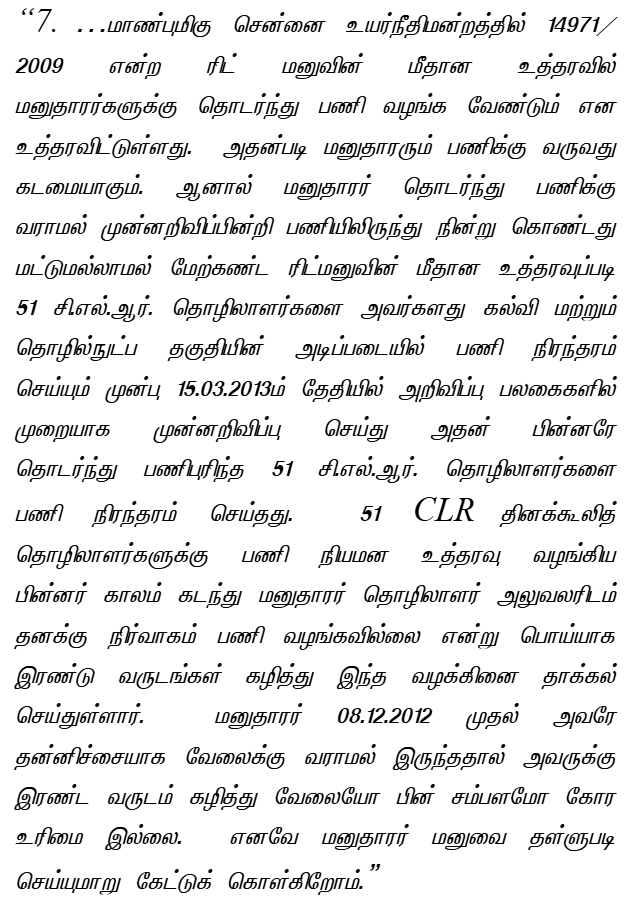
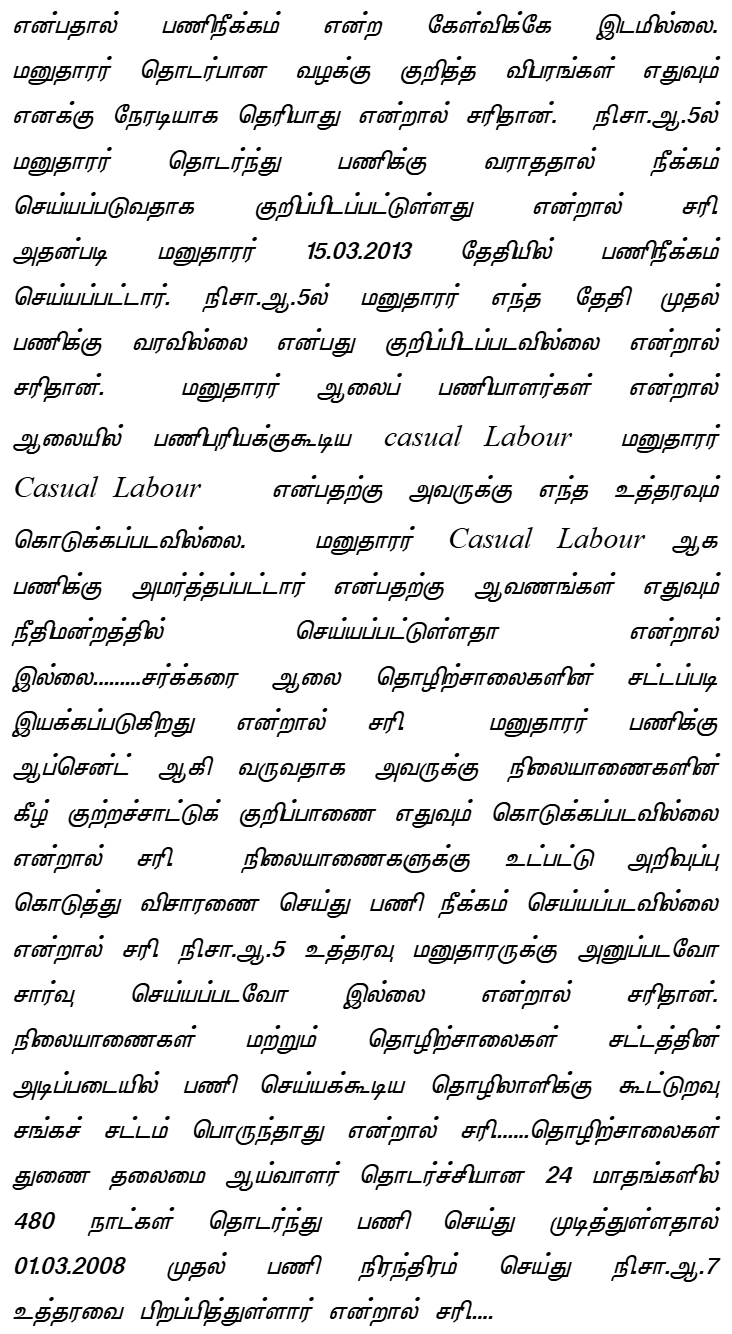
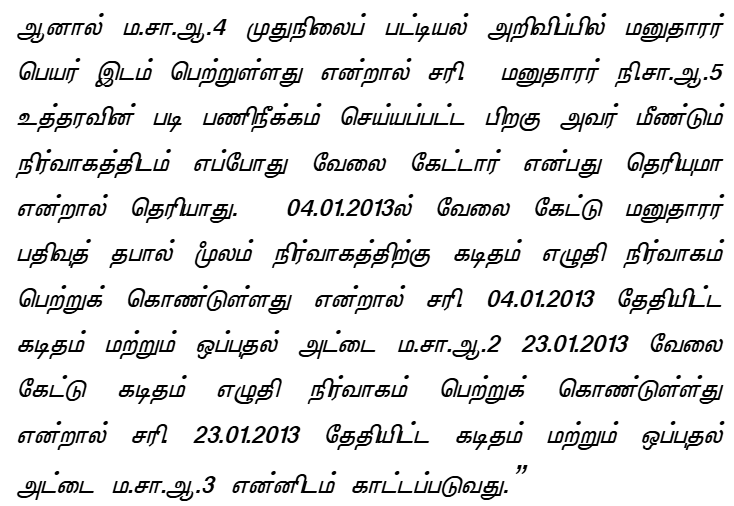
2. The writ petitioner in both petitions is the management of a cooperative sugar factory in Salem. These two petitions challenge the Award issued by the Labour Court, Salem, in I.D. No. 199 of 2014 and I.D. No. 209 of 2014, both dated 29.07.2019. Through separate awards, the Labour Court ruled that the oral termination of the workman C. Boopathy on 08.12.2012 and the termination of Sankar on 12.01.2013 were illegal. Consequently, the court set aside both terminations and directed the management to reinstate the workmen with back wages.
3. In both writ petitions, a notice of motion was issued on 23.12.2020. Although the management filed two Miscellaneous Petitions in W.M.P. Nos. 24386 of 2020 and 24389 of 2020, seeking an interim stay on the operation of the Award, no orders were passed. The Respondent C. Boopathy, in W.P. No. 19742 of 2020, filed a Miscellaneous Petition in W.M.P. No. 2485 of 2024, seeking payment of last drawn wages under Section 17B. However, no orders have been passed in that petition either. As a result, all three WMPs remain pending.
4. The circumstances leading to the filing of these writ petitions are as follows. A trade union, namely the Salem Co-operative Sugar Mills National Workers Union, filed W.P. No. 14700 of 2008 before this Court, seeking a direction to the management to refrain from engaging contract labor in place of 84 workmen who had approached the competent authority under the provisions of the Tamil Nadu Industrial Establishments (Conferment of Permanent Status) Act, 1981 (T.N. Act 46/1981), seeking the conferment of permanent status.
5. After issuing notice to the parties, this Court disposed of the writ petition by an order dated 01.09.2008. Upon noting that a petition was pending before the authority under the Permanent Status Act, the Court directed the authority to complete the inquiry and pass appropriate orders within three months, with the management required to cooperate in the process. After the disposal, the Court issued the following direction to the management:
“It is made clear that after the decision is rendered by the authority under Tamil Nadu Act 46 of 1981, it is open to the 2nd respondent to act in accordance with the decision arrived at by the said authority.”
6. The competent authority, namely the Deputy Chief Inspector of Factories, Salem, by an order dated 10.10.2011, held that the management of the sugar factory falls within the purview of the Permanent Status Act. It was further determined that workmen employed in the factory who complete 480 days of service within a span of 24 calendar months are entitled to permanent status. Accordingly, the authority directed that the individuals listed in the annexure be granted permanency. The annexure contained a list of 108 names.
7. The management filed a writ petition before this Court challenging the order of the authority. After hearing both sides, this Court, by an order dated 31.10.2011, dismissed the writ petition and upheld the authority’s decision granting permanent status to the workmen. In the judgment reported in CDJ 2011 MHC 5561, the operative portion in paragraphs 36 and 37 states as follows:
“36. Further, in the present case, when a direction was issued by this court in W.P.No.14700 of 2008, dated 4.9.2008, this court had directed the parties to act according to the order made by the first respondent and till such time the engagement of these workmen was directed to be continued.
37. In the light of the above factual matrix and the legal precedents set out above, this court do not find any case m


The court affirmed that terminations without adherence to natural justice and statutory provisions are illegal, emphasizing the rights of workers under the Tamil Nadu Permanent Status Act.

There may be cases where termination of a daily-wage worker is found to be illegal on the ground that it was resorted to as unfair labour practice or in violation of the principle of last come first ....

A Government declaration is required to classify a sugar factory as seasonal under the applicable labor law; continuous service of an employee in such a factory permits entitlement to permanent statu....

The court's decision established that when temporary or ad-hoc appointments are continued for a long period of time, the Court has to presume that there is a regular need for service on regular posts....

Labour law – Reinstatement - Granting of relief of reinstatement after such a long gap will not serve any purpose and, therefore, this Court is of the view that if the order to grant compensation

The court upheld the entitlement of petitioners to permanent employment status under the Tamil Nadu Permanent Status Act after completing 480 days of service, highlighting the necessity of adhering t....
Private companies cannot use discretion to justify unfair labour practices, and past financial status as a sick unit does not prevent directions of permanency that may increase financial burden.
The Conferment of Permanent Status Act did not apply to the employees of the Board, and the Labour Court erred in granting retrospective regularisation without adjudication of disputed issues.



An indispensable Tool for Legal Professionals, Endorsed by Various High Court and Judicial Officers
Please visit our Training & Support
Center or Contact Us for assistance

Scan Me!
India’s Legal research and Law Firm App, Download now!


For Daily Legal Updates, Join us on :



 Back to top


