
 Back
Back





BEFORE THE MADURAI BENCH OF MADRAS HIGH COURT
K. Murali Shankar, J.
R.Gnana Soundari - Appellant
Versus
R.Chellappan (died) - Respondent
S.A.(MD).No.164 of 2019 and C.M.P.(MD)No.6780 of 2019
Decided On : 19-02-2026
| Table of Content |
|---|
| 1. background of the appeal regarding specific performance. (Para 1 , 2) |
| 2. plaintiff's and defendant's claims regarding the agreement. (Para 4 , 5) |
| 3. issues framed for trial regarding performance. (Para 6 , 7 , 8) |
| 4. substantial questions regarding limitation and maintainability. (Para 9 , 10) |
| 5. court's analysis on readiness and contractual obligations. (Para 12 , 13 , 16) |
| 6. plaintiff's behavior and notifications related to the contract. (Para 14 , 15) |
| 7. legal interpretations regarding contract's enforceability and limitation. (Para 18 , 19 , 20 , 21) |
| 8. court's determination on the validity of the signed agreement. (Para 22 , 23 , 24) |
| 9. final ruling and dismissal of the appeal. (Para 25 , 26) |
JUDGMENT :
K. Murali Shankar, J.
The Second Appeal is directed against the judgment and decree made in A.S.No.19 of 2016, dated 20.11.2018, on the file of the Principal Subordinate Court, Kumbakonam, reversing the judgment and decree passed in O.S.No.305 of 2008, dated 22.12.2015, on the file of the Principal District Munsif Court, Kumbakonam.
2. The appellant is the defendant. The deceased first respondent as sole plaintiff filed a suit claiming the relief of specific performance of the sale agreement dated 10.06.1990.
3. For the sake of convenience and brevity, the parties will hereinafter be referred as per their status/ranking in their original suit.
4. The case of the plaintiff in brief is as follows:
The suit properties absolutely belonged to the defendant. The defendant offered to sell the suit properties and the plaintiff agreed to purchase the same. Both of them entered into a sale agreement on 10.06.1990 fixing the sale price at Rs.23,500/-. The plaintiff paid the entire sale price of Rs.23,500/- to the defendant on the date of sale agreement itself. The defendant handed over the possession of the suit properties to the plaintiff and the plaintiff has been in possession and enjoyment of the suit properties since 10.06.1990. Both parties agreed to have the execution of the sale deed on any date, according to the plaintiff's desire. Though the plaintiff has always been ready and willing to perform his part of contract to get the sale deed executed and registered, the defendant has been postponing the same on some pretext or the other. Hence, the plaintiff sent a legal notice dated 06.08.2008 calling upon the defendant to execute the sale deed and get it registered. The defendant having received the legal notice on 07.08.2008, sent a reply notice dated 18.08.2008 containing false and untenable allegations. Since the first defendant had denied the sale agreement and refused to execute the sale deed, the plaintiff was constrained to file the above suit for specific performance of the agreement dated 10.06.1990.
5. The defence of the defendant in brief is as follows:
The defendant did not execute any sale agreement dated 10.06.1990 in favour of the plaintiff in respect of the suit properties and did not receive the alleged sale consideration of Rs.23,500/- from the plaintiff. Since the plaintiff is the defendant's cousin's brother, she had requested him to look after the suit properties as she was residing in her matrimonial home in a different village. The plaintiff, under the guise of obtaining patta had secured the signatures of the defendant on blank papers. The plaintiff forged and fabricated the sale agreement with an intention to grab the suit properties. The suit is barred by limitation. The suit has not been properly valued and requisite court fee has not been paid. Hence, the suit is liable to be dismissed.
6. The learned trial Judge, upon considering the pleadings of both parties framed the following issues:
(i) Whether the plaintiff is in possession of the property in pursuance of the sale agreement?
(ii) Whether the plaintiff is entitled to get the relief of specific performance?
(iii) To what other reliefs?
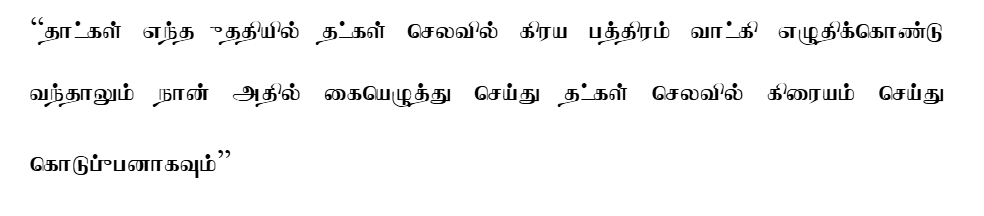
7. During trial, the plaintiff examined himself as P.W.1 and examined one Dhakshinamoorthy as P.W.2 and exhibited

A sale agreement signed solely by the vendor is enforceable, and no fixed date of performance in an agreement allows suit filing within three years of notice of refusal.

The plaintiff's failure to file the suit within the limitation period and to prove readiness and willingness to perform the contract resulted in dismissal of the specific performance claim.

Contractual obligations in specific performance suits require timely action; failure to act within statutory limitation renders claims void.

Suit for Specific Performance – Unlimited limitation would lead to a sense of insecurity and uncertainty.

The plaintiff must establish continuous readiness and willingness to perform a contract to be entitled to specific performance under Section 16(c) of the Specific Relief Act.

The court affirmed that specific performance is a discretionary remedy, requiring the plaintiff to prove the validity of the contract and readiness to perform.


The court ruled that time is not an essence of contract in specific performance cases, and the plaintiffs were entitled to specific performance despite the trial court's dismissal.

A plaintiff seeking specific performance must demonstrate continuous readiness and willingness to complete contract obligations, failing which relief may be denied.



An indispensable Tool for Legal Professionals, Endorsed by Various High Court and Judicial Officers
Please visit our Training & Support
Center or Contact Us for assistance

Scan Me!
India’s Legal research and Law Firm App, Download now!


For Daily Legal Updates, Join us on :



 Back to top


