
 Back
Back





BEFORE THE MADURAI BENCH OF MADRAS HIGH COURT
G.K.ILANTHIRAIYAN, R.POORNIMA, JJ.
Kannan – Appellant
Versus
State rep. by The Inspector of Police – Respondent
Crl.A(MD)No.1041 of 2024 and Crl.M.P(MD)No.369 of 2026
Decided On : 03-02-2026
| Table of Content |
|---|
| 1. background facts of the case and trial outcome. (Para 1 , 2 , 3 , 4 , 5) |
| 2. contentions by the appellant and respondent. (Para 6 , 7) |
| 3. court's analysis on the sufficiency of evidence. (Para 8 , 9 , 10 , 11 , 12) |
| 4. legal interpretation of intent and applicable charges. (Para 13 , 14) |
| 5. final decision and sentencing by the court. (Para 15 , 16) |
JUDGMENT :
G.K.ILANTHIRAIYAN, J.
1. This appeal has been filed as against the Judgment passed in S.C.No.458 of 2016, dated 28.09.2022, on the file of the I Additional District Judge, Madurai, thereby convicting the appellant for the offences punishable under Section 302 of IPC .
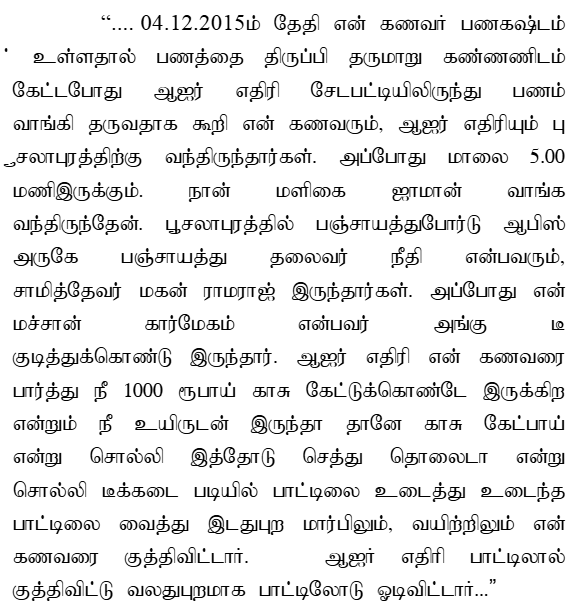
2. The case of the prosecution is that the accused and the deceased were friends for the past three years before the date of occurrence. The deceased had lent a sum of Rs.1,000/- to the accused. On 04.12.2025 the deceased requested the accused to repay the said amount since he had some urgent needs. In response, the accused and the deceased traveled together to Sedapatti on the accused’s two-wheeler. At that juncture, at about 05.00 p.m., near a grocery shop, the accused assaulted the deceased with sprite glass bottle on his chest and stomach. Immediately, a 108 Ambulance was called, and the deceased was taken to Government Hospital, Thirumangalam. Despite medical attention, the deceased succumbed to his injuries on 10.12.2015.
3. On the basis of the complaint, the respondent registered an F.I.R in Crime No.169 of 2015 for the offences punishable under Sections 294 (b), 324 and 307 of IPC . After demise, FIR has been altered into (b), 324, 307 and 302 of . After completion of investigation, the respondent filed a final report and the same has been taken cognizance by the Trial Court.
4.On the side of the prosecution, in order to bring the charges to home, they examined P.W.1 to P.W.16 and Exs.P1 to P16 were marked. The prosecution also produced Material Objects M.O.1 to M.O.4. On the side of the accused, two witnesses were examined as D.W.1 and D.W.2 and no documents were produced before the Trial Court.
5. On perusal of the oral and documentary evidence, the trial Court found the accused guilty for the offence punishable under Section 302 of I.P.C. He was sentenced to undergo life imprisonment and imposed a fine of Rs.5,000/-. Aggrieved by the same, the present appeal has been filed by the appellant.
6. The learned counsel for the appellant submits that the prosecution has failed to establish the charges beyond reasonable doubt. Despite this, the trial court mechanically convicted the appellant, even though the material witnesses did not support the prosecution’s case. The medical evidence also did not support the case of the prosecution. Although, according to the prosecution, many persons had seen the accused in the day light, the prosecution failed to examine any independent witness. The prosecution mainly relied upon the evidence of P.Ws.1 to 3, who are close relatives of the deceased. However, the prosecution failed to examine the owner of the grocery shop, where the alleged occurrence took place. It is fatal to the prosecution case that there are material contradictions and omissions in the evidence of the prosecution witnesses. Despite these serious infirmities, the learned Trial Court mechanically convicted the accused for the offence punishable under Section 302 of the Indian Penal Code.
7. Per contra, the learned Additional Public Prosecutor appearing for the respondent submitted that, P.Ws.1 to 3 are the eye witnesses to the occurrence and they categorically deposed about the specific overt act as against the accused. Admittedly, the accused borrowed a sum of Rs.1,000/- from the deceased and when he was asked to repay the said amount, the accused with an intention to do away with the life of the deceased assaulted him with Sprite glass bottle. In fact, the accused took a Sprite bottle, broke it, and thereafter assaulted the deceased by inflicting injuries on his left chest and sto
AI
The court held that lack of clear intent in a violent altercation necessitated a conviction under Section 304 Part II IPC instead of Section 302 IPC.

The court determined that acts committed in sudden provocation can result in a conviction for culpable homicide under Section 304 Part II instead of murder under Section 302 of IPC.

A conviction for culpable homicide requires establishing intent, which was lacking in this case, leading to a revised charge under Section 304 Part II IPC.
The court clarified that intention to kill is pivotal in distinguishing between murder and culpable homicide, confirming conviction under Section 304 Part II given absence of intent despite a fatal a....
The court emphasized differentiation between murder and culpable homicide based on intention and knowledge, holding the accused liable under Section 304 Part II for culpable homicide due to the absen....
The distinction between murder and culpable homicide hinges on the intention of the accused, with grave provocation leading to a conviction under Section 304 Part II instead of Section 302.
The court affirmed that the prosecution met the burden of proof for murder and attempted murder, establishing intent and lack of self-defense.
The court determined that the absence of premeditation and intent to kill qualified the act as culpable homicide under Section 304 Part II of the IPC.
The court ruled that the appellant's actions stemmed from sudden provocation without intent to kill, modifying the conviction to culpable homicide under Section 304 Part II.



An indispensable Tool for Legal Professionals, Endorsed by Various High Court and Judicial Officers
Please visit our Training & Support
Center or Contact Us for assistance

Scan Me!
India’s Legal research and Law Firm App, Download now!


For Daily Legal Updates, Join us on :



 Back to top


