
 Back
Back





IN THE HIGH COURT OF JUDICATURE AT MADRAS
MANINDRA MOHAN SHRIVASTAVA, C.J., G.ARUL MURUGAN, J.
The Dharmapuri District Co-operative Milk Producers Union Ltd. – Appellant
Versus
The Deputy Commissioner of Income Tax, Circle - 3, Salem – Respondent
T.C.A.No.285 of 2021
Decided On : 17-12-2025
| Table of Content |
|---|
| 1. substantial questions raised by appellants. (Para 1 , 5 , 18) |
| 2. nature of receipt in the hands of the appellant. (Para 2 , 4 , 6) |
| 3. application of purpose test for subsidy classification. (Para 7 , 8 , 10 , 11) |
| 4. dominant purpose asserts the capital nature of subsidy. (Para 12 , 14 , 16 , 17) |
| 5. decision on appeal and cost orders. (Para 19 , 20) |
JUDGMENT :
MANINDRA MOHAN SHRIVASTAVA, CJ.
Heard learned counsel for the parties.
2. This appeal was admitted on the following substantial questions of law:
“(i) Whether on the facts and in the circumstances of the case the Appellate Tribunal was justified in law in holding that the grant-in-aid/subsidy received from the Government under a rehabilitation scheme was a revenue?
(ii) Whether the conclusion of the Tribunal was perverse in law considering that the purposive test was misapplied and Apex Court decision in Ponni Sugars case was held to support the Revenue?
(iii) Whether the Tribunal was right in law in not considering that the purpose test was to be seen in the context of the subsidy granted was to keep the society operational in the interests of the milk growers and not profitability and hence the grant was a capital receipt?
(iv) Whether the Tribunal was right in law in not considering that the assessee as a primary co- operative society satisfies the parameters for deduction u/s.80P(2)(b) and thus ought to have granted the deduction?”
3. The appellant is a co-operative society engaged in procurement of milk, manufacturing by-products and distribution of milk and related items and is a subsidiary to Aavin (Apex Co-operative Society - engaged in distribution of milk). The appellant procures milk in Dharmapuri and Krishnagiri Districts from 536 Primary Milk Co- operative Societies daily, which in turn, collect milk from individual members at village level. The milk collected is transported to Dharmapuri and Denkanikotta Milk Chilling Centres and Krishnagiri Feeder Balancing Dairy. The appellant pays for the procurement on the basis of quality of milk. As a part of the process, the appellant also implements milch animal schemes, society infrastructure schemes and gives veterinary health services to the growers free of cost. The appellant also supplies milch feeds at nominal rate to the growers at the village level. The appellant also provides training, education and awareness programme about clean milk production. The appellant procures milk from primary centres at village level and acts as a bridge between the growers and the marketing activity to reach the end consumer.
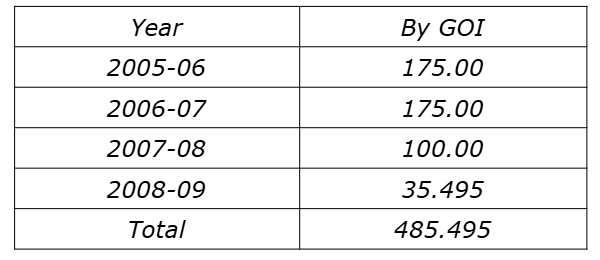
4. For the assessment year 2007-2008, the appellant filed its return of income admitting a loss of Rs.58,46,770/-. The assessment was completed under Section 143(3) of the Income Tax Act, 1961 (the Act). A sum of Rs.3,50,00,000/- received as grant in aid was treated as revenue receipt. Amongst other things, this addition was assailed by the appellant by filing an appeal before the Commissioner of Income (Appeals) and, thereafter, before the Income Tax Appellate Tribunal, though unsuccessfully. This has given rise to the instant appeal.
5. The first, second and third substantial questions of law are substantially the same.
6. The question which arises for consideration is whether the grant in aid/subsidy which was received by the appellant from the Government under rehabilitation scheme should be treated as revenue receipt in the hands of the assessee or as a capital receipt taking it out of the purview of the taxable income.
7. Before we take into consideration the details of the scheme under which the financial assistance was provided to the appellant and which the appellant claims in the nature of capital receipt, we consider it apposite to refer to the Supreme Court decision in the case of Commissioner of Income Tax v. Ponni Sugars & Chemical Limited and others, (2008) 9 SCC 337, wherein the principles applicable in order to ascertain whether the receipt is in the nature of revenue receipt or capital r
The purpose of a subsidy determines its classification as a revenue or capital receipt; financial assistance aimed at rehabilitation is a capital receipt.

Point of Law : Amount given by the Government for a specified purpose and the government having control on its expenditure cannot be said to be income accrued to the assessee.


The classification of sales tax incentives under state schemes hinges on the purpose of the subsidy, determining whether they constitute capital or revenue receipts.


The court ruled that replanting subsidies from the Rubber Board are capital receipts and not taxable income, emphasizing public interest over revenue generation.



An indispensable Tool for Legal Professionals, Endorsed by Various High Court and Judicial Officers
Please visit our Training & Support
Center or Contact Us for assistance

Scan Me!
India’s Legal research and Law Firm App, Download now!


For Daily Legal Updates, Join us on :



 Back to top


