
 Back
Back





IN THE HIGH COURT OF JUDICATURE AT MADRAS
P.T.ASHA, J.
R. Visalakshi – Appellant
Versus
The District Collector, Coimbatore – Respondent
W.P. No. 1893 of 2022, W.M.P. No. 1986 of 2024
Decided On : 11-12-2025
| Table of Content |
|---|
| 1. final order and its implications (Para 1 , 2) |
| 2. arguments presented by both parties regarding the settlement deeds (Para 3 , 4) |
| 3. preceding litigation and its relevance to the case (Para 5 , 6) |
| 4. court's review of authority's jurisdiction and powers (Para 12 , 14 , 15 , 16) |
| 5. legal framework under the maintenance and welfare of parents and senior citizens act (Para 13) |
ORDER :
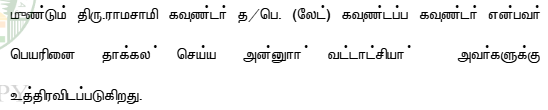
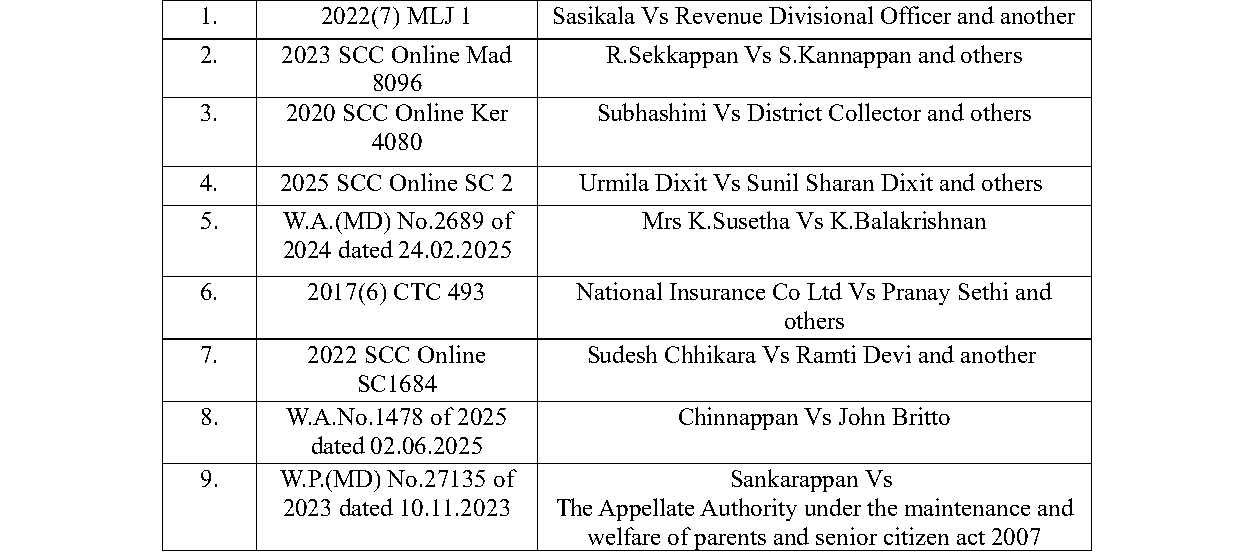
1. The case on hand demonstrates the abuse to the provisions of the benevolent Act and the overreach by the authority constituted under the Act.
2. The facts which had given rise to the above sentiment are herein below set out:
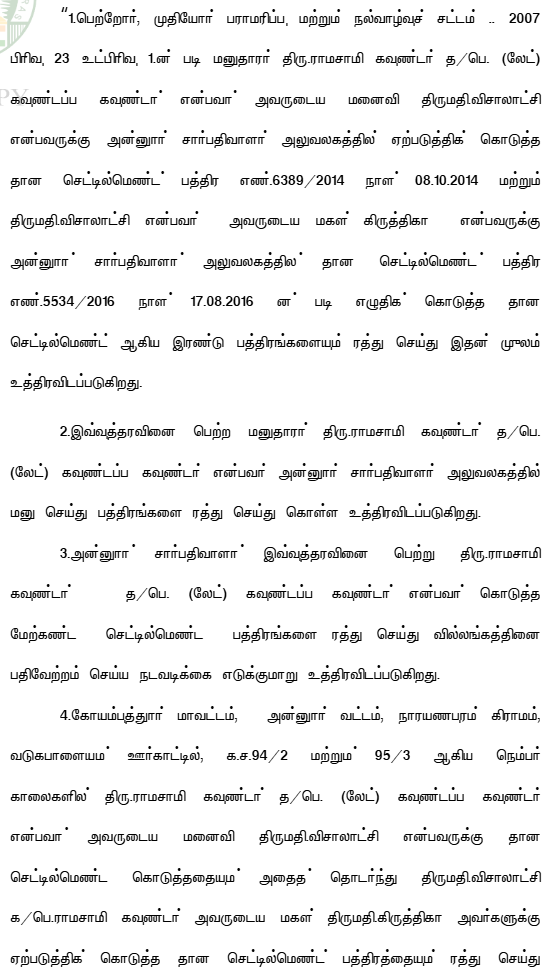
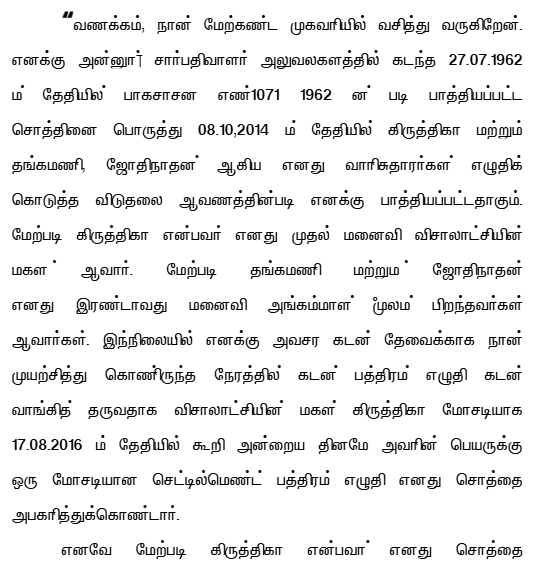
(i) The petitioners before this Court are the first wife and daughter respectively of the 3rd respondent. They seek to challenge the order passed by the 2nd respondent in his proceedings 29.12.2023 in Na.Ka.No.7915/2022/A1. The proceedings before the 2nd respondent was based on a complaint made by the 3rd respondent on 22.12.2022. In the said complaint, the third respondent/senior citizen would submit that he is a resident at Pathanayakkan Palaiyam, S.S. Coimbatore and with regard to the properties belonging to him as per the registered Partition Deed dated 27.07.1962, his legal heirs, namely the 2nd petitioner herein and his children through the 2nd wife, Angammal had executed a release deed dated 08.10.2014 in favour of the 3rd respondent. The 3rd respondent has further stated that when he was in dire need of finance, the 2nd petitioner, under the pretext of arranging a loan got executed a Settlement Deed dated 17.08.2016 fraudulently in her favour and grabbed the property. Since the property has been fraudulently taken away and as she is not maintaining him, the 3rd respondent requested the 2nd respondent to conduct an enquiry and restore the property grabbed by her.
(ii) A very detailed reply had been made by the 2nd petitioner herein wherein she had narrated the manner in which the 3rd respondent had ignored her and her mother for over 16 years. The 2nd petitioner would submit that she was born to the 1st petitioner and the 3rd respondent on 12.06.1973. Immediately, after her birth, she and her mother were taken to her mother’s house in the village and left there. Thereafter, the 3rd respondent neither returned nor took care of either of them. The property which was described in the complaint measuring 4.15 acres is situate in Narayanapuram Village near Sendampalayam Village, where her mother was living. Her mother was cultivating the lands and maintaining the 2nd respondent and herself.
(iii) The 2nd petitioner would submit that her paternal uncle, one Kulanthai Gounder had influenced the petitioner’s father to obtain a loan and financial assistance from the government and had received the original documents from her father. All this happened in and around the year 1970. The petitioner’s mother continued to cultivate the lands.
(iv) While so, in the year 1980, her paternal Kulanthai Gounder came with some goondas and informed the 1st petitioner, her mother that she should not cultivate the lands and forcibly evicted her. The petitioner and her mother thereafter had to rely upon her maternal grandparents for their maintenance. In and around the year 1976, her father had started illegally living with one Angammal, which they came to learn only later. The petitioner would submit that, on account of lack of finance, she had to discontinue her school education and at the age of 17, had to work in a medical shop at R.S.Puram. With the income earned by her, she had completed her degree course and also qualified in a beautician course. Thereafter, she had obtained a job offer in the Maldives as a Spa Training Manager where she earned a good income. Thereafter, she returned to India and took up employment as a Spa Consultant for about 16 years in Wayanad. The petitioner would submit that, out her earnings, she had purchased her jewellery and two properties. Seventeen years after being deserted by him, the 2nd petitioner m
AI
The authority under the Maintenance and Welfare of Parents and Senior Citizens Act exceeded its jurisdiction by canceling the settlement deed without proper legal grounds, as no maintenance condition....

The main legal point established in the judgment is the interpretation of Section 23 of the Senior Citizens Act and the applicability of the Indian Contract Act and the Transfer of Property Act to th....
The love and affection between the parent and the child is an implied condition in the Settlement Deed and any violation of this condition would amount to fraud, coercion or undue influence, thus att....
The Senior Citizens Act mandates that children must ensure their parents lead a dignified life, and property transfers can be voided if basic amenities are not provided.
The conduct of the transferee is crucial in determining the validity of property transfer under the Senior Citizen Act, and children have an obligation to maintain their parents.



An indispensable Tool for Legal Professionals, Endorsed by Various High Court and Judicial Officers
Please visit our Training & Support
Center or Contact Us for assistance

Scan Me!
India’s Legal research and Law Firm App, Download now!


For Daily Legal Updates, Join us on :



 Back to top


