
 Back
Back





BEFORE THE MADURAI BENCH OF MADRAS HIGH COURT
K. MURALI SHANKAR, J.
Indira – Appellant
Versus
Prema – Respondent
S.A. (MD) No. 328 of 2019, C.M.P. (MD) No. 6780 of 2019
Decided On : 28-01-2026
| Table of Content |
|---|
| 1. dispute over property ownership and construction rights (Para 1 , 2 , 4) |
| 2. defendants argue lack of merit in plaintiff's suit (Para 5 , 8 , 13) |
| 3. trial court dismissed plaintiff's suit (Para 6 , 7) |
| 4. counsel's arguments focus on inaction and acquiescence (Para 9 , 10 , 12) |
| 5. court emphasizes the significance of timely objection (Para 21 , 23) |
| 6. mandatory injunction denied due to delay and acquiescence (Para 24 , 26) |
| 7. compensation awarded instead of injunction (Para 27 , 28) |
JUDGMENT :
K. MURALI SHANKAR, J.
1. The Second Appeal is directed against the judgment and decree made in A.S.No.128 of 2017, dated 05.03.2018, on the file of the Subordinate Court, Tiruchendure, reversing the judgment and decree made in O.S.No.133 of 2011, dated 22.02.2013, on the file of the District Munsif Court, Tiruchendure.
2. The defendants are the appellants. The respondent as plaintiff filed the suit claiming reliefs of declaration that the suit II Schedule property belongs to her and for mandatory injunction directing the defendants to remove the construction put up in the suit II schedule property.
3. For the sake of convenience and brevity, the parties will hereinafter be referred as per their status/ranking in their original suit.
4. The plaintiff's case in short is as follows:
(a) The suit I schedule property is owned by the plaintiff. The plaintiff settled the I schedule property in favour of her son Ramkumar, vide settlement deed dated 20.03.2002 and subsequently the said Ramkumar executed a settlement deed dated 18.09.2009 settling the said property in favour of her mother – plaintiff. The defendants' property is situated on the south of the plaintiff's I schedule property. A wall available in the ground floor in between the properties of the plaintiff and the defendants is a common wall with a width of 1 ½ feet. When the plaintiff was attempting to make constructions in the western side of I schedule property, the defendants objected for making any constructions on the common wall. The plaintiff's son had constructed the first floor building by putting their wall on the northern half portion of the common wall and the said northern wall is shown as suit II schedule property. The plaintiff's son Ramkumar entered into an agreement with the defendants on 13.08.2003 in respect of the suit wall wherein it has been specifically shown that II schedule wall was owned by the plaintiff's son and that the defendants are not entitled to make any constructions on the said wall.
(b) The defendants attempted to make constructions on the suit II schedule wall during January 2010 and since the same was objected, they have stopped their constructions, but again the defendants made constructions on 06.05.2011, despite the objections of the plaintiff. The defendants have raised their constructions on the suit II schedule wall and since the defendants are not having any right over the suit II schedule wall, the plaintiff was constrained to file the above suit claiming declaration that the suit II schedule wall is belonging to her and for mandatory injunction for removal of the construction made on II schedule wall by the defendants.
5. The defence of the defendants in short is as follows:
The plaintiff's suit is not maintainable either under law or on facts. The plaint contentions regarding the suit II schedule wall, execution of agreement dated 13.08.2003 and the constructions on the suit II schedule wall are all false and untenable. The defendants had already completed their constructions with Government approval. The plaintiff has absolutely no right or possession over the defendants' property. The plaintiff has created a document with an ulterior motive and the same is illegal and unenforceable. The defendants have purchased their property vide sale deed dated 04.02.1985 and they have been in possession and enjoyment of the property similar to that of their predecessor in title. The plaintiff has no cause of action to file the suit. Hence, the su
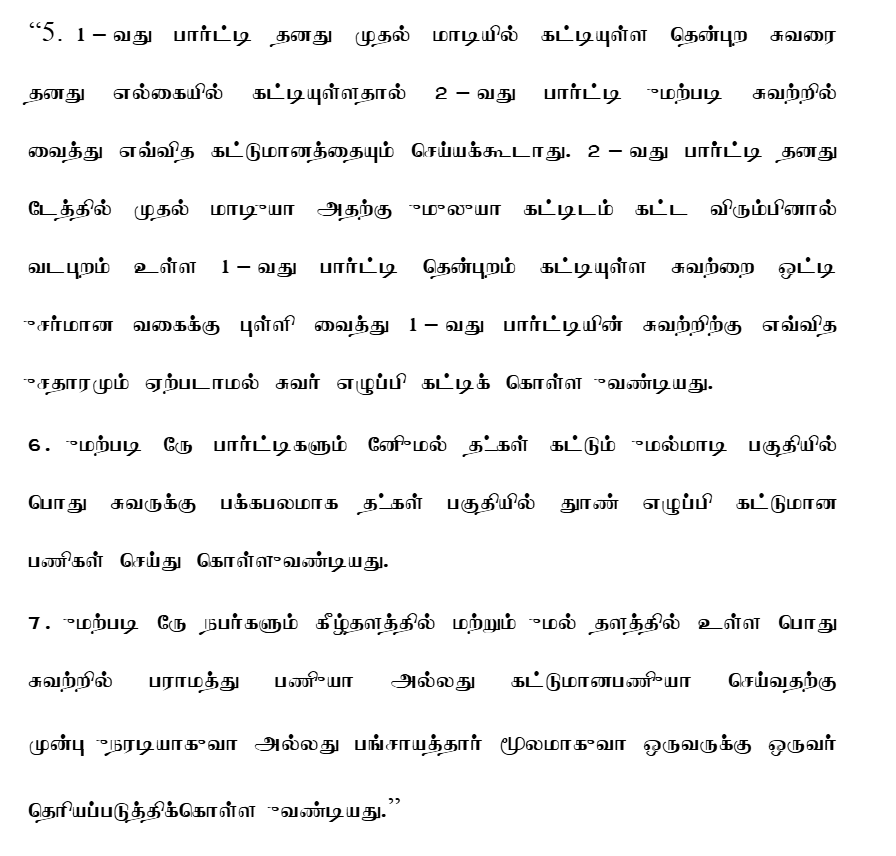
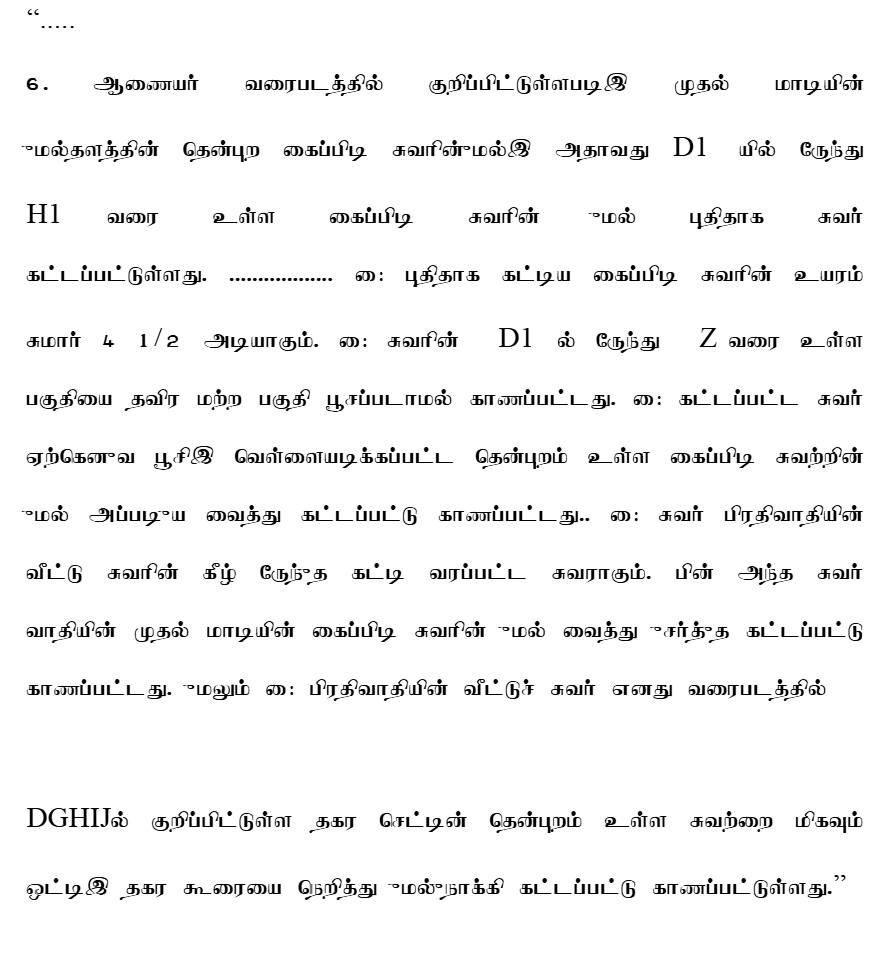
The court ruled that a plaintiff's acquiescence to ongoing construction delays the right to seek mandatory injunction, favoring monetary compensation instead.

The burden of proof lies with the plaintiff to establish their case, and the court will uphold decisions based on evidence presented, rejecting contentions of delay and laches, and the applicability ....


While examining the judgment of trial court, the appellate court has to render its finding only after dealing with all the issues of law as well as of fact and with the oral as well as documentary ev....
The judgment focused on the lack of prima facie evidence of encroachment and the absence of obligation owed to the plaintiff by the defendant in a property dispute.


Point of law : an inference of fact from a document is a question of fact. But the legal effect of the terms or a term of a document is a question of law. Construction of a document involving the app....



An indispensable Tool for Legal Professionals, Endorsed by Various High Court and Judicial Officers
Please visit our Training & Support
Center or Contact Us for assistance

Scan Me!
India’s Legal research and Law Firm App, Download now!


For Daily Legal Updates, Join us on :



 Back to top


