
 Back
Back





BEFORE THE MADURAI BENCH OF MADRAS HIGH COURT
K.MURALI SHANKAR, J.
M. Star Janet Joy – Appellant
Versus
T. Justin Dhas – Respondent
Crl.A.(MD)No.115 of 2023
Decided On : 09-01-2026
| Table of Content |
|---|
| 1. criminal appeal procedures and complainant's case. (Para 1 , 2 , 4 , 5 , 6 , 7) |
| 2. legal presumptions regarding negotiable instruments. (Para 8 , 9 , 14 , 15 , 16 , 17 , 22 , 30) |
| 3. defense arguments regarding repayment and acquaintance. (Para 10 , 12 , 19 , 25 , 26) |
| 4. burden of proof in cheque dishonor cases. (Para 18 , 20 , 28 , 32 , 39) |
| 5. sentencing and conclusion of appeal. (Para 40 , 41 , 42) |
JUDGMENT :
K.MURALI SHANKAR, J.
The Criminal Appeal is directed against the judgment made in S.T.C.No.87 of 2016 dated 29.06.2018 on the file of the Court of Judicial Magistrate No.I, Padmanabhapuram, in acquitting the respondent / accused for the offence under Section 138 of the Negotiable Instruments (hereinafter referred as 'NI') Act.
2. The appellant, who is the complainant, filed a complaint under Section 200 Cr.P.C. against the respondent / accused for the alleged offence under Section 138 r/w 142 of the NI Act.
3. For the sake of convenience and brevity, the parties hereinafter will be referred to as per their status / ranking in the trial Court.
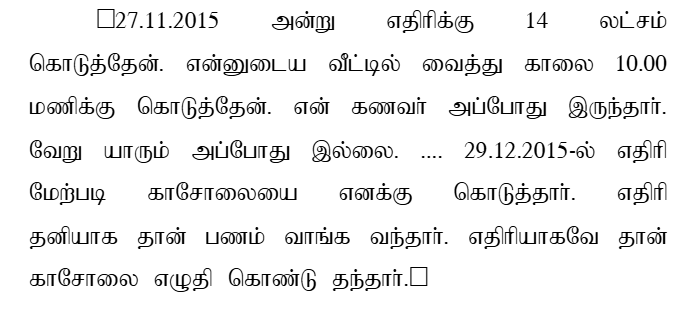
4. The case of the complainant is that the complainant's husband and the accused are friends and on account of that friendship, the accused borrowed a sum of Rs.14 lakhs on 27.11.2015 for the improvement of his jewelry business promising to repay the amount within one month. The complainant approached the accused on 29.12.2015 and demanded the amount. The accused issued a cheque dated 29.12.2015 for Rs.14 lakhs drawn on Andhra Bank, Marthandam Branch in favour of the complainant. The complainant presented the cheque for collection on 29.12.2015 through his banker Pandiyan Grama Bank, Mekkamandapam Branch but the same was returned dishonored as account closed. The complainant sent a legal notice dated 08.01.2016 to the accused demanding him to pay the amount covered by the cheque and the accused having received the notice on 09.01.2016 neither sent any reply nor complied with the notice demand. Since the accused has not repaid the cheque amount within the stipulated time, the complainant was constrained to file the above complaint for the offence under Section 138 r/w 142 of the NI Act.
5. The learned Judicial Magistrate, upon receiving the complaint, recorded the sworn statement of the complainant and on perusing the records, upon satisfied that there existed a prima facie case took the case on file in S.T.C.No.87 of 2016 and ordered for issuance of summons to the accused. After appearance of the accused, copies of records were furnished to him under Section 207 Cr.P.C. on free of costs. When the accused was questioned about the offence alleged against him, he denied the commission of offence and pleaded not guilty.
6. During trial, the complainant examined herself as P.W.1, her husband as P.W.4 and Bank Managers of the complainant as well as the accused Bank as P.W.2 and P.W.3 respectively and exhibited 13 documents as Ex.P.1 to Ex.P.13. The accused examined himself as D.W.1 and 2 other witnesses Thiru.Suresh Paul and Thiru.Andrin Prabhu as D.W.2 and D.W.3 respectively and exhibited 2 documents as Ex.D.1 and Ex.D.2.
7. The learned Judicial Magistrate, upon considering the evidence both oral and documentary and on hearing the arguments of both the sides, passed the impugned judgment dated 29.06.2018 holding that the complainant failed to prove the offence under Section 138 of the NI Act against the accused beyond reasonable doubt, acquitted him under Section 255(1) Cr.P.C. Aggrieved by the impugned judgment of acquittal, the complainant preferred the present appeal.
8.Whether the impugned judgment of acquittal passed in S.T.C.No. 87 of 2016 dated 29.06.2018 on the file of the Judicial Magistrate No.I, Padmanabhapuram, is liable to be set aside? is the point for consideration.
9. Before entering into further discussion, it is necessary to refer Sections 118 (a) and 139 of the Negotiable Instruments Act, which deal with statutory presumptions,
“Section 118 : Presumptions as to nego

A presumption of debt exists under Sections 138 and 139 of the Negotiable Instruments Act, which the accused failed to rebut, affirming liability for dishonored cheques.

A drawer of a cheque is presumed liable unless they provide evidence to rebut the presumption of issuance for debt repayment, established under Sections 138 and 139 of the Negotiable Instruments Act.
The statutory presumption under Sections 138 and 139 of the Negotiable Instruments Act establishes that the accused must rebut the existence of a debt with credible evidence; mere denial is insuffici....


Presumption under Section 139 NI Act shifts burden to accused to rebut by probable defence; trial court erred in requiring complainant to prove debt, rendering acquittal perverse in appeal.

Presumption under Section 139 of the Negotiable Instruments Act requires the accused to present credible evidence to rebut the holder's claim of legal liability regarding the cheque issued.
The burden is on the complainant to prove financial capacity when questioned; a mere presumption does not suffice if evidence is lacking.

The presumption under Section 139 of the NI Act mandates that a cheque is presumed to be issued for discharge of a debt unless the accused proves otherwise.



An indispensable Tool for Legal Professionals, Endorsed by Various High Court and Judicial Officers
Please visit our Training & Support
Center or Contact Us for assistance

Scan Me!
India’s Legal research and Law Firm App, Download now!


For Daily Legal Updates, Join us on :



 Back to top


