
 Back





2026 Supreme(Mad) 1077
IN THE HIGH COURT OF JUDICATURE AT MADRAS
M. Nirmal Kumar, J.
R. Ajay, S/o. Rajmohan - Petitioner
Versus
The State Represented by The Inspector of Police - Respondent
CRL OP No. 11374 of 2026 and Crl.MP.No.8100 of 2026
Decided On : 05-06-2026
Important Points
Subject
Criminal Law - Quashing of Criminal Proceedings
Act Referred
TAMIL NADU PROHIBITION OF HARASSMENT OF WOMEN ACT: S.4
Headnote
(B) Criminal Procedure - Inherent power to quash - Test for quashing involving non-compoundable offences - Court must examine if the crime is purely individual or an offence against society with overriding public interest - Where dispute is purely private and parties have settled, continuation of proceedings serves no useful purpose. (Para 10-11)
Facts of the case:
The petitioner and the complainant previously shared a personal relationship which ended, leading to allegations of harassment, defamatory social media posts, and threats. Criminal proceedings were subsequently initiated against the petitioner. During the trial phase, the parties entered into a mutual compromise and filed a joint memo, requesting the court to quash the proceedings based on their settlement.
Findings of Court:
The court observed that the dispute was personal and limited to the parties involved. No overriding public interest was found that would necessitate the continuation of the criminal trial given the amicable settlement reached by the parties.
Issues: Whether the High Court is empowered to quash criminal proceedings involving non-compoundable offences when the dispute is private and the parties have entered into a compromise.
Ratio Decidendi: When a criminal dispute is strictly individual or personal in nature and lacks elements of overriding public interest, the court may exercise its inherent jurisdiction to quash the proceedings if the parties have reached an amicable settlement, as continuing the prosecution would serve no constructive purpose. (Para 10-11)
Result: Petition allowed; the criminal proceedings are quashed.
For the Petitioner: Ms.N. Sumi Priya
For the Respondent:Mr.R. Rajasekaran, Govt. Advocate, Mr.T.Balaji
| Table of Content |
|---|
| 1. factual background of criminal charges and offences. (Para 1 , 2) |
| 2. parties seeking quashing of proceedings via mutual compromise. (Para 3 , 4 , 5) |
| 3. judicial verification of amicable settlement between parties. (Para 6 , 7 , 8 , 9) |
| 4. standard for quashing non-compoundable offences in individual disputes. (Para 10 , 11) |
| 5. final order quashing criminal proceedings upon settlement. (Para 12 , 13) |
ORDER :
M. Nirmal Kumar, J.
The petitioner/accused facing trial in C.C.No.1529 of 2024 for offences under Sections 126(2), 296(b), 78 of BNS, 2023 and Section 4 of TAMIL NADU PROHIBITION OF HARASSMENT OF WOMEN ACT , 2002 filed this quash petition.
2.The case against the petitioner is that the petitioner and the defacto complainant/second respondent knew each other in the year 2023 and later, the same developed into a friendship. Thereafter, due to difference of opinion, they discontinued their friendship. Subsequently, the petitioner followed the defacto complainant continuously and posted defamatory contents against her in the social media. While so, on 17.08.2024, at about 3.00 pm, while the defacto complainant was on the way to her house along with driver, the petitioner waylaid and abused them in filthy language and also threatened her with dire consequences. Hence, lodged a complaint.
3.The learned counsel for the petitioner submitted that based on the complaint, FIR registered and final report filed, which was taken on file in C.C.No.1529 of 2024 by the Judicial Magistrate, Additional Mahila Court, Coimbatore. He further submitted that the welfare and future of the petitioner and the defacto complainant has to be considered. The parties arrived at mutual compromise and decided to resolve the dispute amicably among themselves.
4.The learned counsel appearing for the petitioner as well as the learned counsel for the second respondent/defacto complainant submitted that on the intervention of elders, both the parties amicably settled the issue among themselves. Further, the learned counsel for the defacto complainant submitted that the defacto complainant is not willing to continue the relationship and to pursue the complaint and has no objection to quash the criminal proceedings. Hence, they seek to quash the proceedings pending against the petitioner and in this regard, Joint compromise memo entered between them, which is scanned and reproduced hereunder:
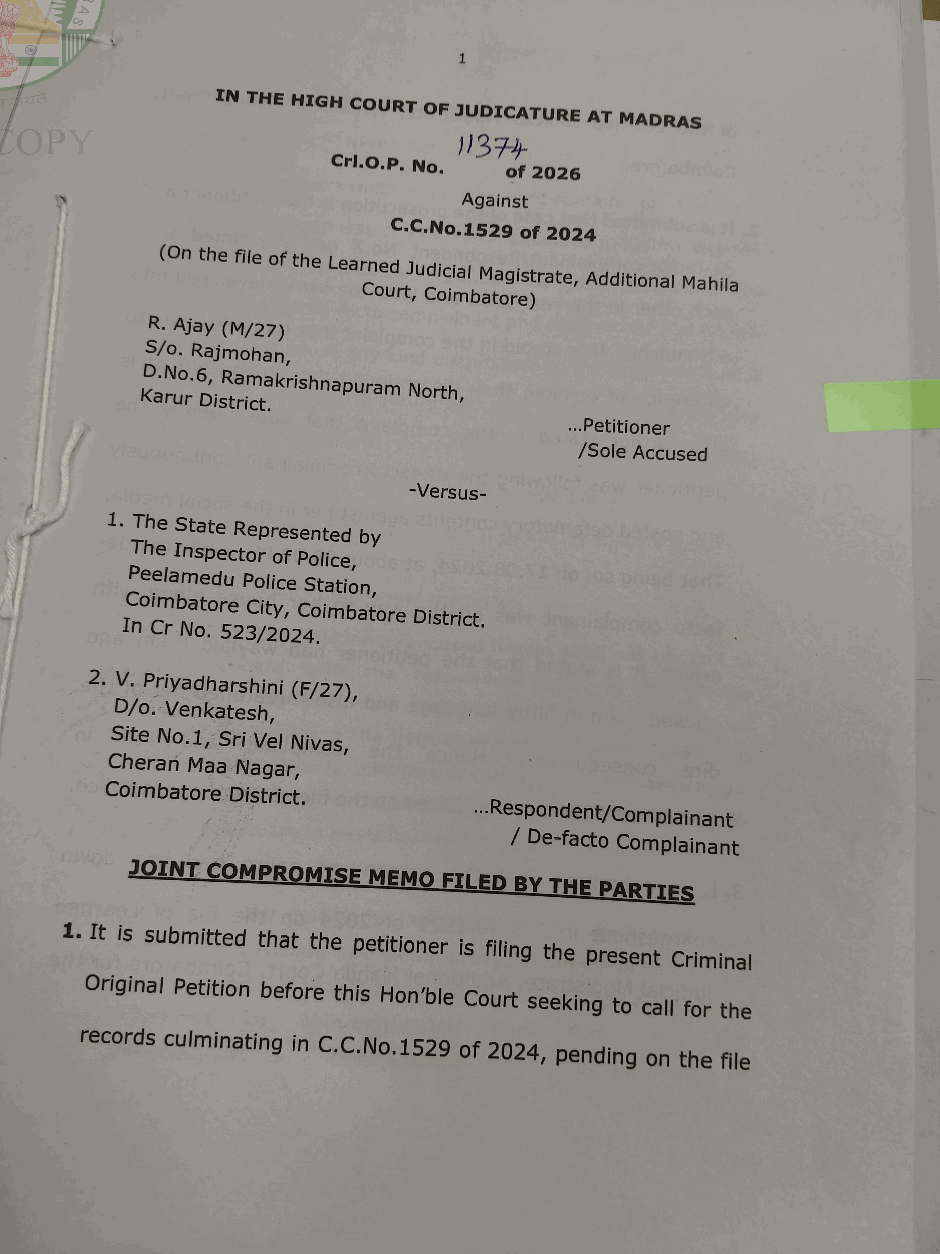
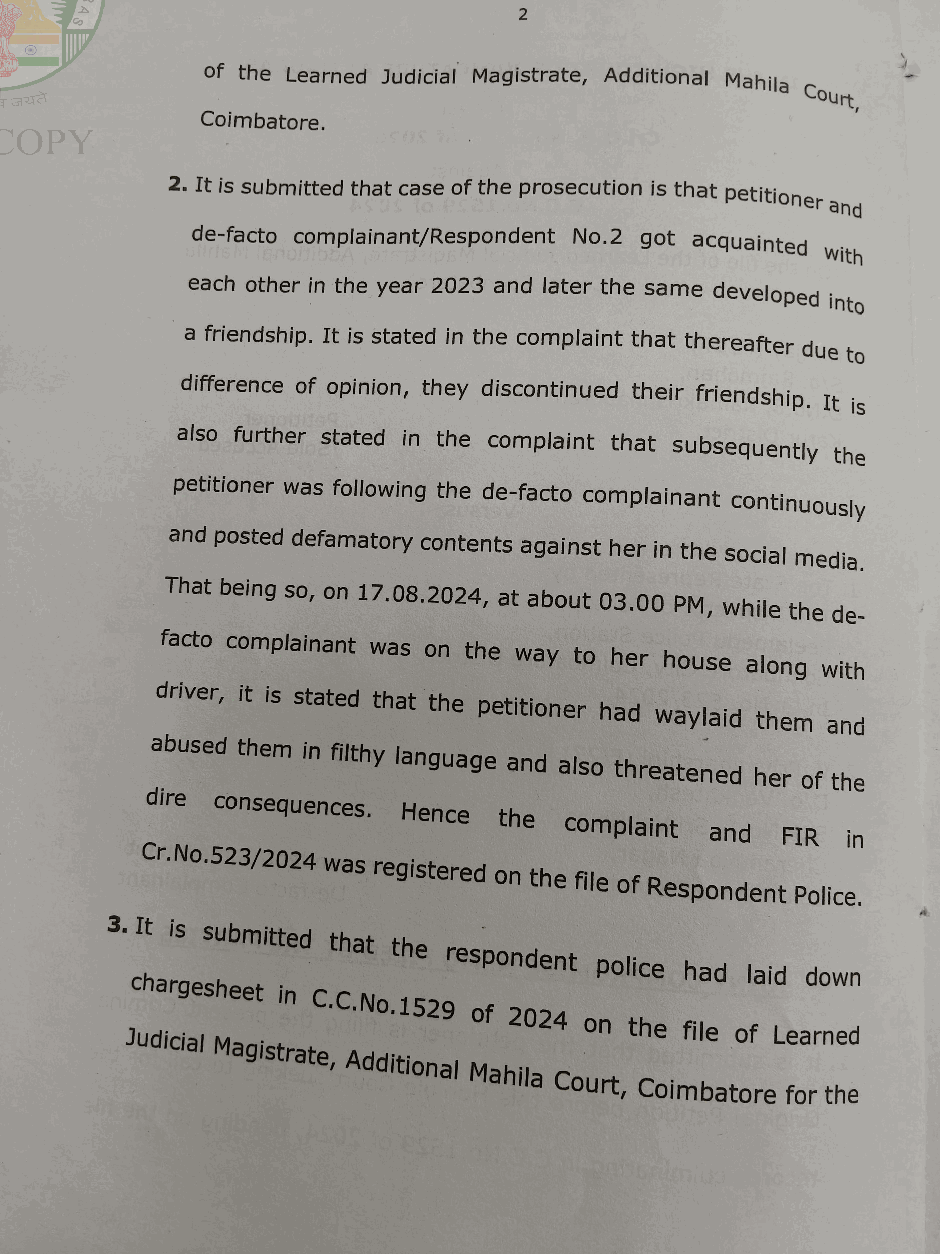
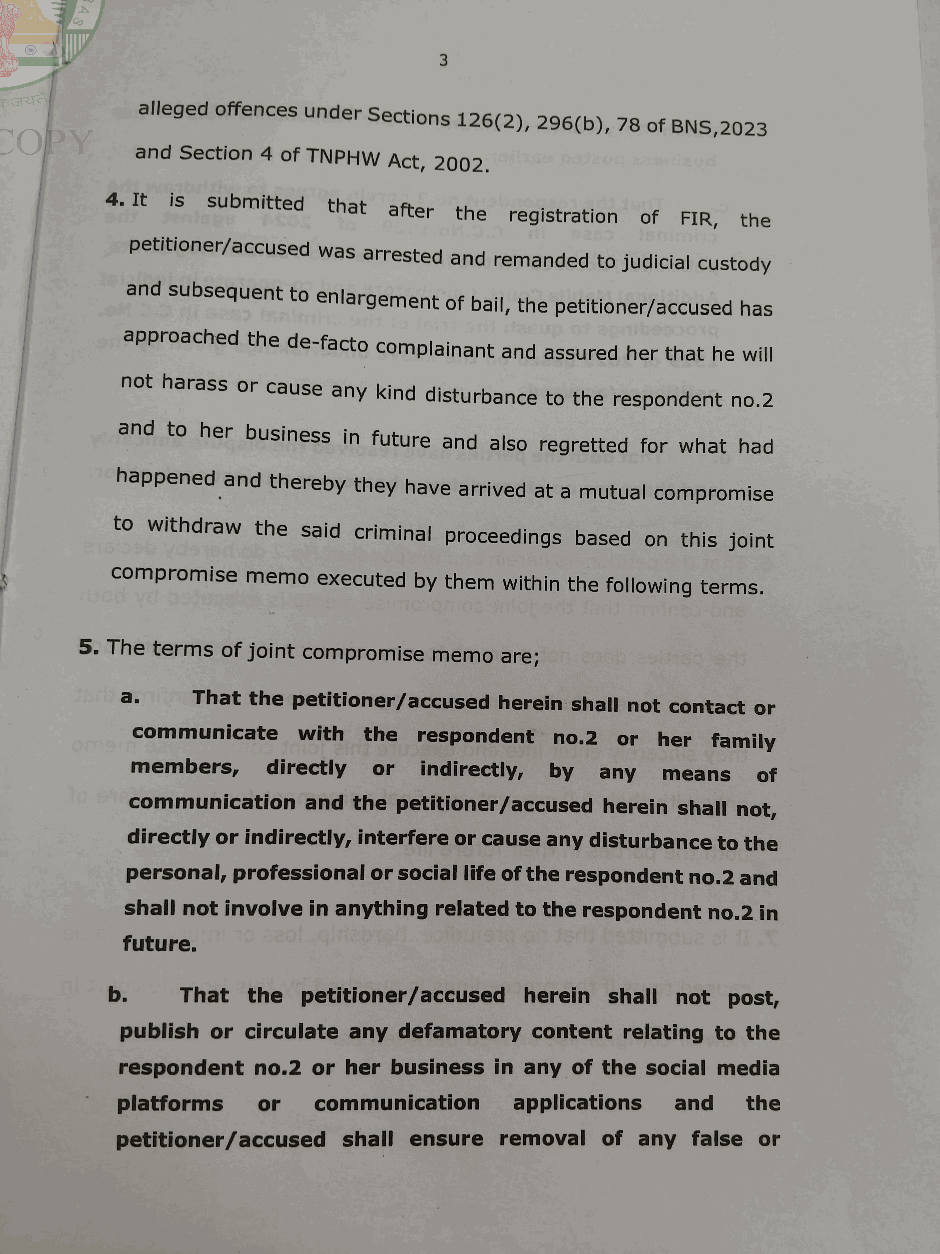
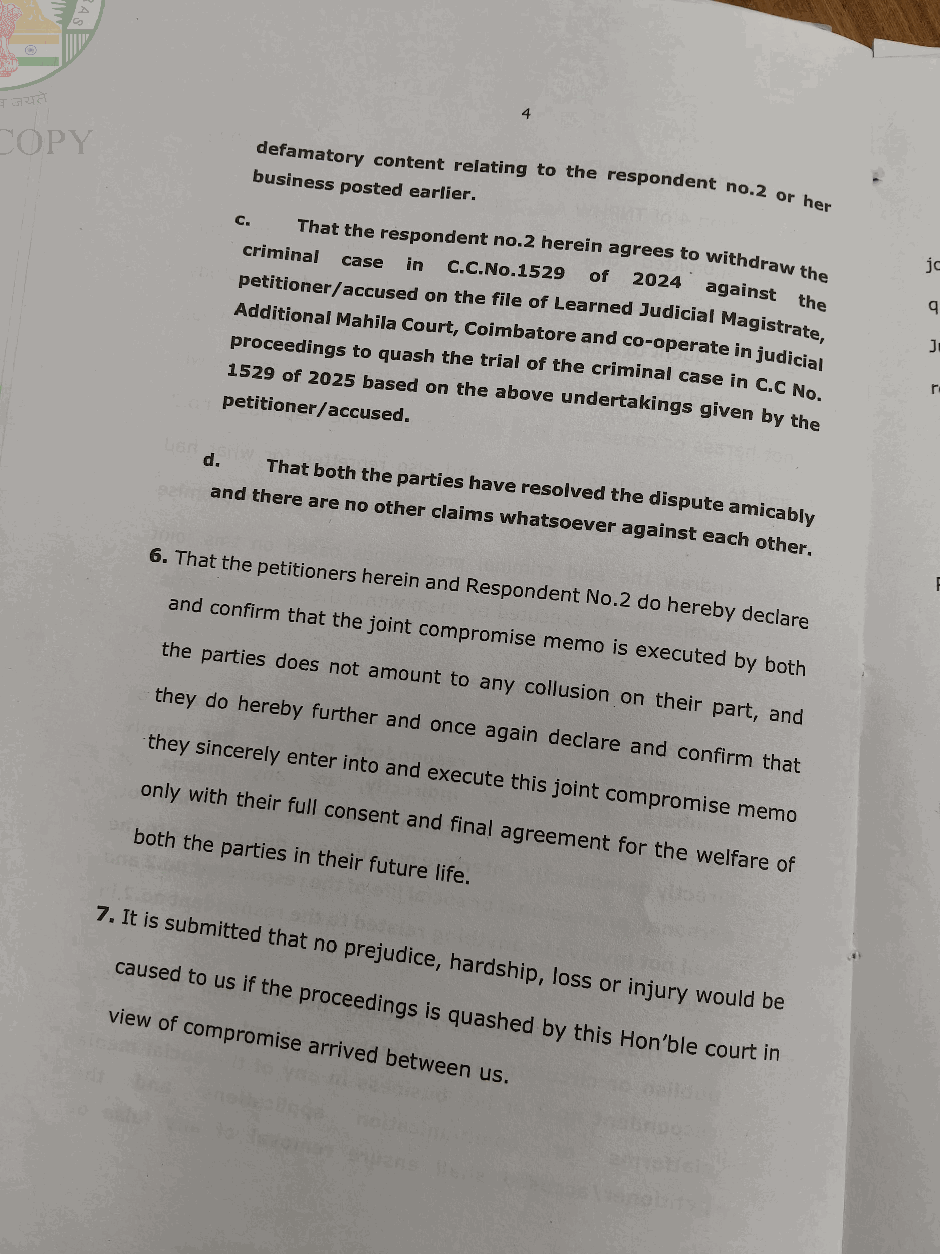
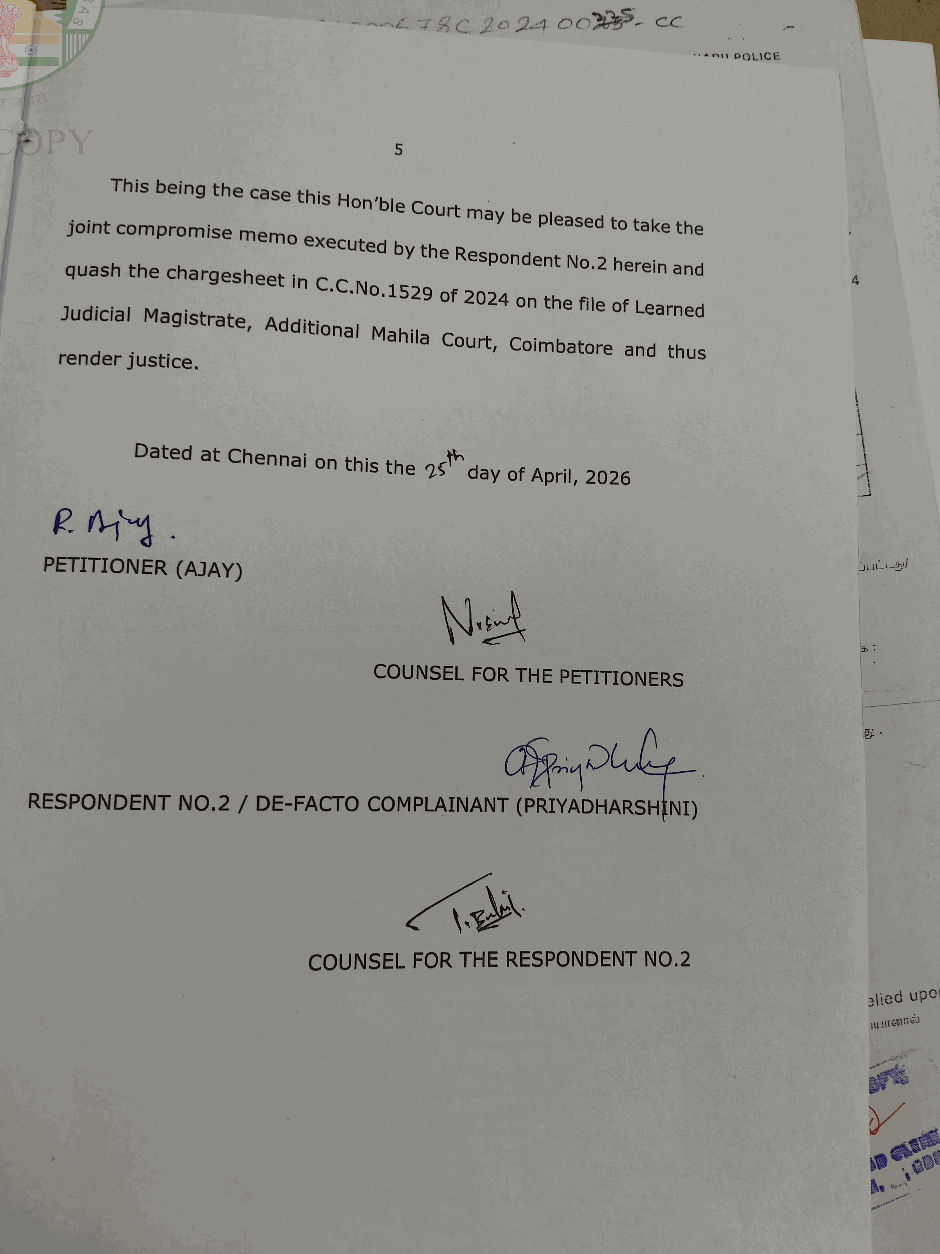
5.The learned Government Advocate (Crl.Side) appearing for the first respondent submitted that though the parties entered into a compromise while this case is pending, this Court, taking into account the seriousness of the offence, has to consider the issue as to whether offences of this nature can be quashed on the ground of compromise between parties.
6.Heard both sides and perused the materials available on record.
7.The case is still at the stage of trial. By passage of time, the parties have decided to bury their hatchet and compromise the dispute amicably among themselves.
8.The petitioner and the defacto complainant/R2 appeared before this Court through video conferencing and were identified by their respective counsel as well as by Mr.Rajesh Kumar, HC 2533, E2, Peelamedu L & O police station, Coimbatore.
9.On being enquired by this Court, the defacto complainant stated that she has amicably settled the dispute with the petitioner and she is not willing to pursue the criminal proceedings and therefore, seeks to quash the same.
10.The main issue that requires the consideration of this Court is as to whether this Court can quash the criminal proceedings involving non- compoundable offences pending against the petitioner. The Hon'ble Supreme Court, in the case of Parbathbhai Aahir @ Parbathbhai Vs. State of Gujarat , reported in (2017) 9 SCC 641, has given sufficient guidelines that must be taken into consideration by this Court while exercising its jurisdiction under Section 482 of Cr.P.C. (corresponding to Section 528 BNSS), to quash non- compoundable offences. One v









