
 Back
Back





IN THE HIGH COURT OF JUDICATURE AT MADRAS
G. JAYACHANDRAN, SHAMIM AHMED, JJ.
Cholamandalam Investment and Finance Co. Ltd. – Appellant
Versus
The State of Tamil Nadu – Respondent
Tax Case (Revision) Nos. 25, 26 of 2013, C.M.P. Nos. 48, 54 of 2019
Decided On : 21-04-2026
| Table of Content |
|---|
| 1. factual background of assessee's returns and assessments (Para 1 , 2 , 3 , 4 , 5 , 6 , 7 , 8 , 9 , 12 , 18) |
| 2. substantial questions of law admitted (Para 10 , 11) |
| 3. transit sales not exempt under section 6(2) cst (Para 13 , 14 , 15 , 19) |
| 4. high sea sales ineligible under section 5(2) cst (Para 16 , 17 , 40 , 41) |
| 5. state taxing power valid despite constitutional limits (Para 20 , 21 , 22 , 23) |
| 6. definitions of 'sale' include hire-purchase (Para 24 , 25 , 26) |
| 7. constitutional provisions restrict state taxation (Para 27 , 28 , 29 , 30 , 31) |
| 8. dual invoices reveal tax evasion attempt (Para 32 , 33 , 34 , 35 , 38) |
| 9. hire-purchase taxable as first sale in state (Para 36 , 37) |
| 10. revisions dismissed; tribunal findings upheld (Para 39 , 42 , 44) |
ORDER :
1. M/s. Cholamandalam Investment & Finance Company Limited (hereinafter referred as ‘assessee’) is the revision petitioner in both the Tax Case (Revision) petitions filed under Section 38 of the Tamil Nadu General Sales Tax Act, 1959.
2. The assessee herein filed returns in Form-I filed under GST Act for the year 1995-96 declaring the total turnover as Rs.68,91,52,009/- and its taxable turnover as ‘NIL’ as under:-
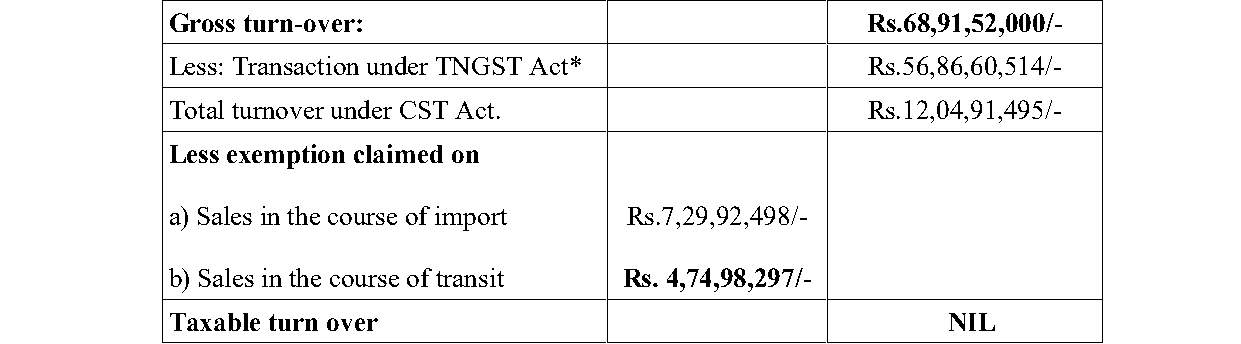
*As far as the Rs.56,86,60,514/- as total turnover in respect of transactions under TNGST Act, same was examined and separate order came to be passed.
3. In respect of exemption sought under the Central Sales Tax Act, the checking of the accounts, unravelled that the assessee claims exemption for High Sea sales by transfer of documents of title to goods in the course of import under Section 5(2) of the Central Sales Tax Act and produced High Sea sales invoices, import invoices and the Bill of Lading. Examination of these documents further disclosed that, in the invoices of High Sea sales, it was mentioned that, ‘the goods delivered under Hire Purchase Agreement.’ Being a sale under hire purchase agreement which means that the goods remain the property of the dealer. Instead the same is shown as High Sea sales as if it is an outright sale. Similarly for the exemption claimed on sales in transit under the Central Sales Tax Act, the connected records produced by the assessee revealed that in the invoice it is stated that the goods are delivered under ‘Hire Purchase Agreement’. However, in the bottom of the invoice it is stated that ‘the sale under Section 6(2) of the Central Sales Tax Act. Hence, C-Form required.’ Neither of the claim as Sales in the course of import and sales in High Seas, title of the goods remained only with the assessee, since the transaction were under Hire Purchase Agreement.
4. After collecting materials from the business premises of the assessee situated at various places and on examination of material documents, the Assessing Officer concluded that the turnover disclosed by the assessee in its return is incorrect and incomplete. The assessee by camouflaging interstate sales as sales in transit had claimed exemption under Section 6(2) of Central Sales Tax Act. Hence, after hearing the assessee, the tax payable determined as below:-

5. Challenging the above assessment order dated 19.03.1999, the assessee preferred an appeal before the Assistant Commissioner (CT)-1 in Appeal Petition No.79 of 2009. The Appellate Authority confirmed the assessment order, holding that there is no case to interfere with the order of the Assessing Officer. Thus, the assessment on the turnover of High Sea sales and Transit sales was sustained. Further, the assessee preferred appeal before the Tamil Nadu General Tax Appellate Tribunal in T.A.No.692 of 2002.
6. By the time, the re-assessment of tax payable under TNGST was done in view of the revised annual return in Form A.1 filed by the assessee, reporting Rs.52,83,68,388/- as the total turnover under TNGST out of which the taxable turnover shown as Rs.1,03,21,440/- and exemption for Rs.51,80,36,921/- claimed.
7. The Assessing Officer held that, based on the prior contract, the goods have moved from other State to the


A contract of sale that occasions movement of goods from one State to another constitutes an inter-state sale under CST provisions; situs remains fixed at delivery point irrespective of later co-ming....


The court clarifies the conditions under which sales are taxable and addresses inter-State sales exemptions under the General Sales Tax Act.


The court ruled that non-furnishing of 'C' Forms by a purchaser due to financial distress does not absolve entitlement to tax exemptions under Section 6(2) of the Central Sales Tax Act, 1956.



An indispensable Tool for Legal Professionals, Endorsed by Various High Court and Judicial Officers
Please visit our Training & Support
Center or Contact Us for assistance

Scan Me!
India’s Legal research and Law Firm App, Download now!


For Daily Legal Updates, Join us on :



 Back to top


