
 Back
Back





IN THE HIGH COURT OF JUDICATURE AT MADRAS
R. SAKTHIVEL, J.
Minor Muthu S/o Sambandam – Appellant
Versus
Prema W/o Late Kaliaperumal – Respondent
S.A. No. 277 of 2012, M.P. No. 1 of 2012
Decided On : 24-03-2026
| Table of Content |
|---|
| 1. suit properties from grandfather; prior partition decreed 1/5 shares. (Para 1 , 2 , 3 , 4) |
| 2. debt from jewels binding; suit collusive to obstruct execution. (Para 5) |
| 3. trial court granted minors 3/20 share; appellate reversed. (Para 6 , 7) |
| 4. appellants claim birth right in joint properties under prior decree. (Para 8 , 10) |
| 5. separate property under hsa s.8; no share during father's life. (Para 11 , 12 , 13 , 14 , 15 , 16) |
| 6. second appeal dismissed; suit not maintainable. (Para 18) |
JUDGMENT :
R. SAKTHIVEL, J.
1. Feeling aggrieved by the Judgment and Decree dated December 21, 2010 made in A.S. No.26 of 2009 by 'the Additional Subordinate Court, Mayiladuthurai' ['First Appellate Court' for brevity], reversing the Judgment and Decree dated August 07, 2008 passed in O.S. No.438 of 2005 by 'the Additional District Munsif, Myladuthurai' ['Trial Court' for short], the Respondents 1 to 3/Plaintiffs therein have preferred this Second Appeal.
2. For the sake of convenience, the parties will be referred to as per their array in the Original Suit.
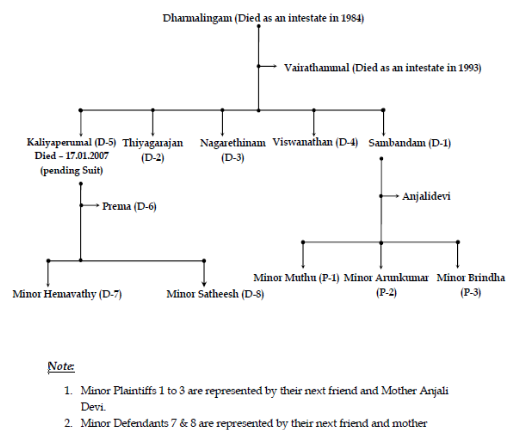
3. For ease of reference, a genealogical tree is drawn showing the undisputed relationship between the parties:
PLAINTIFFS’ CASE IN BRIEF:
4. The suit properties originally belonged to Dharmalingam, the grandfather of the minor plaintiffs, who passed away intestate in 1984. Dharmalingam's wife - Vairathammal passed away intestate in 1993. Defendants 1 to 5 are their sons/legal heirs. Sixth defendant is the wife of the fifth defendant. The first defendant is the father of the minor plaintiffs 1 to 3, who are represented by their mother - Anjalidevi.
4.1. The fifth defendant - Kaliyaperumal filed a Suit for partition of the properties left behind by Dharmalingam as against defendants 1 to 4 herein in O.S. No.711 of 1998 on the file of the Principal District Munsif Court, Mayiladuthurai. The present suit properties are same as those in that Suit. The said Suit was decreed and a preliminary decree was passed declaring that the defendants 1 to 5 herein are entitled to 1/5 share each in the suit properties. Feeling aggrieved by the same, defendants 1 and 2 herein preferred an appeal in A.S. No.97 of 2004 on the file of the Principal Subordinate Court, Mayiladuthurai, which ended in dismissal; the Trial Court's Judgment and Decree were confirmed in the appeal.
4.2. The plaintiffs, being the children of the first defendant herein, claim a right by birth in the suit properties, which according to them are the properties of their grandfather. Though the suit properties are being cultivated and managed by the first defendant, the plaintiffs and the defendants are deemed to be in joint possession and enjoyment of the same.
4.3. A plea of joint family debt was rejected by the Court in O.S. No.711 of 1998, following which the sixth defendant being the fifth defendant's wife, filed a Suit in O.S. No.116 of 1997 on the file of the Additional District Munsif Court, Mayiladuthurai against the first defendant, alleging that he had borrowed jewels valued at Rs.21,000/- and seeking return of the same or payment of their value. The said Suit was decreed on February 27, 2004. Pursuant to the decree, E.P. No.16 of 2002 was filed, and the undivided 1/5 share of the first defendant was attached.
4.4. The plaintiffs in the present Suit contend that the plea of joint family debt raised in O.S. No.711 of 1998 was negatived by the Court. Therefore, the liability arising out of O.S. No.116 of 1997 is not binding on the plaintiffs and they are not legally bound to discharge the same out of their share in their father/first defendant's 1/5 undivided share in the suit properties. According to the plaintiffs, they are each entitled to 1/4 share out of the 1/5 undivided share of the first defendant in the suit properties.
4.5. Pending E.P. No.16 of 2002, in June 2005, the first defendant attempted to alienate his undivided 1/5 share in favour of third parties. Hence, the present Suit for partition came to be instituted by th
The properties in question were determined to be ancestral, granting coparcenary rights to the daughter under the Hindu Succession (Amendment) Act, 2005.


The claim of property as ancestral requires proof of lineage and sufficient income, with living together not granting rights. The second appeal is restricted to substantial questions of law.
The main legal point established in the judgment is that properties derived by the father through a partition deed are to be treated as his self-acquired properties, as per Section 8 of the Hindu Suc....

A son born from a void marriage has rights to inheritance under amendments to the Hindu Succession Act, affirming equal status to legitimate and illegitimate children in claims for partition post the....

The court reaffirmed that daughters have equal rights as sons in ancestral properties, emphasizing the applicability of Section 6 of the Hindu Succession Act.
The main legal point established in the judgment is that the nature of the suit properties as separate properties or coparcenary properties under the Hindu Succession Act, 1956 is crucial in determin....
The court affirmed that items 1 and 2 of suit properties are ancestral, and items 3 to 11 are self-acquired, highlighting the plaintiffs' burden to prove family property claims.



An indispensable Tool for Legal Professionals, Endorsed by Various High Court and Judicial Officers
Please visit our Training & Support
Center or Contact Us for assistance

Scan Me!
India’s Legal research and Law Firm App, Download now!


For Daily Legal Updates, Join us on :



 Back to top


