
 Back
Back





BEFORE THE MADURAI BENCH OF MADRAS HIGH COURT
N. ANAND VENKATESH, K.K. RAMAKRISHNAN, JJ.
D. Duraiyarasan – Appellant
Versus
The State – Respondent
Crl. Appeal (MD) No. 779 of 2023, Crl. M.P. (MD) No. 15194 of 2023
Decided On : 21-04-2026
| Table of Content |
|---|
| 1. circumstantial evidence requires complete guilt chain (Para 1 , 2 , 3 , 4 , 5 , 6 , 7) |
| 2. jewelry recovery proof fails due contradictions (Para 8) |
| 3. extra-judicial confession unreliable and improbable (Para 9 , 10 , 11) |
| 4. last seen theory not established by hearsay (Para 12) |
| 5. fingerprint evidence lacks proper foundational proof (Para 13 , 14 , 15 , 16 , 17 , 18 , 19 , 20) |
| 6. murder for gain theory unproved missing theft link (Para 21) |
| 7. bloodstained clothes recovery not corroborated (Para 22) |
| 8. acquittal due prosecution failure beyond doubt (Para 23 , 24 , 25) |
JUDGMENT :
K.K. RAMAKRISHNAN, J.
1. The sole accused in S.C.No.61 of 2015, on the file of the learned Sessions Judge, Fast Track Mahila Court, Srivilliputhur has preferred the present appeal challenging the conviction and sentence imposed upon him under Section 450 of sentencing him to undergo 10 years Rigorous Imprisonment and to pay fine of Rs.2000/- indefault, to undergo 3 months Rigorous imprisonment and convicting him under Section 302(2 counts) of and sentencing him to undergo life imprisonment and fine of Rs.5,000/- in default, to undergo 6 months Rigorous imprisonment (2 counts) and convicting him under Sections 404 of and sentencing him to undergo 3 months Rigorous imprisonment and to pay fine of Rs.1000/- indefault to undergo 3 months Rigorous imprisonment and convicting him under Section 380 of and sentencing him to undergo 7 years Rigorous imprisonment and to pay fine of Rs.3000/- indefault, to undergo three months Rigorous imprisonment and directing the sentences to concurrently, as per the judgment dated 26.07.2023.
2. Brief facts of the case: According to the prosecution, the deceased, namely Saroja (D1), was a retired Office Assistant in the Panchayat Union, and her husband Solaimalai (D2) was employed as a teacher in a private Higher Secondary School at Srivilliputhur. The couple resided at Soundiamman Koil Street, Srivilliputhur and had no children. PW1, the sister of D1, and PW4, her husband, were residing separately. On 17.02.2014 at about 9:30 a.m., PW1 tried to contact the deceased over phone, but there was no response. Suspecting something foul, PW1, along with PW4 and other relatives, went to the house of the deceased at about 5:15 p.m. On entering the house, they were shocked to see both D1 and D2 lying dead with severe head injuries. PW1 lodged a complaint before the respondent police, upon which a case in Crime No.101 of 2014 was registered under Sections 450 and 302 of the Indian Penal Code. The First Information Report was marked as Ex.P14. PW20, the Inspector of Police, took up the investigation, visited the scene of occurrence, and prepared the Observation Mahazar and Rough Sketch (Exhibits.P8 and P15) in the presence of witnesses. He also seized material objects including bloodstained earth and a grinder stone alleged to have been used for the commission of the offence.
2.1. Inquest was conducted over the bodies of both deceased (Exs.P16 and P17), and the bodies were sent for postmortem. PW14, the Doctor, conducted autopsy on 18.02.2014 and opined that the deaths were due to head injuries sustained, and that the time of death was approximately 32 to 46 hours prior to postmortem.
2.2. On 24.02.2014, the accused allegedly appeared before the Village Administrative Officer (VAO) and gave an extra-judicial confession, which was recorded as Ex.P15. In the said confession, the accused is stated to have admitted that he committed the murder due to a monetary dispute, as the D1 had failed to give him money. He further stated that when D2 intervened, he assaulted him also with a grinder stone and he had stolen and sold of gold jewels belonged to the deceased.
2.3. Pursuant to the said confession, recoveries were effected under Section 27 of the Indian Evidence Act, including bloodstained clothes (MOs 13 and 14).
2.4. Based on his disclosure, part of the jewels were traced through one Sheikh Alavuddin and subsequently in a jewellery shop,
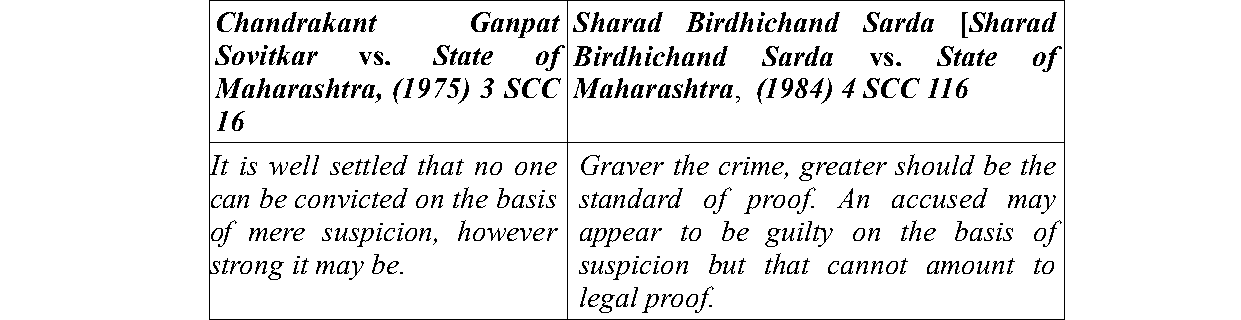
In circumstantial evidence cases, prosecution must establish complete chain of fully proven, conclusive circumstances consistent only with guilt, excluding all other hypotheses; unreliable confession....


Circumstantial evidence requires complete unbroken chain conclusively proving guilt and excluding innocence hypothesis; failure of key links like last seen, extra-judicial confession, motive, recover....

In murder cases based on circumstantial evidence, each link must be established beyond reasonable doubt, with all evidence consistently pointing to the guilt of the accused.
Convictions under circumstantial evidence require a complete and unbroken chain of proof; mere suspicion is insufficient for establishing guilt.

Circumstantial evidence must create a complete and cogent chain linking the accused to the crime; mere suspicion, without proof beyond reasonable doubt, is insufficient for conviction.
Circumstantial evidence must form a complete chain pointing to guilt, with the prosecution required to establish every link beyond reasonable doubt.

The prosecution must establish guilt beyond reasonable doubt, and mere circumstantial evidence or suspicion is insufficient for conviction.



An indispensable Tool for Legal Professionals, Endorsed by Various High Court and Judicial Officers
Please visit our Training & Support
Center or Contact Us for assistance

Scan Me!
India’s Legal research and Law Firm App, Download now!


For Daily Legal Updates, Join us on :



 Back to top


