Back
Back





2026 Supreme(Mad) 1827
IN THE HIGH COURT OF JUDICATURE AT MADRAS
C.V. KARTHIKEYAN, K. KUMARESH BABU, JJ.
Textile Connection - Appellant
Versus
M/s. Burlington’s Exports – Respondent
OSA No. 262 of 2017
Decided On : 13-03-2026
For the Appellant : Mr.R.Bharanidharan For M/s.Sampathkumar & Associates.
For the Respondent: Mr.C.Mohan for Ms.A.Rexy Josephine Mary for M/s.King and Partridge
The burden of proof lies with the claimant to substantiate claims with credible documentation, and evidence of timely payments to claimants influence recovery judgments.
Headnote:(A) Partnership Act - Agreement Terms - Appeal against dismissal of a suit for payment of Rs.39,67,144/- - Suit dismissed for failure to prove the claim - Managing Partner of plaintiff testified, with evidence lacking from defendant side regarding debit notes, resulting in ambiguity in claims. (Paras 1-56)
(B) Evidence and Burden of Proof - The appellant is required to substantiate their claims in the absence of which a suit can be dismissed for lack of proof of documentation and timely payments. (Paras 2, 12, 46)
(C) Limitation - Invoices prior to claim period and those barred by limitation were correctly rejected by the Single Judge. (Paras 37, 56)
Facts of the case:
The plaintiff, a registered Partnership Firm, supplied cotton fabrics to a defendant firm. Disputes arose over payments for supplies and alleged defective materials leading to the suit claiming Rs.39,67,144/- with interest.
Findings of Court:
The court affirmed the dismissal of the suit based primarily on evidentiary shortcomings from the plaintiff side and the lack of documentation to support claims against the defendants.
Issues: 1) Whether the plaintiff could recover the suit amount; 2) Whether interest was justified at 24%.
Ratio Decidendi: The court concluded that the plaintiff failed to substantiate the claims, especially regarding the disputed amounts and acceptance of corresponding documentation. The absence of debits and proper documentation by the defendants was pivotal.
Result: Appeal partly decreed for Rs.23,62,162/- with 24% interest from the plaint date till decree date.
| Table of Content |
|---|
| 1. background of the suit and involved parties (Para 1 , 2 , 3 , 4 , 5 , 6 , 7 , 8 , 9 , 10) |
| 2. defendants' written statement and disputes (Para 11 , 12) |
| 3. trial observations and findings (Para 13 , 14 , 15 , 16 , 17) |
| 4. plaintiff's arguments regarding claims (Para 18 , 20 , 21 , 22 , 23) |
| 5. defendants' counterarguments and evidence (Para 25 , 28 , 29) |
| 6. trial process and disputes over quality and payment (Para 30 , 32 , 33 , 34) |
| 7. invoices and limitations addressed (Para 35 , 36 , 37 , 38 , 39) |
| 8. reliability of evidence and documentary requirements (Para 40 , 41 , 42 , 46) |
| 9. final rulings on claims and decrees (Para 52 , 54 , 56) |
JUDGMENT :
C.V. Karthikeyan, J.
The plaintiff in C.S.No.29 of 2000 aggrieved by the judgment dated 01.09.2016 passed by a learned Single Judge of this Court, on the Original Side dismissing the said suit, has filed the present appeal.
2.C.S.No.29 of 2000 had been filed seeking a judgment and decree against the defendants jointly and severally to pay a sum of Rs.39,67,144/- together with interest at 24% per annum from the date of the plaint till date of realization and for costs of the suit.
3.It had been contended in the plaint that the plaintiff, a registered Partnership Firm was a regular supplier of cotton fabrics to the 1st defendant which was also a Partnership Firm carrying on business at Thane, Maharashtra. The defendant would convert the fabrics into garments and export such garments. The 2nd, 3rd and 4th defendants were partners of the 1st defendant. The 5th defendant who was yet another partner was subsequently impleaded during the pendency of the suit.
4.It had been stated in the plaint that the 1st defendant used to send to the plaintiff the details of the fabrics required, the construction, colour and other points of specification. The plaintiff would get the samples ready and send the same to the 1st defendant. If the 1st defendant were to indicate changes / modifications in the samples, the plaintiff would have to obtain fresh samples and send them for final approval. After the samples had been approved, the plaintiff would quote the price for acceptance by the 1st defendant.
5.The arrangement between the parties was that the 1st defendant would first place a trial order for about 100 meters which would be supplied by the plaintiff. Thereafter, the 1st defendant would place bulk orders and issue purchase orders setting forth the terms and conditions for the supply. The purchase orders would be countersigned by the plaintiff. This was the usual / normal practice. There would be occasions when there would be considerable time interval between the trial order and the bulk order to about four to five months. But the plaintiff did not alter the quoted price even if there had been increase in input prices. The plaintiff never claimed the price which prevailed on the date of the supply but raised invoice only on the contracted price.
6.It had been further stated that the supplies were made either directly or by signing documents by the bank. When documents were sent through the bank, the payments were cleared within a reasonable time. But when supplies were made directly, the payments for the bills were always belated, with the delay being anywhere between three to twelve months though in the invoices it had been stated that the payments should be effected within thirty days. It had been further stated that though the payments were delayed by the 1st defendant, the plaintiff still continued to honour its commitment to supply the fabrics in accordance with the purchase order.
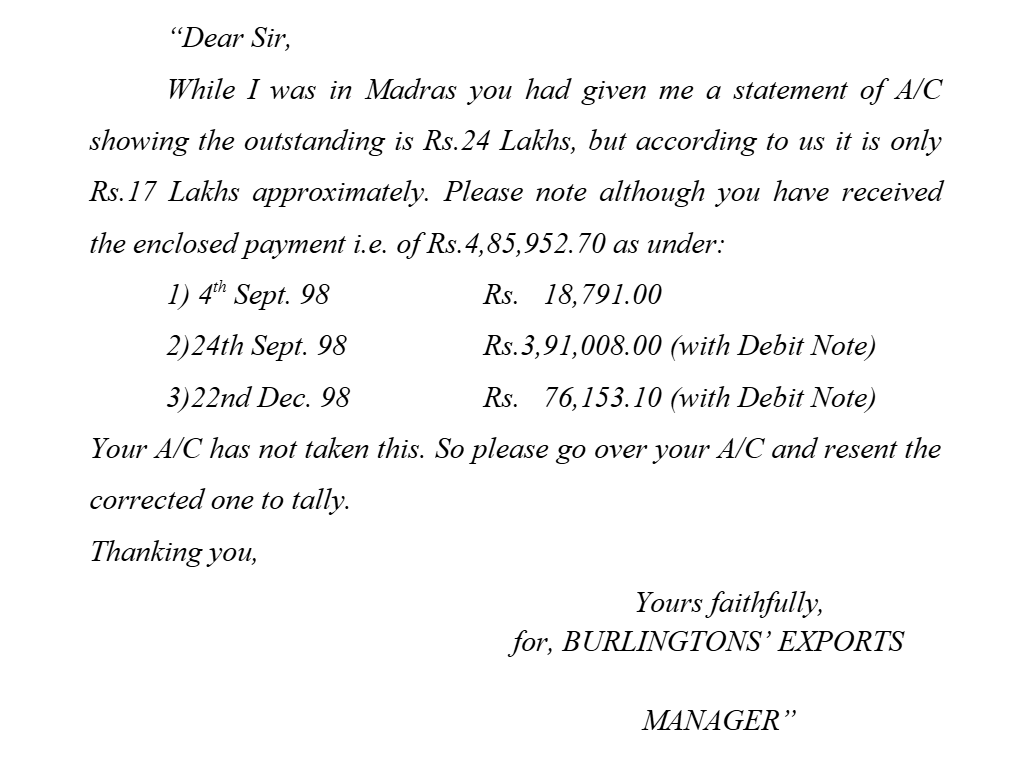
7.In June 1998, the 1st defendant wrote to the plaintiff that they had obtained quotations from other suppliers and found that the prices quoted by the plaintiff over the last two years had been 20% to 30% higher than the other suppliers. The 1st defendant wanted the plaintiff to issue credit note at 10% of all supplies for the period from 01.04.1996 to 30.06.1998. The plaintiff issued a reply denying the allegations.