Back
Back





2026 Supreme(Mad) 2260
BEFORE THE MADURAI BENCH OF MADRAS HIGH COURT
P. VADAMALAI, J.
Thirugnanam S/o Shenbhagam – Appellant
Versus
S.B. Vijayaraghavan (Died) S/o Balasundaram – Respondent
A.S. (MD) No. 214 of 2017, C.M.P. (MD) No. 12141 of 2017
Decided On : 02-02-2026
For the Appellant : K. Ganesamoorthy
For the Respondent: J. Barathan
Continuous readiness and willingness to perform a contract is essential for specific performance; suits filed beyond statutory limitation periods, without valid acknowledgments, are barred.
Headnote:(A) Specific Relief Act, 1963 - Section 16(c) - Limitation Act, 1963 - Section 18 - Relief of specific performance - Time is not the essence of a contract, but the plaintiff must demonstrate continuous readiness and willingness to perform his part - Suit dismissed as barred by limitation having been filed beyond the prescribed period. (Paras 1, 16, 22, 24, 26)
(B) Limitation Period - On a sale agreement executed on 16.09.2007, suit for specific performance filed on 13.01.2015 is barred as acknowledgments (Ex.A.4 and Ex.A.6) were made beyond the three-year period. (Paras 20, 22)
Facts of the case:
The plaintiff and defendant entered into a sale agreement on 16.09.2007 for specific property with an advance payment of Rs.3,60,000. The plaintiff alleged the defendant delayed executing the sale deed, leading to the suit filed in 2014.
Findings of Court:
The Court concluded that the suit was barred by limitation as the relevant acknowledgements were outside the prescribed period, and the plaintiff did not demonstrate ongoing readiness and willingness to complete the sale.
Issues: The main issues addressed were whether the suit was barred by limitation and if the plaintiff was ready and willing to perform the contract as per the agreement.
Ratio Decidendi: The court ruled it is essential to prove readiness and willingness for specific performance, and that mere assertions are insufficient without substantial evidence; acknowledgment letters cannot be considered valid if issued after the limitation period.
Result: Appeal dismissed.
| Table of Content |
|---|
| 1. establishment of basic facts of the case (Para 1 , 2 , 4 , 5 , 6 , 7) |
| 2. arguments on limitation and readiness (Para 8) |
JUDGMENT :
P. VADAMALAI, J.
1. This Appeal is filed against the judgment and decree, dated 17.07.2017 made in O.S.No.10 of 2015 on the file of the VI Additional District Court, Madurai.
2. The appellant is the plaintiff in O.S.No.10 of 2015 on the file of the VI Additional District Court, Madurai. The first respondent is the defendant in that suit.
3. For the sake of convenience, the parties are referred to as per their rank before the trial Court.
4. The brief facts are as below:
(a) The case of the plaintiff (appellant herein ):
The suit properties to a total extent of 12 acres 72 cents, shown as three items. The item Nos.1 and 2 are absolute properties of the defendant by virtue of the sale deed, dated 21.03.1985. In the 3rd item, he is having 1/5th share. He and his brother are in joint possession of the 3rd item. The defendant agreed to sell item Nos.1 and 2 and 1/5 share in item No.3 to the plaintiff for a total consideration of Rs.10,49,400/- at the rate of Rs.825/- per cent. The plaintiff and the defendant entered into sale agreement on 16.09.2007. The plaintiff paid Rs.1,00,000/- to the defendant as advance. The sale should be completed within one month. The defendant further received Rs.1,50,000/- on 07.02.2008; Rs.1,00,000/- on 11.02.2008 and Rs.10,000/- on 25.02.2008 and thus the defendant received totally Rs.3,60,000/- out of sale consideration. The defendant made an endorsement for receipt of the said sum on the back side of sale agreement. The plaintiff has always been ready and willing to perform his part of the contract and insisting the defendant to execute the sale deed. The defendant has been postponing the registration, stating that there was a dispute between the defendant and his brothers. On 14.02.2014, the plaintiff approached the defendant and insisted for execution of the sale deed, for which the defendant gave a promise letter stating that he would definitely perform his part of the contract. However, the defendant failed to do so. Hence, the plaintiff issued a legal notice on 28.03.2014 to the defendant, calling upon him to execute the sale deed. Again, the defendant gave another letter on 25.04.2014 promising that he would definitely complete the sale and asked the plaintiff to wait for some period. The plaintiff is having sufficient means and is always ready and willing to get the sale deed registered. Since the plaintiff was in possession of the suit properties, he was on hope that the defendant would sell the suit property to him. On 05.01.2015, the plaintiff learnt that the defendant was attempting to sell the suit properties to third parties. Hence, the plaintiff filed the suit for specific performance.
(b) The case of the defendant:-
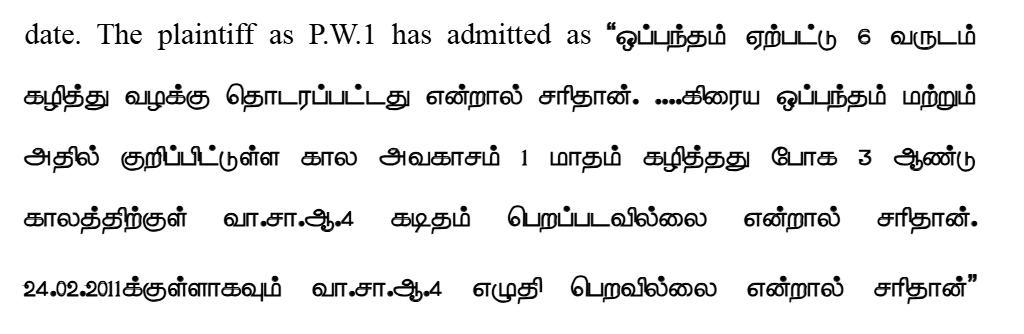
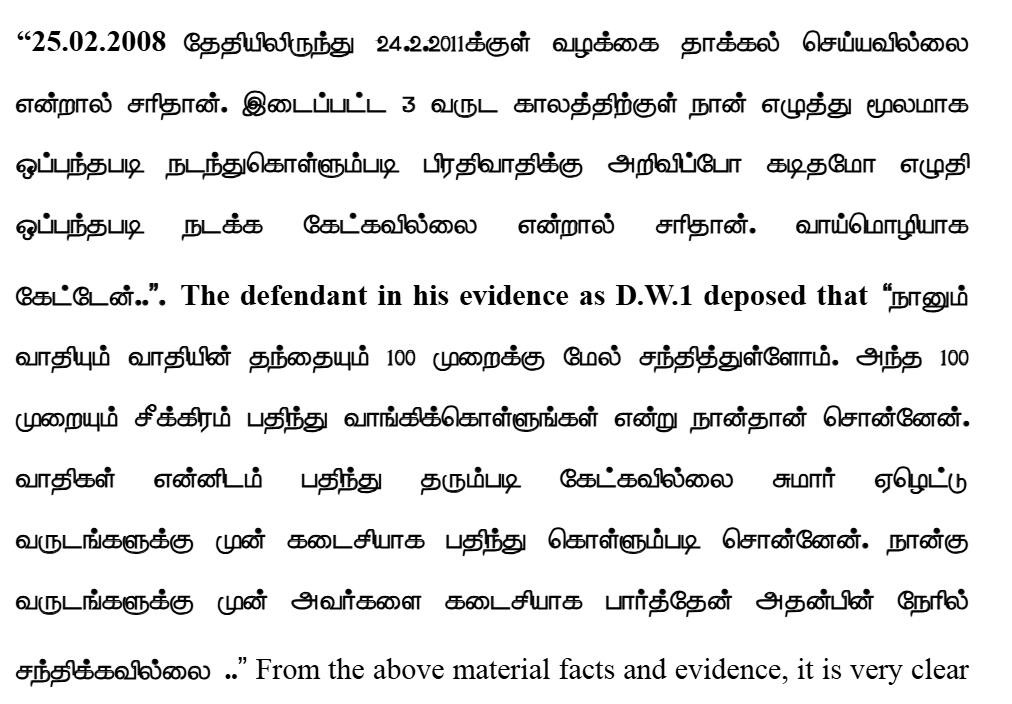
The plaintiff and the defendant entered into sale agreement, dated 16.09.2007. One month time was stipulated for completion of sale. The defendant received a sum of Rs.1,00,000/- on 16.09.2007, Rs.1,50,000/- on 07.02.2008, Rs.1,00,000/- on 11.02.2008 and Rs.10,000/- on 25.02.2008. The balance sale consideration was to be paid within another one month time. The plaintiff has not paid. The plaintiff has to file the suit within three years, i.e., on or before 22.03.2011, but the plaintiff filed the suit on 14.02.2014, stating that the defendant sent a letter to the plaintiff promising to perform his part of contract. As per Limitation Act, the acknowledgement should have been given within three years i.e., on or before 22.03.2011. The defendant never sent any reply on 25.04.2014 as alleged. So, the suit is filed beyond the limitation period and the suit is barred by limitation. The plaintiff was not ready and willing to perform his part of contract. The plaintiff committed a breach of contract. Hence, the plaintiff is not entitled to the discretionary relief of specific performance and the suit is liable to be dismissed.
5. The trial Court