
 Back
Back





IN THE HIGH COURT OF ORISSA AT CUTTACK
Sashikanta Mishra, J.
Bhagirathi Khuntia (Dead) Sudam Charan Khuntia (Dead) their legal heirs Nakhyatramala Mohankudo and others - Appellants
Versus
Golapi Gouduni (Dead) her legal heirs Jugal Gouda and others - Respondents
S.A No.121 of 1994
Decided On : 19-03-2026
| Table of Content |
|---|
| 1. ownership and relationships regarding suit property (Para 1 , 4 , 5 , 6 , 10) |
| 2. procedural aspects related to proof of documents (Para 8 , 15 , 19) |
| 3. arguments regarding validity of gift deeds (Para 12 , 13 , 14 , 26) |
| 4. legal standards for proving validity of a will (Para 18 , 22 , 23 , 24 , 25 , 27) |
| 5. conclusion and result of the appeal (Para 30 , 31) |
JUDGMENT :
Sashikanta Mishra, J.
This is a defendant’s appeal against a partly reversing judgment. Judgment dated 24.3.1994 followed by decree passed by learned Civil Judge (Sr. Division), Gunupur in T.A. No.3/1992 is under challenge whereby the judgment dtd.03.4.1992 followed by decree passed by learned Addl. Munsif, Bissamcuttack in T.S. No.2/1991 was modified, though the appeal was dismissed.
2. For convenience, the parties are referred to by their respective names to avoid confusion.
3. At the outset, it would be proper to refer to the genealogy showing relationship between the parties.
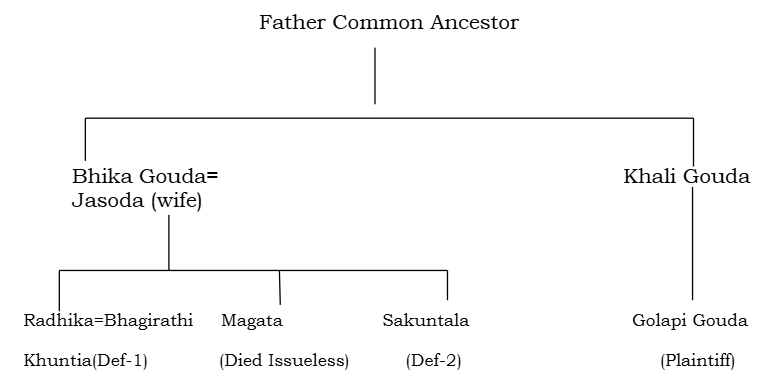
4. The plaintiff’s case, briefly stated, is that Bhika Gouda and Khali Gouda were two brothers and constituted a joint Hindu family. They acquired the suit properties as such. Bhika died somewhere in the year 1951 leaving behind his widow Jasoda, two daughters namely, Radhika and Sakuntala and a son namely, Magata, who died unmarried. Radhika died in 1979 leaving behind her husband Bhagirathi (defendant No.1). Jasoda died in 1988. During her lifetime, Jasoda executed two gift deeds relating to the suit property, one in favour of Golapi (Plaintiff) in respect of ‘A’ schedule property and the other in favour of Sakuntala (Defendant No.2) in respect of ‘B’ Schedule property. Subsequently, Sakuntala sold the said property to Golapi in 1986 through a registered sale deed. Thus, the Plaintiff-Golapi claims to be the owner in possession of the suit properties. Bhagirathi filed T.S. No.1/1990 against the Plaintiff in the same Court for recovery of possession of the ‘B’ schedule property. Said suit was decreed. Defendant No.1, on the strength of the said decree dispossessed the plaintiff from ‘B’ schedule property on 23.2.1991. Hence, the suit for declaration of right, title, interest and possession and to declare the judgment and decree passed in the aforementioned suit as void.
5. Pursuant to notice, Defendant No.2 appeared and filed written statement supporting the case of the Plaintiff.
6. Defendant No.1 contested the suit by filing written statement denying the plaint averments, inter alia, taking the stand that Bhika and Khali were separated during their lifetime. Khalia died somewhere in 1976 leaving behind his widow Pana Gouda and daughter Golapi (Plaintiff). Pana is also dead. Bhika had no male issue. As such, he brought Defendant No.1 to his house as illatom son-in-law. Defendant No.1 performed the obsequies of Bhika and maintained his widow and daughter Sakuntala. He was also looking after the properties of Bhika and performed the marriage of Sakuntala. He was in possession of the properties to the knowledge of Sakuntala openly and continuously for more than 30 years, for which the plaintiff and defendant No.2 have lost their title by way of adverse possession.
It is further claimed the suit properties are the exclusive self-acquired properties of Bhika Gouda and not jointly acquired with his brother. As such, Khali Gouda has no right over the property. The claim regarding execution of gift deed by Jasoda in favour of Golapi and Sakuntala was specifically denied. It was stated that Jasoda was very old and not in a sound state of body and mind and also lost her eyesight for which she was not competent to execute the deed. As such, no title can be said to have passed through such deeds.
7. Basing on the rival pleadings, the trial Court framed the following issues;
1. Whether the suit is maintainable? 2. Whether the suit is under-valued?
3. Whether this Court has pecuniary jurisdiction to try the suit?
4. Whether the plaintiff has a right, title and possession over the suit land?
5. Wheth
AI
The validity of gift deeds executed by an illiterate Pardanashin woman requires clear evidence of conscious execution and understanding; the burden remains on the propounder in the absence of explici....

The burden of proof for executing gift deeds rests on the proponent, especially when the grantor is vulnerable due to age or literacy, necessitating clear evidence of understanding.
Precise compliance with statutory execution and proof requirements for Wills is necessary, especially when involving Pardanashin individuals; the burden of proof lies on those asserting the validity ....

Failure to amend pleadings post-trial without due diligence limits claims, and a will's validity requires testimony from attesting witnesses to overcome burdens of proof and dispel doubts.

The central legal point established in the judgment is the importance of proper execution and attestation of gift deeds, the reversal of onus in cases of undue influence, and the need to consider the....

legal requirements of proving the Will has been satisfied and the factum of excluding the plaintiff Akha from the properties by the testator is reflected in the Will itself, are sufficiently proved. ....

A Kartha of a Hindu Joint Family cannot gift joint family property without the consent of other coparceners, rendering such a Gift Deed invalid.

The main legal point established in the judgment is that the execution of a gift deed and a registered WILL must be proved in accordance with the law, and expert evidence of handwriting is not conclu....

The court ruled that a gift deed requires valid execution, while stating possession need not be transferred for validity, and that unprobated wills are valid in specific jurisdictions under the India....

Point of Law : Essential conditions of a valid attestation under Section 3 of Act are : (1) two or more witnesses have seen the executant sign instrument or have received from him a personal acknowle....



An indispensable Tool for Legal Professionals, Endorsed by Various High Court and Judicial Officers
Please visit our Training & Support
Center or Contact Us for assistance

Scan Me!
India’s Legal research and Law Firm App, Download now!


For Daily Legal Updates, Join us on :



 Back to top


