
 Back
Back





PUNJAB AND HARYANA HIGH COURT AT CHANDIGARH
SURESHWAR THAKUR, SUDEEPTI SHARMA, JJ.
Kuldeep Singh @ Keepa And Another - Appellant
Vs.
State Of Punjab - Respondent
CRA-D-671-DB-2013 (O&M)
Decided On : 19-11-2024
JUDGMENT :
Sureshwar Thakur, J.
The instant appeal is directed against the impugned verdict, as made on 30.5.2013, upon Sessions Case No. 116 of 4.12.2007, by the learned Additional Sessions Judge, Sangrur, where through in respect of charges drawn against the accused-appellants qua offences punishable under Sections 392 and 302 IPC, the learned trial Judge concerned, proceeded to record a finding of conviction against the accused-appellants.2. Moreover, through a separate sentencing order of even date, the learned trial Judge concerned, sentenced both the convicts-appellants in the hereafter extracted manner-
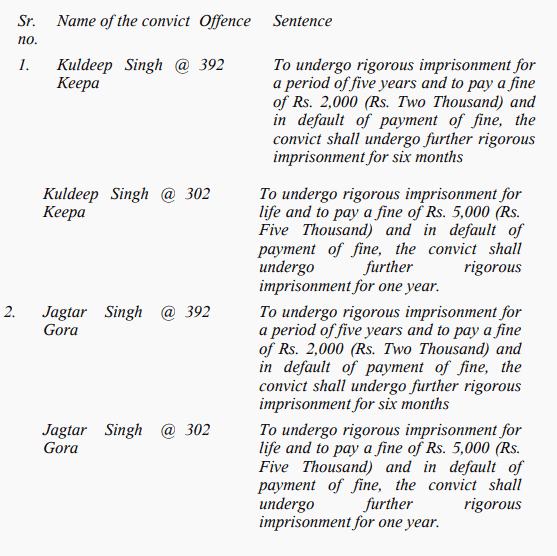
3. All the above imposed sentences of imprisonment, were ordered to run concurrently However, the period of detention undergone by the accused-appellant, during the investigations, and, trial of the case, was, in terms of Section 428 of the Cr.P.C., rather ordered to be set off from the above imposed sentence(s) of imprisonment.
Factual Background
4. The genesis of the prosecution case, becomes embodied in the appeal FIR, to which Ex PA/1 is assigned. As per the prosecution case, on 22.03.2007, Inspector Daljit Singh, SHO of Police Station Sadar Sunam along with other police officials were present within the vicinity of village, Nangla in connection with patrolling, where complainant Reema Singh son of Gurbachan Singh Jat, resident of Nangla came, and, got recorded his statement to the effect that on 22.03.2007, he along with his father proceeded towards his village, after doing work in their fields, known as 'Dhak Wala'. His father proceeded towards the village, on bullock cart. When he reached near 'Wadda' bridge, thereupon at about 3.00/3.30 P.M., two clean shaven persons were standing near the canal bridge. He stopped near them and they asked him about the drinking water. He pointed to the water pump across the bridge. In his statement, the complainant also gave full description of both the persons. The complainant further stated thereins, that when he reached about two acres ahead of the bridge, he heard a noise of bursting of cracker. He though that the tyre of motor cycle Bhagwan Singh son of Bachan Singh, who is his cousin and was returning from the fields on his motor cycle make Bajaj, migh have been burst. He did not return, as he though that his father, who was on the same way on his bullock cart, and, he would bring the motorcycle of Bhagwan Singh by keeping the same on his cart. However, after a while, both the said persons proceeded towards his village, Nangla after crossing him on the red colour motorcycle. Subsequently, when he reached his house, one Darshan Singh, Electrician informed him that two unknown persons had snatched the motorcycle of Bhagwan Singh and also caused injuries to him. The complainant further stated that the aforesaid persons had snatched the motor cycle of Bhagwan Singh. Bhagwan Singh was got admitted in the hospital by his father after arranging a vehicle. On the basis of the said statement, an offence under Section 382/34 of IPC was found to be made out and a ruqa was sent to the police station for registration of an FIR.
Investigation proceedings
5. During the course of investigations, the investigating officer reached the spot and took into possession blood stained earth. Rough site plan of place of occurrence was prepared. Case property was deposited in police Malkhana. On 23.03.2007, Hari Singh Ex Sarpanch disseminated information regarding death of Bhagwan Singh at Amar Hospital, Patiala, upon which, offence under Section 302 IPC was added. Autopsy of the dead body of Bhagwan Singh was got conducted. On 01.04.2007, Section 392 IPC was added in place of Section 382 IPC. On 03.07.2007, complainant Reema Singh got recorded his supplementary statement, in which, apart from reiterating his earlier version, he further stated that when he went ahead, both the clean shaven persons after firing upon Bhagwan Singh snatched his motor cycle make CT 100 bearing No. PB13B-2421 of red colour. They


The conviction was upheld based on strong evidentiary links, including a confession and ballistic evidence, demonstrating the accused's culpability in murder and related firearms offences.
The prosecution must prove its case beyond reasonable doubt, and a weak motive can undermine convictions; corroborated evidence must link defendants to the crime convincingly.
The court emphasized that disclosure statements must be corroborated by credible evidence to establish guilt, and acquittals were upheld due to insufficient evidence against several accused.
The main legal point established in the judgment is the requirement for conclusive and creditworthy evidence to support the charges against the accused, especially in cases involving eyewitness testi....

Circumstantial evidence can establish guilt if it forms a complete chain pointing to the accused, even without direct evidence.
The court upheld the conviction based on corroborated witness testimony, emphasizing the admissibility of expert reports without cross-examination if no request was made by the accused.



An indispensable Tool for Legal Professionals, Endorsed by Various High Court and Judicial Officers
Please visit our Training & Support
Center or Contact Us for assistance

Scan Me!
India’s Legal research and Law Firm App, Download now!


For Daily Legal Updates, Join us on :



 Back to top


