
 Back
Back





IN THE HIGH COURT OF PUNJAB AND HARYANA AT CHANDIGARH
DEEPAK GUPTA, J.
M3M India Private Limited – Petitioner
Versus
MGF Developments Limited & Ors. – Respondents
CR No. 2227 of 2025
Decided On : 26-05-2025
Key Points: - Parties must disclose all relevant documents, whether favourable or unfavourable, at the outset of commercial proceedings to prevent trial by ambush (!) (!) (!) . - The plaintiff must file a comprehensive list of documents with the plaint, and the defendant must disclose documents in the written statement, with limited exceptions for documents that answer a case subsequently set up by the opposite party (!) (!) . - Additional documents may only be produced with the court's leave upon showing reasonable cause for earlier non-disclosure; mere oversight or error by counsel does not qualify (!) (!) (!) . - Reasonable cause must refer to circumstances beyond the party's control that prevented disclosure; procedural delays and failure to disclose known documents are not excused (!) (!) (!) . - Documents that were within a party's power, possession, or custody at the time of filing must be disclosed early; late applications to produce such documents, without reasonable cause, will be dismissed (!) (!) (!) . - The provisions of the Commercial Courts Act are to be strictly construed, and courts must resist diluting the strict disclosure requirements on sympathetic or equitable considerations (!) (!) (!) . - The principles mandate early disclosure, narrow exceptions, and strict adherence to timelines, ensuring procedural discipline and effective case management in commercial litigation (!) (!) (!) .
| Table of Content |
|---|
| 1. court's review of submissions and record. (Para 5 , 6) |
| 2. interpretation of procedural rules under cpc. (Para 18 , 21 , 23) |
| 3. court's conclusion on the application for additional documents. (Para 26 , 32) |
JUDGMENT :
DEEPAK GUPTA, J.
Petitioner herein is the plaintiff in civil suit No. 4 of 2023 titled ‘M3M India Private Limited Vs. MGF Developments Limited & Ors.’, pending before learned Additional District Judge-cum-Presiding Officer, Exclusive Commercial Court at Gurugram exercising jurisdiction under Commercial Courts Act, 2015 [in short – ‘commercial court’]. The petitioner is aggrieved by the order dated 05.03.2025 (Annexure P-1), whereby Commercial Court has dismissed the application filed by the said petitioner under Order XI Rule 1 (5) CPC for producing certain additional documents.
2.1 Defendants No.1 and 2 (respondents N: 1 & 2 herein) were owner of the suit land. Collaboration agreement dated 23.11.2016 (Annexure P-2) was executed between the plaintiff and defendants No.1 & 2 regarding the said land; and an amount of Rs.88 crores was paid by the plaintiff to the said defendants, which as per plaintiff’s case was a refundable security. Irrevocable power of attorney was executed by defendant No.1 & 2 in plaintiff’s favour on the same day i.e. 23.11.2016. The plaintiff was represented by one Mr. Ravi Khera. On 24.11.2016, a supplementary agreement is purported to have been executed between the parties, whereby refundable security deposit under the collaboration agreement was made non-refundable. Plaintiff claims that Ravi Khera had tendered his resignation on 25.05.2017. It is further the allegation that cancellation agreement dated 18.12.2017 was later on executed between the plaintiff through Ravi Khera and defendants No.1 & 2, thus, cancelling the collaboration agreement.
2.2 Later on, out of total 61 kanals 18 marlas of the suit land, defendants No.1 & 2 sold 60 kanals 7 marlas to defendant No.3 (respondents N: 3 herein) on 09.09.2021, who was granted license to develop the plotted colony by Director Town and Country Planning.
2.3 Cancellation agreement dated 18.12.2017 is alleged by the plaintiff to be a forged document, having been prepared by the defendants No.1 & 2 in collusion with its erstwhile employee Mr. Ravi Khera, who had already resigned in May 2017. On a complaint moved by the plaintiff on 30.12.2021, FIR No. 3 dated 03.01.2022 under Sections 120 -B, 406, 409, 420, 467, 468, 471 IPC was registered against defendants No.1 and 3, its Directors and Mr. Ravi Khera. CRM-M 4263 of 2022 was filed by defendant No.1 to quash the FIR before this High Court.
2.4 Plaintiff then filed civil suit No. 2770 of 2022 on 07.06.2022 before the Court of learned Civil Judge (Jr. Divn.), Gurugram seeking decree of declaration of his rights under the collaboration agreement. Defendants No.1 and 3 filed separate applications under Order 7 Rule 11 CPC contending that suit was not maintainable being a commercial dispute and so, same should have been brought before Commercial Court. The objection of maintainability was also raised in the written statement filed by defendants No.1 and 2 in October, 2022. Defendant No.3 pleaded itself to be a bonafide purchaser.
2.5 The plaint of aforesaid suit was returned by the learned Civil Judge on 09.01.2023 and thereafter, plaintiff brought the present suit on 21.01.2023 seeking decree of declaration regarding validity of the collaboration agreement, contending that it was still subsisting and seeking cancellation of sale deeds executed by defendants No.1 and 2 in favour of defendant No.3. Declaration was also sought that supplementary agreement and the cancellation agreement were void. Besides, decree of permanent injunction was sought against the defendants from creating third party rights.
2.6 During pendency of the suit, this High Court disposed of CRM-M 4263 of 2022 having been rendered infructuous in the light of the cancellation report filed in FIR No.3 of 2022, vide order d
AI
The Commercial Courts Act mandates strict disclosure obligations, requiring all documents to be submitted at the outset. Late submissions necessitate a clear justification for non-disclosure, which w....


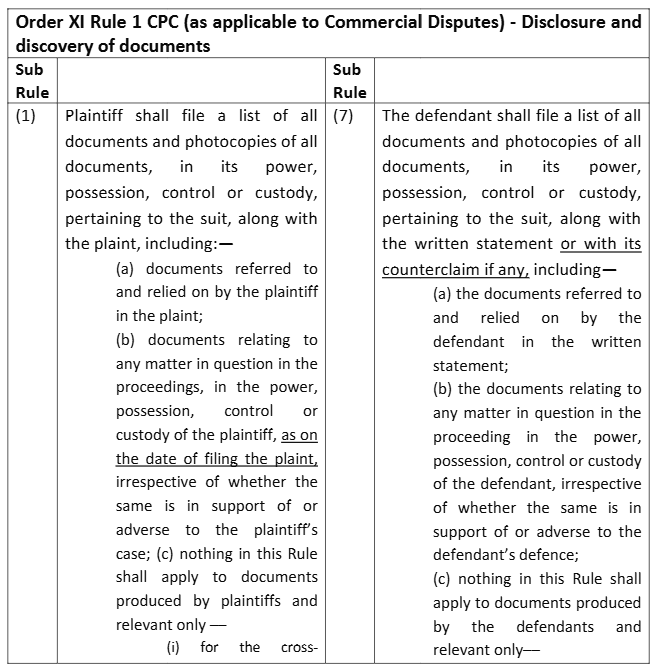
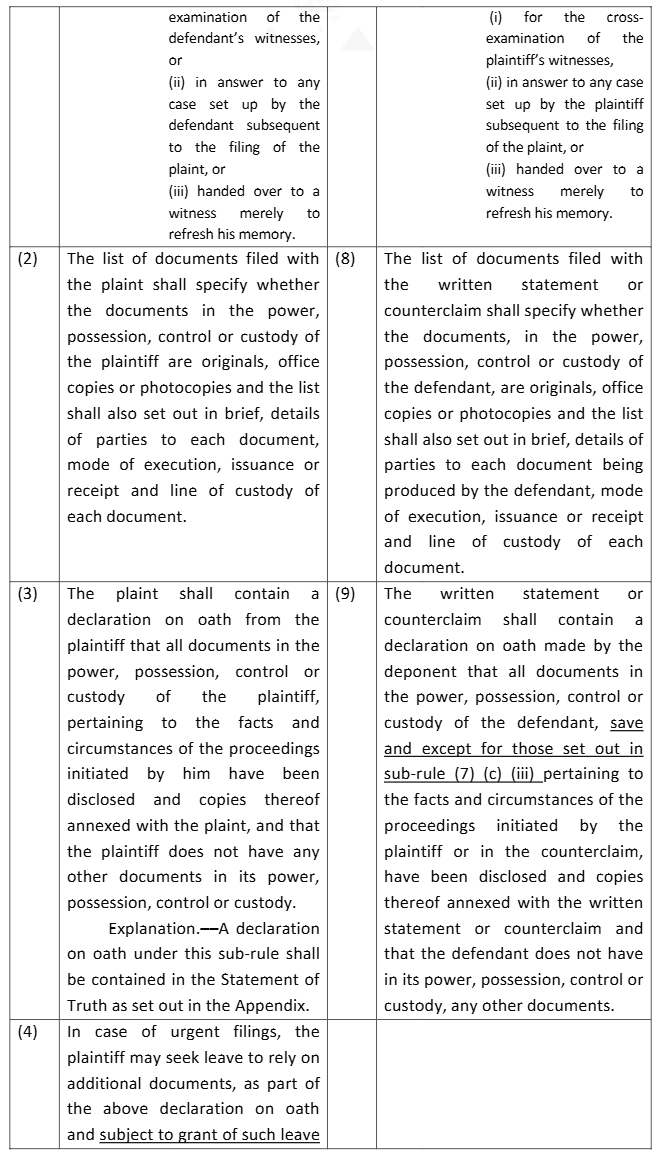
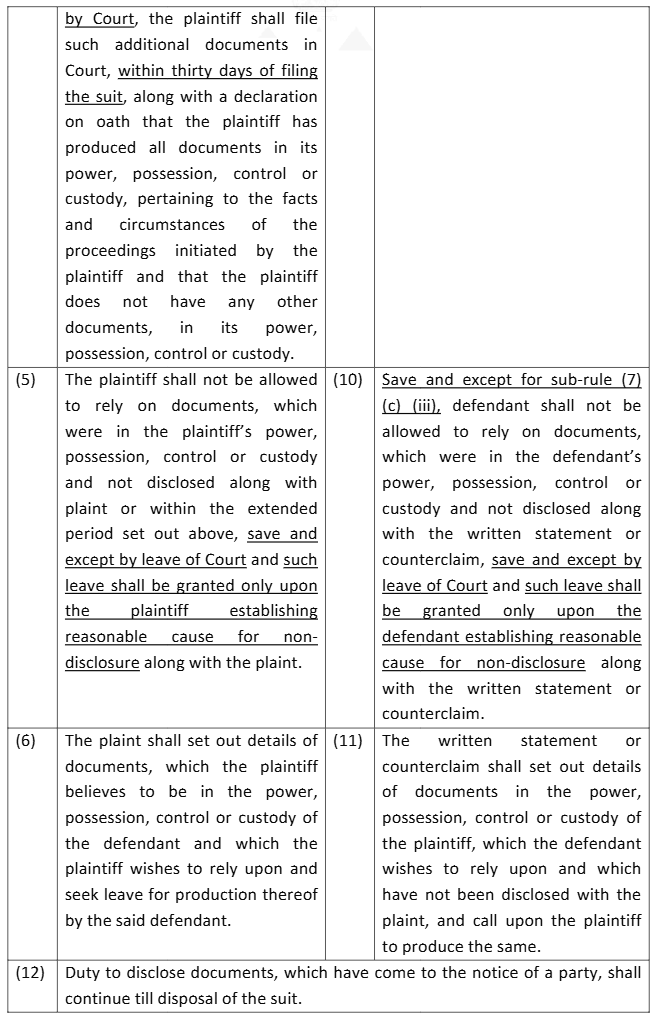
(1) After Order XI Rule 1 has been amended with respect to suits before commercial courts and a specific provision/procedure has been prescribed with respect to suits before commercial division and b....

The court established that mere reference to documents in a written statement does not satisfy the requirement of 'reasonable cause' for late submission under the amended Civil Procedure Rules.

The main legal point established in the judgment is the requirement for the plaintiff to disclose all documents in its power, possession, control or custody, pertaining to the Suit, along with the pl....

The court affirmed that documents not disclosed with the written statement in commercial cases cannot be admitted, but contradictory decisions on evidence closure were ruled unsustainable.

The court emphasized strict adherence to procedural timelines in commercial disputes, concluding that introducing additional documents post-evidence closure undermines the intent of the Commercial Co....
In commercial litigation, negligence or inadvertence does not constitute 'reasonable cause' for late document disclosure; strict adherence to procedural timelines is mandatory under the Commercial Co....



An indispensable Tool for Legal Professionals, Endorsed by Various High Court and Judicial Officers
Please visit our Training & Support
Center or Contact Us for assistance

Scan Me!
India’s Legal research and Law Firm App, Download now!


For Daily Legal Updates, Join us on :



 Back to top


