Back
Back





2026 Supreme(P&H) 797
IN THE HIGH COURT OF PUNJAB AND HARYANA AT CHANDIGARH
SUDEEPTI SHARMA, J.
National Insurance Co. Ltd. – Appellant
Versus
Bimla Rani and Others – Respondents
FAO No. 920 of 2017, XOBJC No. 236-CII of 2017
Decided On : 09-03-2026
For the Appellant : Deepak Suri
For the Respondent: Brijesh Khosla
JUDGMENT :
SUDEEPTI SHARMA, J.
FAO-920-2017
1. For orders, see detailed order of the even date passed in FAO No.912-2017, titled as National Insurance Company Ltd. Vs. Gurdeep Kaur and others.
CM-27105-CII-2017
1. This is an application filed under Section 5 of the Limitation Act, 1963 read with Section 151 of the Code of Civil Procedure, 1908 for condonation of delay of 96 days in filing the cross-objection.
2. Notice in the application.
3. Mr. Deepak Suri, Advocate accepts notice on behalf of appellant and contends that he has no objection if the application is allowed.
4. Learned counsel for the claimants/cross-objectors contends that the they would not ask for interest for the delayed period.
5. For the reasons mentioned in the application for condonation of delay which is supported by an affidavit, the application is allowed.
6. The delay of 96 days in filing the cross-objection is condoned.
XOBJC-236-CII-2017
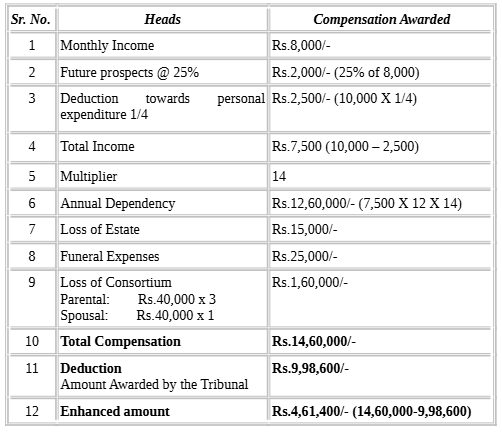
1. The present cross-objection has been preferred against the award dated 19.07.2016 passed by the learned Motor Accident Claims Tribunal, Ferozepur in the claim petition filed under Section 166 of the Motor Vehicles Act, 1988 (for short 'the Tribunal’) for enhancement of compensation granted to the claimants to the tune of Rs.9,98,600/- along with interest @ 7.5% per annum, on account of death of Joginder Singh in a Motor Vehicular Accident, occurred on 13.03.2015.
2. As sole issue for determination in the present cross-objection is confined to quantum of compensation awarded by the learned Tribunal, a detailed narration of the facts of the case is not required to be reproduced here for the sake of brevity.
SUBMISSIONS OF LEARNED COUNSEL FOR THE PARTIES
3. The learned counsel for the claimants/cross-objectors contends that the amount assessed by the learned Tribunal is on the lower side and deserves to be enhanced. Therefore, he prays that the present cross-objection be allowed and amount of compensation be enhanced as per latest law.
4. Per contra, learned counsel for appellant-Insurance Company, however, vehemently argues that the amount of compensation, as assessed by the learned Tribunal has rightly been granted. Therefore, he prays for dismissal of the cross-objection.
5. I have heard learned counsel for the parties and perused the whole record of this case with their able assistance.
SETTLED LAW ON COMPENSATION
6. Hon’ble Supreme Court in the case of Sarla Verma Vs. Delhi Transport Corporation and Another, (2009) 6 SCC 121 laid down the law on assessment of compensation and the relevant paras of the same are as under:-
“30. Though in some cases the deduction to be made towards personal and living expenses is calculated on the basis of units indicated in Trilok Chandra, the general practice is to apply standardised deductions. Having a considered several subsequent decisions of this Court, we are of the view that where the deceased was married, the deduction towards personal and living expenses of the deceased, should be one-third (1/3rd) where the number of dependent family members is 2 to 3, one-fourth (1/4th) where the number of dependent family members is 4 to 6, and one-fifth (1/5th) where the number of dependent family members exceeds six.
31. Where the deceased was a bachelor and the claimants are the parents, the deduction follows a different principle.
In regard to bachelors, normally, 50% is deducted as personal and living expenses, because it is assumed that a bachelor would tend to spend more on himself. Even otherwise, there is also the possibility of his getting married in a short time, in which event the contribution to the parent(s) and siblings is likely to be cut drastically. Further, subject to evidence to the contrary, the father is likely to have his own income and will not be considered as a dependant and the mother alone will be considered as a dependant. In the absence of evidence to the contrary, brothers and sisters will not be considered as dependants, because they will either be independent and earning,