
 Back
Back





IN THE HIGH COURT OF PUNJAB AND HARYANA AT CHANDIGARH
LISA GILL, PARMOD GOYAL, JJ.
M/S Jyoti Strips Pvt. Ltd., Faridabad - Appellant
Versus
The State Of Haryana And Others - Respondents
VATAP-83-2018 (O&M), VATAP-95-2019 (O&M), VATAP-96-2019 (O&M), VATAP-107-2019 (O&M), VATAP-127-2019 (O&M),
Decided On : 27-02-2026
JUDGMENT :
PARMOD GOYAL, J.
1. All the above said five appeals were taken up together for consideration and adjudication at request and with consent of learned counsel for parties.
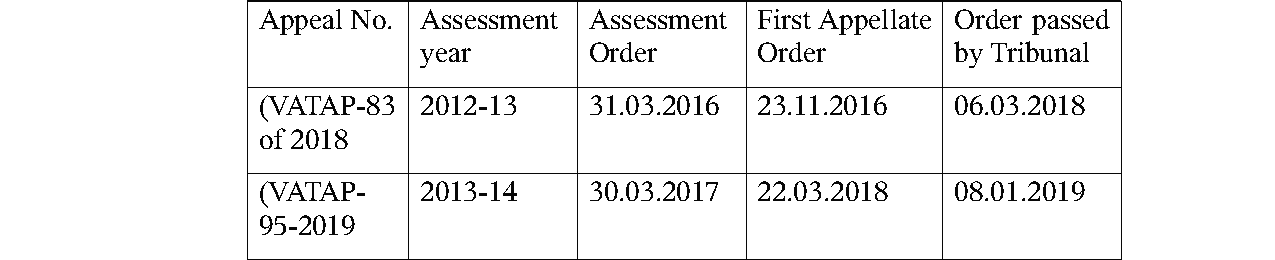
2. The appellant, who is a registered assessee / dealer with the Department of Sales Tax under the Haryana Value Added Tax Act, 2003 (for short ‘2003 Act’) and the Central Sales Tax Act, 1956 (for short ‘1956 Act’), has preferred the present appeals being aggrieved by the scrutiny- assessment/assessment orders, the dismissal of appeals by the First Appellate Authority and the dismissal of further appeals by the Haryana Tax Tribunal, Chandigarh (for short ‘Tribunal’), passed for different assessment years, as detailed hereunder:-

3. Appellant is aggrieved of the alleged erroneous interpretation of Sections 7 and 7-A of 2003 Act by the Assessing Authority as well as the Appellate Authorities. Case of appellant is that the authorities have wrongly construed Sections 7 and 7-A of 2003 Act and have incorrectly determined the taxable turnover by applying different yardsticks under the said provisions, beyond the parameters contemplated under the said Act. Provision for levy of additional tax/surcharge u/s 7A of 2003, Act, cannot be applied in a manner contrary to the prescribed statutory scheme by ignoring provision under which VAT is leviable u/s 7 of 2003, Act.
4. Facts are not in dispute. Appellant is a registered dealer engaged in trading of iron and steel goods. Iron and steel goods being “declared goods” are taxable @ 5% on the taxable turnover under the 1956 Act. The appellant effected sales to registered dealers within the State of Haryana at a concessional rate of tax of 4%, subject to production of the prescribed declaration in Form D-1, issued by the purchasing manufacturing dealer certifying that the goods were to be used in manufacture of goods for sale. Appellant had duly charged tax @ 4% on such sales; produced the declaration in Form D-1; issued certificates in Form C-4 and claimed the benefit of input tax credit @ 4% against such C-4 certification.
5. However, the Assessing Authority has levied surcharge @ 5% on tax payable making total tax payable to be 4.2 % (4 % of taxable turnover u/s 7 of 2003 Act + 0.2 % as additional tax / surcharge u/s 7-A of 2003 Act i.e. 5% of 4% tax paid u/s 7 of 2003 Act) despite production of the prescribed declaration forms. This additional levy of 0.2 % additional tax / surcharge u/s 7A of 2003 Act is under challenge.
6. By placing reliance upon the definition of “last turnover” under Section 2(u), “sale” under Section 2(ze), “sale price” under Section 2(zg), “taxable turnover” under Section 2(zn), the incidence of tax under Section 3, as well as Sections 7 and 7-A of 2003 Act, it was contended by learned counsel for appellants that no additional tax/surcharge was leviable in the manner calculated and imposed by the authorities below. It is the specific case of appellant that the scheme of the Act does not contemplate levy of additional tax over and above the concessional rate once the taxable turnover is determined in accordance with Section 7 of 2003 Act on the basis of prescribed declaration forms. The interpretation adopted by the Assessing Authority and upheld by Appellate Authorities travels beyond the statutory framework and results in an impermissible dual levy.
7. Ld. Counsel for State, however, asserted that additional tax / surcharge is not on taxable turnover but tax is levied on tax payable u/s 7 of 2003 Act and since section 7A starts with non-obstante clause, nothing in 2003 Act comes in the way of levy of additional tax / surcharge.
8. VATAP No.83./2018 was admitted on 04.10.2018 for consideration of following questions of law:-
i) Whether in the facts and circumstances of the case, there is no difference between tax leviable and tax payable as tax and additional tax is leviable on the seller on the sale of goods?
ii) Whether in the facts and circumstances of the case, tax leviable on the taxable turno

The main legal point established in the judgment is the interpretation of Section 40(a)(iib) of the Income-tax Act, 1961, to determine the deductibility of specific fees and taxes paid by the appella....


The court affirmed that turnover tax is applicable on taxable turnover under Section 5-A of the APGST Act, establishing its legal basis and clarifying the interpretations from earlier judgments.

Sales made outside Uttar Pradesh are excluded from turnover calculations for tax liability under the U. P. Sales Tax Act, reaffirmed by constitutional provisions.

The court established that the turnover of sub-contractors does not add to the main contractor's turnover, affirming the single deemed sale principle and preventing double taxation under the Andhra P....



An indispensable Tool for Legal Professionals, Endorsed by Various High Court and Judicial Officers
Please visit our Training & Support
Center or Contact Us for assistance

Scan Me!
India’s Legal research and Law Firm App, Download now!


For Daily Legal Updates, Join us on :



 Back to top


