
 Back
Back





IN THE HIGH COURT OF PUNJAB & HARYANA AT CHANDIGARH
HARKESH MANUJA, J.
Sadhu Singh - Petitioner
Versus
Amarjit Kaur and others - Respondents
Civil Writ Petition No. 11380 of 2020 (O&M)
Decided On : 28-01-2026
JUDGMENT :
HARKESH MANUJA, J.
By way of present writ petition, challenge has been laid to the decision dated 05.02.2020 (Annexure P-8) passed by the learned Additional District Judge, Mohali (hereinafter to be referred as “Reference Court”) whereby petition preferred under Section 3H (4) of the National Highway Act, 1956 (for short ‘the Act’) at the instance of petitioner/land owner was dismissed.
[2] Briefly stating, one Chuhar Singh owned 91 Kanal 02 Marlas in the revenue estate of Village Singhpura Hadbast No.111, Tehsil Kharar, District Mohali. Chuhar Singh had 05 sons and one daughter. Pedigree table to this effect is extracted hereunder:-
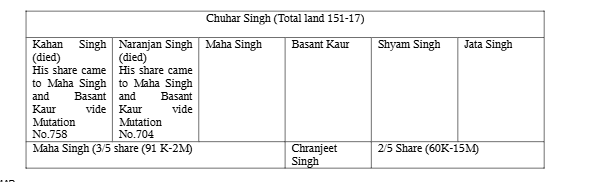
[3] After the death of Chuhar Singh, land was recorded in the name of his 05 sons with 1/5th share each. Thereafter, upon death of Kahan Singh and Naranjan Singh, their 1/5th share each was muted in the name of their heirs namely Maha Singh and Basant Kaur, respectively. By virtue thereof, Maha Singh became owner to the extent of 2/5th share in total.
[4] Later, around 07 kanals 13 marlas of land of the joint holdings, comprised in rectangle No.16 i.e. Kh/Kh No.33/50, 51 Khasra No.16//10/2min(3-11), 16//10/2min(3-11), [16//1010/1(0-18), 10/2(6-13), 11(0-2) came to be acquired vide notifications dated 24.06.2014 and 07.11.2014 under Section 3-A(1) and Section 3-D (1) of the Act. Revised award under Section 3(G) of the Act was passed on 28.07.2015.
[5] The grouse of the petitioner-Sadhu Singh who happened to be the son of Gurdev Singh son of Dalip Singh was that his grand-father-Dalip Singh had purchased 28 kanals 08 marlas of land from Maha Singh and Basant Kaur vide registered sale deed dated 15.07.1968 and thus, were entitled for the award of compensation as per the share. However, on the other hand, claim set up by respondent No.1-Amarjit Kaur was that she had purchased 04 kanals 14 marlas of land and 05 kanals 12.5 marlas of land from Charanjit Singh son of Basant Kaur vide two separate registered sale deed dated 07.08.2012 and 27.07.2015 and was thus, rightly awarded compensation as per her share in the acquired land. Aggrieved thereof, petitioner preferred petition under Section 3H (4) of the Act which came to be dismissed upon trial vide impugned decision dated 05.02.2020.
[6] Learned counsel for the petitioner submitted that out of the total land holding of Chuhar Singh, one of his son Maha Singh inherited 2/5th share whereas Basant Kaur inherited 1/5th share. However, both of them sold their entire share vide 08 different registered sale deed executed between 30.05.1962 till 15.07.1968 on different dates and thus as on the date when sale by Charanjit Singh son of Basant Kaur was made in favour of respondent No.1-Amarjit Kaur, he already had no rights or interest in the subject land and as such, no rights flow infavour of respondent No.1-Amarjit Kaur on the basis of sale deeds dated 07.08.2012 and 27.07.2015. Learned counsel for the petitioner also submitted that the learned Reference Court went wrong having discarded the registered sale deeds on the ground that aforementioned 08 different sale deeds were not proved on record as per the law of evidence. He further submits that in terms of Section 3 (H) read with Section 3(I) of the Act, the proceedings of apportionment were to be adjudicated upon by following the principles of natural justice rather than applying the strict principles of the Code of Civil Procedure or even those of the Indian Evidence Act. He also submits that dehors the proof of aforementioned 08 sale deeds, Charanjit Singh son of Basant Kaur not been left with any share in the joint property, which was duly established by the order dated 22.03.2002 passed by the learned Assistant Collector, Second Grade, Kharar and therefore, the impugned order was liable to be set aside.
[7] On the other hand, learned counsel for respondent No.1 while relying upon the reasoning and findings recorded by the learned Reference Court in its order dated 05.02.2020 submitted that in the abs


The competent authority under the National Highways Act lacks jurisdiction to resolve title disputes regarding compensation entitlement, which must be adjudicated by the civil court.

Once land is acquired and vests in the state, compensation obligations persist and cannot be negated by later claims of non-utilization.


The main legal point established in the judgment is that land on the road should be divided amongst all the co-sharers in proportion to their share in the total land holding, as per the Haryana Land ....



An indispensable Tool for Legal Professionals, Endorsed by Various High Court and Judicial Officers
Please visit our Training & Support
Center or Contact Us for assistance

Scan Me!
India’s Legal research and Law Firm App, Download now!


For Daily Legal Updates, Join us on :



 Back to top


