
 Back
Back





IN THE HIGH COURT OF ALLAHABAD
SAURABH SHYAM SHAMSHERY, J.
Prem Nath Mishra and Others – Appellants
Versus
State of Uttar Pradesh and Another – Respondents
Application U/s 482 No. 18853 of 2024
Decided On : 02-08-2024
CRIMINAL LAW - MULTIPLE PROCEEDINGS - Sections 323, 325, 504, 506 IPC; Section 2(d) Cr.P.C.; Sections 200, 202, 204, 210 Cr.P.C. - The court discussed the implications of multiple proceedings arising from the same set of facts, emphasizing the need to prevent abuse of the judicial process. It highlighted the importance of the trial court's role in curbing frivolous litigations and ensuring that proceedings are not pursued with malafide intentions. The court referenced the case of Krishna Lal Chawla, establishing that proceedings cannot continue simultaneously if they are intended to harass the accused. The court ultimately quashed the impugned order and remitted the matter for fresh consideration, ensuring that all relevant facts, including prior NCR filings, are duly considered.
Fact of the Case:
The case involves rival NCRs filed regarding an incident on 13.03.2021. The applicants faced charges under Sections 323, 325, 504 IPC after a charge sheet was filed for a cognizable offence. The complainant later filed a criminal complaint for additional charges under Sections 452 and 506 IPC, leading to the trial court summoning the applicants. The applicants challenged the legality of the trial court's order, arguing it constituted an abuse of process.
Finding of the Court:
The court found that the trial court had erred in summoning the applicants without considering the prior NCR and the charge sheet filed for non-cognizable offences. It emphasized the need for the trial court to assess the potential for abuse of process and to ensure that the proceedings were not frivolous or initiated with malafide intent.
Issues: Whether multiple proceedings based on the same facts can proceed simultaneously, and whether the trial court acted appropriately in summoning the applicants without considering the prior NCR and charge sheet.
Ratio Decidendi: The court established that the trial court has a duty to prevent frivolous litigations and to ensure that proceedings are not pursued with malicious intent. It reiterated the principle that multiple proceedings arising from the same facts cannot continue if they are intended to harass the accused, referencing the case of Krishna Lal Chawla.
Final Decision: The court quashed the impugned order summoning the applicants and remitted the matter back to the trial court for fresh consideration, ensuring that all relevant facts, including the prior NCR and charge sheet, are taken into account.
JUDGMENT :
SAURABH SHYAM SHAMSHERY, J.
1. In present case, it is not in dispute that in regard to alleged occurrence took place on 13.03.2021, rival NCR were lodged.
2. It is further not in dispute that in cross NCR filed by applicants, after investigation, since it was found that a cognizable offence took place, therefore, a charge sheet was filed under Sections 323, 325, 504 IPC wherein cognizance was taken and opposite party no. 2 and others were summoned.
3. It is further not in dispute that in the NCR filed by complainant herein, a charge sheet was filed only under Sections 323, 504 IPC on 18.03.2021 whereon vide order dated 03.04.2023, in terms of Section 2(d) Cr.P.C., the charge sheet was considered to be a complaint case and present applicants were summoned and that order was not challenged at the instance of either party.
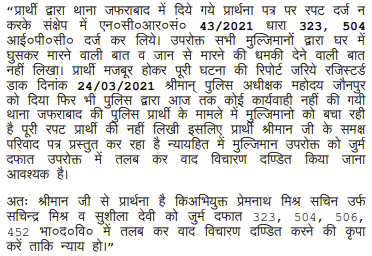
4. After filing of charge sheet as referred above for non-cognizable offence, complainant being felt aggrieved that no charge sheet was filed under Section 452 and 506 IPC i.e. cognizable offence, filed a criminal complaint on 01.10.2022 for same occurrence allegedly occurred on 13.03.2021. In the application, he has disclosed about NCR and for reference, relevant paragraph is mentioned below:
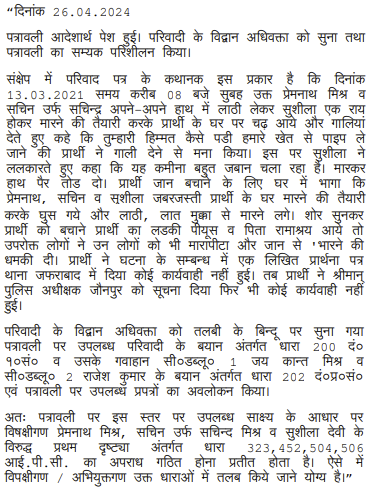
5. Aforesaid complaint was considered as a complaint case. Trial Court after considering statements recorded under Sections 200 and 202 Cr.P.C. summoned present applicants by impugned order dated 26.04.2024 under Sections 323, 452, 504, 506 IPC. For reference, said order in its entirety is quoted below:
6. Sri Deepak Upadhyay, learned counsel for applicants has heavily placed reliance on Krishna Lal Chawla and another vs. State of Uttar Pradesh and another, (2021) 5 SCC 435 that on similar set of facts as well as on similar set of allegations, proceedings arising out of police report as well as proceedings of complaint case could not proceed together if they are instituting by misleading the Court and abusing its process of law only with a view to harass the helpless litigants and relevant paragraphs thereof are quoted below:
“23. As aforesaid, the trial courts and the Magistrates have an important role in curbing this injustice. They are the first lines of defence for both the integrity of the criminal justice system, and the harassed and distraught litigant. We are of the considered opinion that the trial courts have the power to not merely decide on acquittal or conviction of the accused person after the trial, but also the duty to nip frivolous litigations in the bud even before they reach the stage of trial by discharging the accused in fit cases. This would not only save judicial time that comes at the cost of public money, but would also protect the right to liberty that every person is entitled to under Article 21 of the Constitution. In this context, the trial Judges have as much, if not more, responsibility in safeguarding the fundamental rights of the citizens of India as the highest court of this land.
24. As recorded by us above, the present controversy poses a typical example of frivolous litigants abusing court process to achieve their mischievous ends. In the case before us, the Magistrate was aware of the significant delay in the filing of private complaint by Respondent 2, and of the material improvements from the earlier NCR No. 158 of 2012 which were made in the private complaint. It was incumbent on the Magistrate to examine any possibility of abuse of process of the court, make further enquiries, and dismiss the frivolous complaint at the outset after judicial application of mind.
25. However, this was not done - the Magistrate issued process against the appellants by order dated 4-4-2019, and this controversy has now reached this Court for disposal.
26. It is a settled canon of law that this Court has inherent powers to prevent the abuse of its own processes, that this Court shall not suffer a litigant utilising the institution of justice for unjust means. Thus, it would be only proper for this Cour
AI

Filing multiple complaints for the same occurrence constitutes an abuse of process, and courts must prevent frivolous litigations.


The court reaffirmed that inherent powers under Section 482 of the Cr.P.C. are to prevent abuse of process and ensure justice, requiring substantial grounds for quashing proceedings.
Cognizance of non-cognizable offences must follow complaint procedure, and any delay in cognizance is barred by limitation under the Code of Criminal Procedure.

Point of law : Defamation - In case of criminal defamation neither any FIR can be filed nor can any direction be issued under Section 156(3) of Cr.P.C.

The court emphasized that the Magistrate, at the stage of taking cognizance and summoning, is required to apply judicial mind only to find out whether a prima facie case has been made out for summoni....
Judicial Magistrates must follow procedural requirements for taking cognizance of non-cognizable offenses, treating police reports as complaints and ensuring fair opportunity to the accused.



An indispensable Tool for Legal Professionals, Endorsed by Various High Court and Judicial Officers
Please visit our Training & Support
Center or Contact Us for assistance

Scan Me!
India’s Legal research and Law Firm App, Download now!


For Daily Legal Updates, Join us on :



 Back to top


