Back
Back





2024 Supreme(All) 1481
IN THE HIGH COURT OF JUDICATURE AT ALLAHABAD
SAURABH SHYAM SHAMSHERY, J.
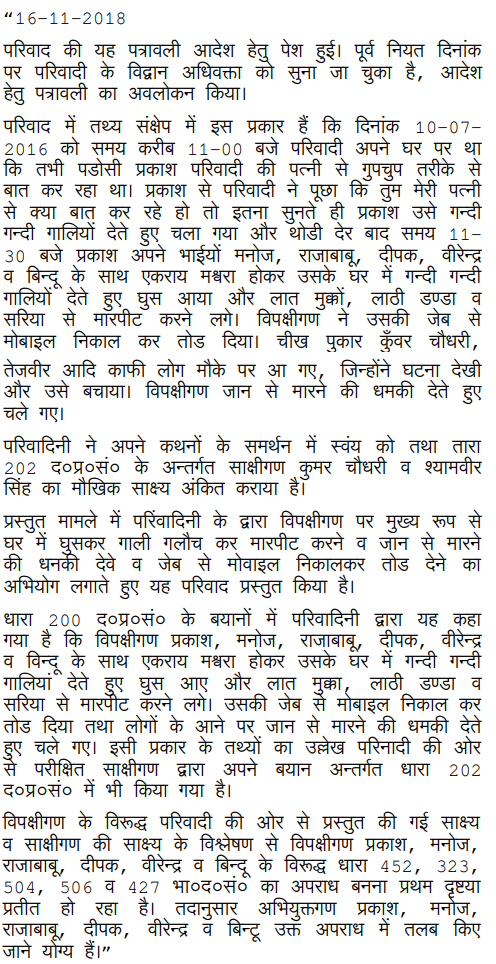
Prakash And Others – Applicants
Versus
State of Uttar Pradesh and Another - Opposite Parties
Application U/S 482 No. 9885 Of 2024
Decided On : 06-08-2024
For the Applicants : Mayank Pratap Singh.
For the Opposite Parties : Dharmendra Pratap Singh, G.A.
IMPORTANT POINT
Filing multiple complaints for the same occurrence constitutes an abuse of process, and courts must prevent frivolous litigations.
Headnote:
(A) Criminal Procedure Code, 1973 - Sections 155(2), 204, 210 - Multiple proceedings arising from the same occurrence - The court emphasized that filing multiple complaints for similar alleged occurrences constitutes an abuse of process of law, and the trial courts have a duty to prevent frivolous litigations. (Paras 7, 11, 12, 15)
(B) Abuse of Process - The court reiterated that inherent powers exist to quash proceedings that are instituted with mala fide intentions or to harass the accused. (Paras 11, 12)
Facts of the case:
The complainant lodged an NCR against several applicants for offences under IPC sections, followed by a criminal complaint that included additional applicants, leading to a summoning order by the trial court.
Findings of Court:
The court found that the trial court failed to consider the prior NCR and charge sheet, leading to an erroneous summoning order.
Issues: The main issue was whether multiple proceedings on the same facts could proceed simultaneously without constituting an abuse of process.
Ratio Decidendi: The court ruled that the trial court must consider the potential for abuse of process when multiple proceedings arise from the same facts.
Result: Orders of the trial court were set aside and the matter was remitted for fresh consideration.
JUDGMENT :
(Saurabh Shyam Shamshery, J.)
1. In the present case, on basis of alleged occurrence took place on 10.07.2016, complainant has lodged an NCR on 11.08.2016 i.e. about 1 month against Prakash, Manoj, Raja Babu and Bintu (applicants no. 1 to 3 and 6) for offence under Sections 323, 504, 427 IPC.
2. The complainant thereafter has filed an application under Section 155(2) Cr.P.C. for investigation disclosing names of all six applicants and that they have committed offences under Sections 323, 504, 427 IPC wherein vide order dated 16.08.2016, a direction was passed for investigation. Consequently investigation was conducted on above referred NCR and a charge sheet was submitted on 03.01.2017 against above referred 4 applicants under Sections 323, 504, 427 IPC.
3. The trial Court considered above referred charge sheet as a complaint under provisions of Section 2(d) Cr.P.C. and summoned above referred 4 applicants under Sections 323, 504, 427 IPC vide order dated 18.03.2017.
4. Controversy involved in present case arose when before above referred charge sheet was filed on 03.01.2017, the complainant approached Court of a Magistrate by way of filing a criminal complaint on 17.09.2016 not only above referred 4 applicants but other two applicants (applicants no. 4 and 5) that they were involved in above referred occurrence allegedly took place on 10.07.2016 and have committed cognizable offence under Sections 452, 323, 504, 506, 427 IPC. In complaint, factor of filing NCR was disclosed with an allegation that correct facts and name of all assailants were not correctly recorded.
5. In aforesaid complaint, learned Magistrate recorded statement of complainant and witnesses respectively under Section 200 and 202 Cr.P.C. (on 09.12.2016, 21.01.2017 and 17.07.2018) and thereafter vide order dated 16.11.2018 passed under Section 204 Cr.P.C. summoned all applicants to face trial for offence under Sections 452, 323, 504, 506, 427 IPC. It would be relevant to refer here that statement of complainant Nawab Singh and witness Kunwar Singh were earlier recorded by police during investigation of NCR but this fact was not disclosed in their subsequent statement recorded in criminal complaint case as well as they have disclosed involvement of only 4 applicants therein.
6. Applicants being aggrieved by above summoning order have filed a revision petition mainly on ground that on same occurrence, complainant has already filed an NCR wherein name of only 4 applicants were mentioned for committing non-cognizable offence, on which investigation was conducted and a charge sheet under non-cognizable offence against only 4 applicants was filed and which was treated as a complaint case and summons were issued. Aforesaid facts were suppressed at least during arguments and trial Court has also not taken endeavour to call a report on it and erroneously summoned the applicants.
7. In support of above grounds, Sri Rishi Bhushan Johari, Advocate holding brief of Sri Mayank Pratap Singh, learned counsel for applicants has placed reliance on Krishna Lal Chawla and others vs. State of Uttar Pradesh and others, (2021) 5 SCC 435 and Kapil Agarwal and others vs. Sanjay Sharma and others, (2021) 5 SCC 524 that filing of multiple complaints for similar alleged occurrence by improving earlier version, would be considered as abuse of process of law.
8. Sri Dharmendra Pratap Singh, learned counsel for opposite party-2 and learned AGA for State have not disputed aforesaid facts on basis of record but they submitted that there is no legal bar in lodging NCR and complaint case on same occurrence and in such event, procedure prescribed under Section 210 Cr.P.C. would be applicable.
9. Heard learned counsel for parties and perused the record.
10. As referred above, it is not disputed that on basis of same occurrence, two proceedings were initiated, one arising out of charge sheet filed on basis of non-cognizable report wherein after investigation, a charge sheet was filed for non-cogn