
 Back
Back





IN THE HIGH COURT OF ALLAHABAD
AJIT KUMAR, J.
Measures Sarnath Auto Zone Pvt. Ltd. – Appellant
Versus
Measures Span Infra Developers Pvt. Ltd. – Respondent
Civil Revision No. 35 of 2024
Decided On : 31-05-2024
LIMITATION - SPECIFIC PERFORMANCE OF CONTRACT - Limitation Act, 1963 - Article 54; Code of Civil Procedure - Order 7 Rule 11 - The court analyzed the provisions of Article 54 of the Limitation Act, 1963, which stipulates that for a suit for specific performance, the limitation period begins either from the date fixed for performance or, if no date is fixed, from the date the plaintiff receives notice of refusal. The court interpreted the absence of a fixed date in the agreement for sale and the conditions surrounding the execution of the sale deed, concluding that the limitation period was a mixed question of law and fact, requiring evidence to determine if the suit was filed within the prescribed time.
Fact of the Case:
The petitioner challenged the order of the Civil Judge rejecting a miscellaneous application to dispose of a plea under Order 7 Rule 11 CPC, arguing that the suit for specific performance was barred by limitation as it was filed beyond three years from the date of the agreement for sale executed on 12.09.2012.
Finding of the Court:
The court found that the agreement did not specify a fixed date for the execution of the sale deed, and the limitation period was contingent upon the resolution of disputes regarding the property. The court concluded that the issue of limitation was a mixed question of law and fact that required evidence to resolve.
Issues: Whether the suit for specific performance was barred by limitation under Article 54 of the Limitation Act, 1963, and whether the trial court erred in rejecting the application under Order 7 Rule 11 CPC.
Ratio Decidendi: The court held that the absence of a fixed date for performance in the agreement meant that the limitation period would begin when the plaintiff received notice of refusal. The court emphasized that the determination of limitation was not straightforward and required factual evidence regarding the disputes over the property.
Final Decision: The court upheld the trial court's order, stating that there was no manifest error in its decision and directed that the issue of limitation under Order 7 Rule 11 CPC be treated as a preliminary issue to be decided before any other issues.
JUDGMENT :
AJIT KUMAR, J.
1. Heard Sri Rakesh Pandey, learned Senior Advocate assisted by Sri Satish Chandra Dubey, learned counsel for the petitioner and Ms. Shreya Gupta, learned counsel for the contesting respondent.
2. Petitioner before this court has questioned the order passed by Civil Judge (Senior Division), Bareilly rejecting the misc. application filed by the petitioner being paper no. 36-C requesting for disposal of misc. application filed under Order 7 Rule 11 CPC first before proceeding with suit.
3. The argument advanced by learned counsel for the petitioner was that the court was to hear and dispose of application filed under Order 7 Rule 11 CPC for rejection of the plaint, if it appeared from bare pleadings raised in the plaint that suit was barred by law. Learned counsel for the petitioner submitted that for a decree of specific performance of contract, the limitation prescribed under Article 54 of Second Schedule of Limitation Act, 1963 was three years and according to him from the pleadings raised in the plaint, it was apparently an admitted position that agreement for sale was executed on 12.09.2012. Thus according to him limitation to maintain a suit would be upto 3 years whereas the suit had been instituted in the year 2020 as the plaint was verified and presented on 07.12.2020. It was also submitted that in paragraph 5 of the plaint it was pleaded that there were two suits going on being O.S. Nos.843 of 2012 and 758 of 2012 relating to the property which was subject matter of agreement for sale and which came to be finally decided on 26.10.2020 and 30.07.2020 respectively but there was no statement of fact pleaded that there was any interim order operating in favour of the parties not to dispose of the suit land during pendency of the suit proceedings. Thus according to him, petitioner was not restrained by any order of court from executing the sale deed pursuant to the agreement for sale. Learned Senior Advocate has placed reliance upon judgment of the Supreme Court in the case of Ahmadsahab Abdul Mulla (Dead) v. Bibijan and others, (2009) 5 SCC 462 in support of his arguments and prayed to interfere with the order in my exercise of jurisdiction under Section 115 of Code of Civil Procedure.
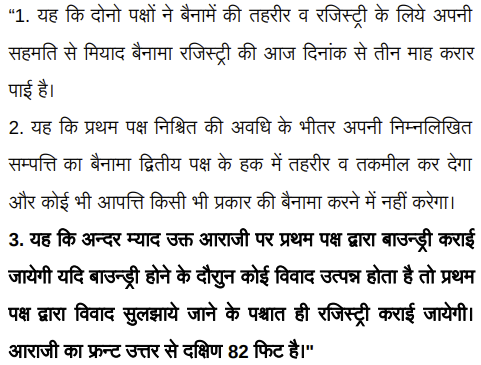
4. Per contra, it was argued by learned counsel appearing for the contesting respondents, Ms. Shreya Gupta that in view of the limitations as contained under Article 54 of Part 2 of Schedule of Limitation Act, 1963, in the event date was not fixed for performance, the limitation of three years period would start when the plaintiff received a notice of refusal of performance by the proposed vendor. In support of her argument she took the Court to the pleadings raised in paragraphs 4 and 7 of the plaint in which a categorical statement had been made that the last notice sent to the defendant on 03.11.2020 was not replied to and it was for the first time on 30.11.2022 that the defendants refused to execute agreement for sale except on payment of a higher price towards sale consideration. Thus according to her in view of Article 54 cause of action accrued to file a suit on 30.11.2020 only and so the presentation of the suit on 07.12.2020 was well within the time prescribed for. She also took the Court through the document of agreement for sale in which vide paragraph 1 it was stated that the petitioner would get the sale deed registered within three months from the date of agreement for sale and vide paragraph 3 thereof it was stated that the boundary wall will be constructed within a period of 3 months and if there would be any dispute then any registry will be done only after the resolution of such dispute.
5. Ms. Gupta submitted that those two suits were going on relating to the property in question and there was some serious boundary dispute and that is why no boundary was constructed within prescribed period of three months of execution of agreement for sale. She submitted that vide paragraph 4 of the plaint it was clearl
AI
The absence of a fixed date for performance in a contract for sale means that the limitation period for filing a suit for specific performance begins when the plaintiff receives notice of refusal, ma....


The issue of limitation for specific performance of a contract is a mixed question of fact and law, and the plaint cannot be rejected solely based on the averments in the plaint.


The court ruled that a civil suit for specific performance must be filed within three years from the refusal to perform, reinforcing that delay and lack of sufficient pleading detail bar such claims.

Contractual obligations in specific performance suits require timely action; failure to act within statutory limitation renders claims void.



An indispensable Tool for Legal Professionals, Endorsed by Various High Court and Judicial Officers
Please visit our Training & Support
Center or Contact Us for assistance

Scan Me!
India’s Legal research and Law Firm App, Download now!


For Daily Legal Updates, Join us on :



 Back to top


