
 Back
Back





IN THE HIGH COURT OF ALLAHABAD
SAURABH LAVANIA, J.
Kalavati Devi @ Kalavati – Appellant
Versus
State Of U.P. Thru. Prin. Secy. Deptt. Of Home Lko And Another – Respondent
APPLICATION U/S 482 No. - 363 of 2025
Decided on : 31-01-2025
(A) Indian Penal Code, 1860 - Section 420 - Criminal Procedure Code, 1973 - Section 239 - Discharge application - The applicant, as Gram Pradhan, verified an affidavit for a housing scheme, later found false - The Magistrate and Revisional Court dismissed discharge applications - Court found that the essential ingredients of cheating were not made out, as no fraudulent intention was established - The courts below failed to record reasons for their decisions, violating principles of natural justice. (Paras 16, 18, 20, 22, 34)
(B) Recording of Reasons - Judicial orders must be supported by reasons to ensure transparency and fairness, allowing for meaningful appeal. (Paras 17, 18, 20, 34)
Facts of the case:
The applicant verified an affidavit for a housing scheme, which was later found to be false regarding the applicant's knowledge of the affiant's housing status. The application for discharge was rejected by the Magistrate and affirmed by the Revisional Court.
Findings of Court:
The essential ingredients of Section 420 IPC were not made out, and the lower courts did not record sufficient reasons for their decisions.
Issues: Whether the applicant's actions constituted cheating under Section 420 IPC and whether the lower courts provided adequate reasoning for their rulings.
Ratio Decidendi: The court ruled that the prosecution failed to establish fraudulent intent necessary for the charge of cheating, and the lower courts' lack of reasoning violated natural justice principles.
Result: Application allowed; orders set aside, case remanded for fresh consideration.
JUDGMENT
1. Heard Sri Sharad Pathak and Sri Gaurav Shukla, learned counsel for the applicant and Sri Alok Kumar Tiwari, learned A.G.A. for the State and perused the record.
2. The present application has been filed seeking following main relief(s):-
I. Impugned order dated 23.11.2024, passed by Additional District and Sessions Judge, Barabanki (Court No.5), in Criminal Revision No.94/2023, contained in Annexure No. 1 to this petition;
II. Impugned order 15.03.2023, passed by Additional Chief Judicial Magistrate, Barabanki (Room No.25), on Case Crime No.186/2020, under Section 420 Indian Penal Code, Police Station Dariyabad, District Barabanki, contained in Annexure No.2 to this petition. The application for discharge filed by the Petitioner under Section 239 Cr.P.C. may be allowed and the Petitioner may be discharged in proceedings at Case Crime No.186/2020, under Section 420 Indian Penal Code, at Police Station Dariayabad, District Barabanki.
3. Vide impugned order dated 15.03.2023 passed in the case registered as CNR No. UPBB 040149722021 (State Versus Kalawati and Others), arising out of Crime No. 186 of 2020 under Sections 420 IPC , Police Station Dariabad, District Barabanki, the Additional Chief Judicial Magistrate, Room No.4, Barabanki (in short 'Magistrate'), rejected the application of the applicant seeking discharge preferred under Section 239 Cr.P.C. The order dated 15.03.2023 is extracted hereinunder:-
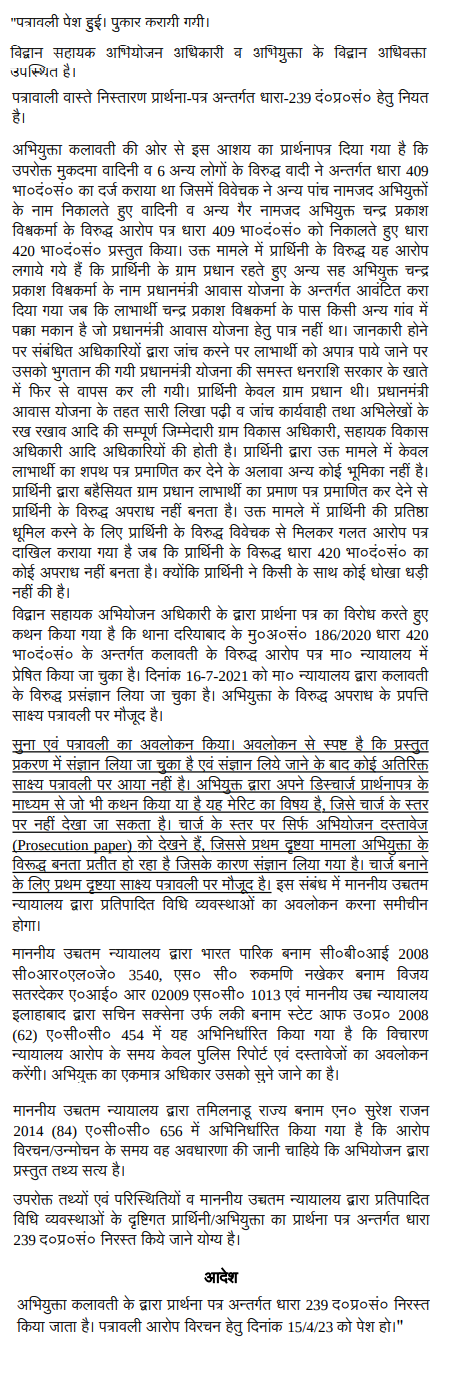
4. Being aggrieved by the order dated 15.03.2023 passed by the Magistrate, the applicant filed the revision registered as CNR No. UPBB010046682023.
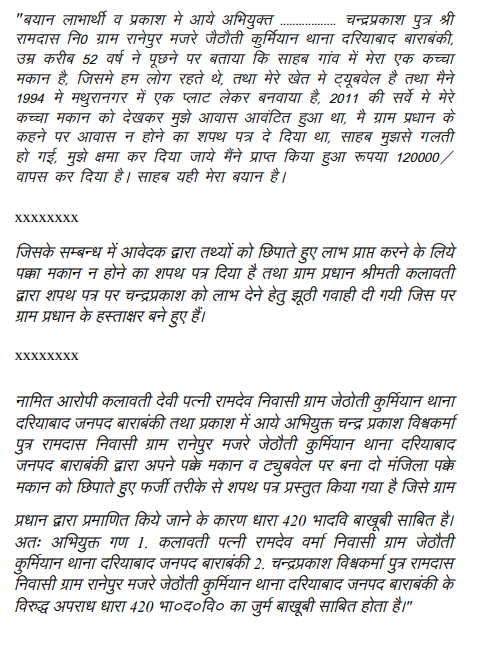
5. The Additional District and Sessions Judge, Court No.5, Barabanki (in short 'Revisional Court') vide impugned order dated 23.11.2024 dismissed the revision and affirmed the order of Magistrate dated 15.03.2023. The relevant portion of order dated 23.11.2024 reads as under:-

6. Impeaching the impugned order(s) it is stated that the case of prosecution against the applicant, in nutshell, is to the effect that the applicant being Gram Pradhan of Village Jethauti Kurmiyan, District Barabanki verified the contents of affidavit of one Chandra Prakash Vishwakarma r/o Ranepur hamlet of Village-Jethauti, Kurmiyan, Police Station-Dariyabad, District- Barabanki, which he filed to get the benefit of the scheme known as "Pradhanmantri Awas Yojna', indicating therein that he has no 'iDdk edku/Pakka Makan' i.e. 'Brick House' in the Village, which in fact was correct as in enquiry/investigation, it was found that Chandra Prakash Vishwakarma is having a house in Village Mathura Nagar and considering these facts of the case the applicant ought to have been discharged as offence under Section 420 IPC against the applicant is not made but without recording reasons after considering the facts of the case in the light of the law settled, the Magistrate as also the Revisional Court passed the impugned order(s) and being so the same are liable to be interfered by this Court.
7. In support of his submissions reliance has been placed on the judgments indicated hereinafter.
8. Referred paragraphs of judgment passed in the case of Anil Kumar Bose v. State of Bihar, (1974) 4 SCC 616, are as under:-
"11. For the purpose of holding them guilty, the evidence adduced must establish beyond reasonable doubt, mens rea on their part. We will, therefore, consider the case of each appellant from that aspect. With regard to the Accountant, Raghunath Prasad, the evidence relied upon by the High Court for its conclusion of guilt of this appellant may be Ext. 1 is the Duty Chart of the Accountant. The first item of this chart is 'sole in charge of accounts and to exercise general supervision on all staff working under him for the efficient working of the Accounts Section'. The third item of this Chart is To complete the Bill Book and get it checked and signed by the Dy. Superintendent'. I must point out that this duty has not been performed by the Accountant in the case of these disputed bills. The fifth item of his duty
To establish an offence under Section 420 IPC, fraudulent intent must be shown; mere verification of a false affidavit without intent does not constitute cheating.

The court ruled that mere failure to keep a promise cannot constitute cheating; intention to deceive must exist at the time of the promise.


A breach of contract does not constitute cheating unless fraudulent intent is proven at the outset of the agreement, as established in relevant legal precedents.

The prosecution must establish beyond a reasonable doubt the elements of cheating and conspiracy, including dishonest intent and the specific role of accused in the alleged fraud.


The Court held that the inherent power of the High Court under Section 482 CrPC can be exercised to quash a criminal proceeding if it is found that the proceeding is an abuse of the process of the Co....

(1) Dishonest inducement is sine qua non to attract provisions of Sections 415 and 420 of IPC.(2) Any effort to settle civil disputes and claims which do not involve any criminal offence, by applying....
The court affirmed that criminal proceedings cannot be used as leverage in civil disputes, emphasizing the need for proof of dishonest intent and necessary ingredients for offences claimed. Lack of v....



An indispensable Tool for Legal Professionals, Endorsed by Various High Court and Judicial Officers
Please visit our Training & Support
Center or Contact Us for assistance

Scan Me!
India’s Legal research and Law Firm App, Download now!


For Daily Legal Updates, Join us on :



 Back to top


