
 Back
Back





IN THE HIGH COURT OF ALLAHABAD, LUCKNOW BENCH
CHANDRA KUMAR RAI, J.
Jitendra - Appellant
Versus
State Of U.P. And 4 Others - Respondent
Writ B No. 2525 of 2024, Writ - B No. - 318 of 2025
Decided on : 25-07-2025
| Table of Content |
|---|
| 1. introduction of parties and procedural history of the case. (Para 1 , 4 , 7) |
| 2. dispute over succession involving shanti devi. (Para 2 , 8 , 11) |
| 3. arguments on rightful heirs under u.p.z.a. and l.r. act. (Para 5 , 6) |
| 4. legal rules regarding inheritance and application of sections 171-175. (Para 9 , 10 , 12 , 13 , 14) |
| 5. application of the principle of survivorship. (Para 15 , 16 , 17) |
| 6. final dismissal of writ petitions without costs. (Para 18) |
JUDGMENT :
CHANDRA KUMAR RAI, J.
1. Heard Mr. R.C. Singh, learned Senior Counsel assisted by Mr. Kamlesh Sharma, learned counsel for the petitioner, Mr. Dhirendra Singh/ Mr. J.P. Singh, learned counsels for the private respondents and Mr. P.S. Chauhan, learned Standing Counsel for the State respondents in both the petitions.
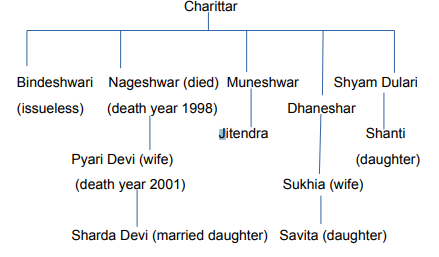
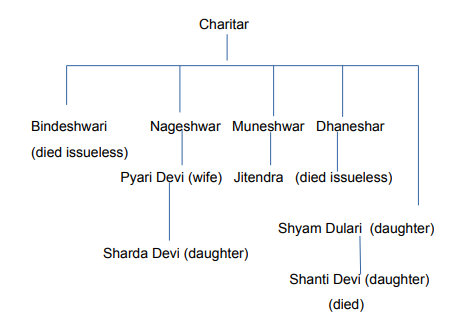
2. Brief facts of the case are that dispute relates to chak No. 151 situated in Village Luduhi, Pargana-Ghosi, District Mau. The family pedigree of the parties is mentioned in paragraph No.6 of Writ B No. 2525 of 2024. The family pedigree demonstrate that one Charittar had four sons (Bindeshwar, Nageshwar, Muneshwar and Dhaneshwar) and one daughter (Shyam Dulari). The pedigree further demonstrate that Bindeshwar and Dhaneshwar died issueless. Nageshwar had died leaving behind his widow Pyari Devi and from the wedlock of Nageshwar and Pyari Devi, two daughters (Sharda and Sheela) were born. Sharda is private respondents in both the writ petitions. Muneshwar had died leaving behind his son Jitendra who is petitioner in both the writ petitions and Shyam Dulari died leaving behind her daughter (Shanti). During consolidation proceeding in the Village in question, C.H. Form 23 was distributed in the name of Shanti Devi (daughter of Shyam Dulari) in respect to chak No. 151. Subsequently the C.H. Form 45 was prepared and new plot No. 302 area 1 acre 86 kari was carved out in the name of Shanti Devi. Shanti Devi had expired accordingly application under Section 12 of U.P. Consolidation of Holdings Act, 1953 hereinafter referred to as U.P.C.H. Act was filed by petitioner claiming right on the basis of the provisions contained under Section 171 of the U.P. Zamindari Abolition and Land Reforms Act, 1950 hereinafter referred to as U.P.Z.A. and L.R. Act. The aforementioned proceeding under Section 12 of the U.P.C.H. Act was initiated before issuance of notification under Section 52 of the U.P.C.H. Act. The Assistant Consolidation Officer passed an order dated 23.2.1983 to record the name of petitioner/ Jitendra in the place of Shanti Devi. Against the order dated 23.2.1983 passed by Assistant Consolidation Officer, one Nageshwar, son of Charittar filed a revision under Section 48 of the U.P.C.H. Act along with the prayer for condonation of delay. The aforementioned revision was heard and allowed by Deputy Director of Consolidation vide order dated 30.9.2014 after condoning the delay in filing the revision and remitted the matter back before the Consolidation Officer setting aside the order dated 23.2.1983 passed by Assistant Consolidation Officer for fresh decision of the proceeding/ application under Section 12 of the U.P.C.H. Act. In pursuance of the remand order passed by Deputy Director of Consolidation, the matter was proceeded before the Consolidation Officer and an issue was framed to the effect as who is the legal heir of Smt. Shanti Devi (daughter of Shyam Dulari). Consolidation Officer passed an ex-parte order on 18.5.2016 accordingly petitioner filed a restoration application which was dismissed by Consolidation Officer vide order dated 26.12.2018. Against the orders dated 18.5.2016 and 26.12.2018 passed by Consolidation Officer, appeal was preferred by petitioner/ Jitendra before the Settlement Officer of Consolidation. The aforementioned appeal was heard and allowed by Settlement Officer of Consolidation vide order dated 7.12.2019 setting aside the orders dated 18.5.2016/ 26.12.2018 and directed to record the name of petitioner/ Jitendra and Sharda Devi
AI
Succession rights under U.P. Zamindari Abolition and Land Reforms Act are governed by principles of survivorship for heirs, as per Sections 171 and 175, validating joint succession claims.

Property inheritance claims based on will versus statutory succession are to be thoroughly assessed, considering criminal convictions affecting rights under the Hindu Succession Act.
The court affirmed the principle that title objections must be decided on merit rather than based on previous compromises, ensuring fair opportunity for parties to present evidence.
The Deputy Director of Consolidation exceeded jurisdiction by not considering the limitation and locus standi of the respondents in appeals under the U.P. Consolidation of Holdings Act.

Substantial justice must be served in property succession cases, even if procedural irregularities exist, as per statutory provisions.
The Deputy Director of Consolidation has jurisdiction to restore revisions for adjudication; adherence to procedural fairness and inclusion of all parties is mandated under the U.P. Consolidation of ....
The civil court's decree in an injunction suit cannot be enforced under the U.P. Consolidation of Holdings Rules, affirming the jurisdiction of consolidation authorities.
Succession rights for women under the U.P. Z.A. & L.R. Act prioritize female heirs over husbands, as established in Sections 172 and 174.
Succession rights for female tenure holders are governed by Section 172 of the U.P. Land Revenue Act, denying rights to husbands in such cases.



An indispensable Tool for Legal Professionals, Endorsed by Various High Court and Judicial Officers
Please visit our Training & Support
Center or Contact Us for assistance

Scan Me!
India’s Legal research and Law Firm App, Download now!


For Daily Legal Updates, Join us on :



 Back to top


