Back
Back





2025 Supreme(All) 2975
IN THE HIGH COURT OF ALLAHABAD
Ajit Kumar, J.
Dharm Dev Maurya -Petitioner
Versus
State of UP And Others - Respondents
Writ - A No. - 2377 of 2024
Decided On : 14-07-2025
Advocate Appeared:
For the Petitioner: Raghavendra Singh, Suvarna Singh, Upendra Singh
For the Respondent: C.S.C.
Disciplinary authorities must adhere to procedural regulations and cannot impose penalties not prescribed in discipline rules, ensuring due process and fairness.
Headnote:(A) Constitution of India - Article 226 - Disciplinary action - Warning issued to petitioner after exoneration in domestic inquiry - Disciplinary authority acted improperly by not following due process, including issuing notice prior to imposing warning - No punishment prescribed for warning under relevant rules. (Paras 2, 5, 9 and 10)
(B) Legal principles - A disciplinary authority is not permitted to impose penalties that are not specified in the governing discipline regulation. The authority must either agree with the inquiry officer's findings or sufficiently disagree by providing appropriate notice to the delinquent employee before imposing any penalty. (Paras 8, 9 and 10)
Facts of the case:
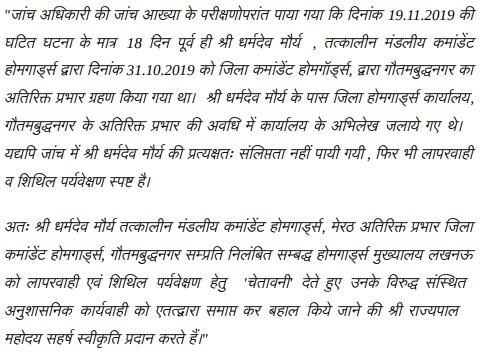
The petitioner was issued a warning based on a domestic inquiry that exonerated him. The disciplinary authority reinstated him, yet issued a warning without notice, relying on findings that contradicted the inquiry report.
Findings of Court:
The warning is quashed due to lack of lawful authority, as it was not prescribed as a penalty by the Discipline and Appeal Rules, reinforcing that penalties must be supported by the inquiry's findings.
Issues: Whether the disciplinary authority could issue a warning after an exoneration without due process, and whether such a warning is permissible under the applicable rules.
Ratio Decidendi: The court held that disciplinary authorities must adhere to procedural requirements and cannot impose penalties not prescribed by law, thereby ensuring fairness and due process in disciplinary proceedings.
Result: Petition allowed; warning quashed.
| Table of Content |
|---|
| 1. assessment of disciplinary proceedings and procedural rules. (Para 2 , 3) |
| 2. arguments presented by both parties. (Para 4) |
| 3. court's evaluation of the disciplinary authority's actions. (Para 5 , 6 , 8 , 9 , 10 , 11) |
| 4. court's directive regarding procedural conformity. (Para 7) |
| 5. final ruling and quashing of the disciplinary order. (Para 12) |
JUDGMENT :
Hon'ble Ajit Kumar, J.
1. Heard Shri Vibhu Rai and Shri Upendra Singh, learned counsel appearing for the petitioner and learned Additional Chief Standing Counsel appearing for the State-respondent.
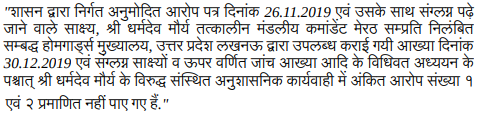
2. By means of this petition filed under Article 226 of the Constitution, petitioner has assailed the order dated 03.12.2020 passed by the Under Secretary, Government of Uttar Pradesh issuing him warning as a sequel to the disciplinary proceeding accepting the domestic inquiry report and directing for reinstatement of the petitioner revoking the order of suspension. Assailing the order dated 03.12.2020, three fold arguments have been advanced by learned counsel for the petitioner:
(A) Once the disciplinary authority has proceeded to accept the domestic inquiry report in which the delinquent employee was exonerated of the charges leveled in the charge sheet, there was no occasion for the respondent disciplinary authority to have issued warning to such delinquent employee as a consequence to the domestic inquiry;
(B) The disciplinary authority was not justified even in issuing warning without disagreeing with the findings of inquiry report submitted by the inquiry officer in the domestic inquiry and that too without issuing any notice to the petitioner, delinquent employee to show cause as to why the domestic inquiry report may not be partially rejected to issue such a warning;
(C) There is no punishment as such prescribed under punishment and appeal rules namely Uttar Pradesh Government Servant (Discipline and Appeal) Rules, 1999 (hereinafter referred to as 'The Rule, 1999') either by way of minor penalty or major penalty and hence the order is bad for want of authority in law, inasmuch as for want exercise of lawful authority by the disciplinary authority.
Sufficient pleadings have came to be raised qua above grounds in various paragraphs of the petition and more specifically in paragraph nos. 46, 47, 48, 49 and 50 that run as under:-
"46. That the impugned order itself is non speaking order and the same is baseless and without any reason and the grounds and reasons as given by the petitioner in his representation dated 11.10.2022 as well as 11.11.2022 has not been considered and without considering the reasons and grounds in regard to cancel the 'Chetawani' against the petitioner has been decided.
47. That the said impugned order dated 24.05.2023 is not speaking and liable to be set aside.
48. That the impugned order dated 24.05.2023 is arbitrary and illegal.
49. That there is no reason and occasion to give the 'Chetawani' being no fault of the petitioner, however the inquiry report as well as request of the respondent no. 2 itself is clear that the petitioner is not guilty and as such he has been exonerated from all charges by the inquiry officer and letter of the respondent no. 2 to the respondent no. 2 in regard to revoking the suspension of the petitioner is very clear.
50. That the disciplinary authority cannot punish anyone without reason or material on record but in the present case the respondent has given the 'Chetawani' against the petitioner merely on the basis of surmises and conjectures, the said action of the respondent is illegal arbitrary and baseless and not sustainable in the eyes of law."
3. It is next contended by learned counsel appearing for the petitioner that in view of the Government order dated 27.09.2019 for the purposes of consideration of promotion and allotment of marks five marks may be deducted qua punishment of 'warning' issued to an employee. He contends further that according to government order five marks could be deducted only for the warning i