Back
Back





2025 Supreme(All) 3536
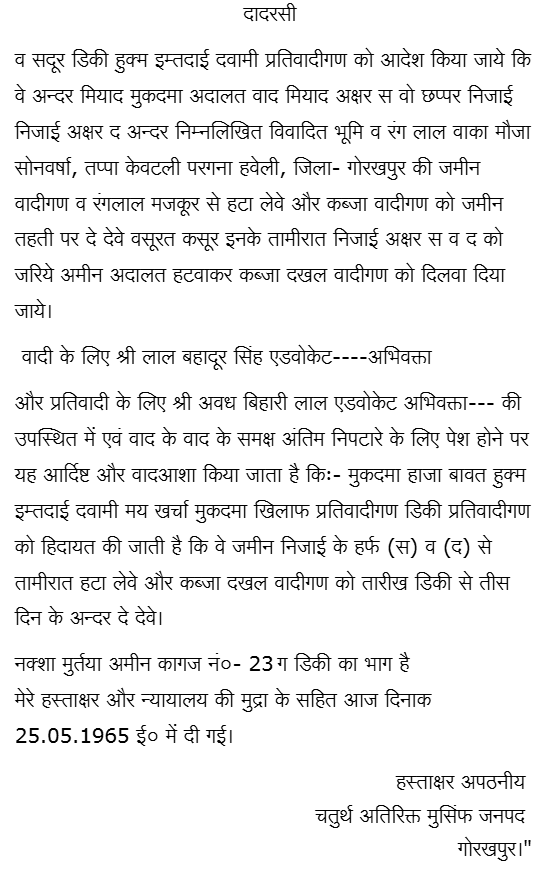
HIGH COURT OF JUDICATURE AT ALLAHABAD
MANISH KUMAR NIGAM, J.
Ghanshyam and others - Petitioners
Versus
Tulsi and others – Respondents
Matters Under Article 227 No. 10979 of 2023
Decided On : 13-11-2025
For the Petitioners: Ashok Kumar Shukla
For the Respondents: Gautam.
One joint decree-holder may apply for execution for the benefit of all unless expressly stated otherwise; courts can assess intent beyond strict decree wording.
Headnote:(A) Civil Procedure Code - Section 47 & Order XXI Rule 15 - Execution of joint decree - Petitioners challenged execution based on non-compliance of rules pertaining to joint decree-holders - Court ruled one decree-holder can execute warrant if intended for all unless specified otherwise - Execution upheld despite certain mapping ambiguities. (Paras 8, 12, 24)
(B) The executing court's jurisdiction includes assessing the decree's intent and details surrounding its execution rather than being solely confined to its literal drafting. (Paras 21, 22)
Facts of the case:
Joint decree obtained in 1965 for possession; the petitioners contested its execution, arguing that the execution application lacked necessary details to benefit all decree holders, and that the map did not properly identify the property. (Paras 3, 19)
Findings of Court:
No illegality in lower courts' decisions; execution proceedings are to be allowed to continue. (Para 24)
Issues: Validity of execution by one decree-holder, whether the decree was sufficiently identified in the execution application. (Paras 4, 6)
Ratio Decidendi: It is permissible for one decree-holder to file for execution unless expressly conditioned otherwise; courts retain the discretion to ascertain the detail and intent of a decree. (Paras 12, 23)
Result: Writ petition dismissed with directions to expedite execution proceedings.
| Table of Content |
|---|
| 1. background and procedural history of the case. (Para 2 , 3) |
| 2. arguments related to the execution application's validity. (Para 4 , 5) |
| 3. analysis of order xxi rule 15 cpc regarding execution. (Para 6 , 7 , 8 , 9 , 10) |
| 4. interpretation of joint decree-holder's execution rights. (Para 11 , 12 , 16) |
| 5. identifying property and executing despite omissions. (Para 19 , 21 , 23) |
| 6. final decision and directive for expeditious execution. (Para 24 , 25) |
JUDGMENT :
MANISH KUMAR NIGAM, J.
1. Heard Sri A.K. Shukla, learned counsel appearing for the petitioners and Sri Gautam, learned counsel for the respondents.
2. This petition has been filed challenging the order dated 27.10.2017 passed Additional Civil Judge, Court No. 3, Gorakhpur rejecting the objections filed by the judgment debtor-petitioners under Section 47 C.P.C. (registered as Misc. Case No. 80 of 1980) in execution case No. 158 of 1979 (Ghanshyam and others Vs. Lorik and others) and order dated 06.09.2023 passed by Additional District Judge, Court No. 1, Gorakhpur in Civil Revision No. 39 of 2021 rejecting the revision filed by the judgment debtor-petitioners against the order dated 27.10.2017.
3. Brief facts of the case are that Original Suit No. 149 of 1964 was instituted by the predecessor in interest of the respondents, namely, Tulsi against predecessor in interest of the petitioners, namely, Ghanshyam, Mithai and one Sanwary for the relief that defendants be directed to remove their possession over any dispute shown by letter l and n shown with red colour situated at Mauja Sonbarsa, Tappa Keotali, Pargana Haveli, District-Gorkahpur and hand over possession to the plaintiffs after demolishing their constructions shown by letter l and n . During pendency of the suit, original plaintiff Tulsi died and was substituted by his son Hansraj. Hansraj also died during pendency of the suit and was substituted by Lorik son of Hansraj, Smt. Dulari and Smt. Tapesari daughters of Tulsi. Suit No. 149 of 1964 was decreed after contest by judgment and decree dated 25.05.1965 directing the defendants to remove constructions shown at letter l and n existing on the land in the suit and also to deliver the possession over the land in suit within thirty days. Ameen map 23-Ga was made on the part of the decree. Civil Appeal No. 320 of 1965 was filed by Ghanshyam and other defendants in the suit against the judgment and decree dated 25.05.1965 which was dismissed by judgment and decree dated 03.03.1978 and the decree became final. Lorik one of the decree holders filed Execution Case No. 158 of 1979 for executing the decree dated 25.05.1965. The judgment debtor-petitioners filed objection against the execution application Paper No. 4 Ga which was registered as Misc. Case No. 80 of 1980. During pendency of the execution case, decree holders as well as judgment debtors died and were substituted by their heirs. Decree holders also filed objections against the objection filed by the judgment debtor-petitioners under Section 47 C.P.C. The executing court by judgment and order dated 27.10.2017 dismissed the objections filed by the petitioners under Section 47 C.P.C. The order dated 27.10.2017 was challenged in revision being Revision No. 39 of 2021 and the same was dismissed by the revisional court by order dated 06.09.2023. Hence the present writ petition.
4. It has been submitted by counsel for the petitioners that judgment and decree dated 25.05.1965 was a joint decree in favour of heirs of original plaintiff Tulsi. Only Lorik, one of the decree holders filed the execution petition without their being any recital in the said petition that the execution case is being filed for the benefit of other decree holders and therefore, in view of the provisions of Order XXI Rule 15 of C.P.C., the said petition was not maintainable. In this regard, counsel for the petitioners relied upon judgment of Hon’ble Patna High Court in case of Shaikh Mohammad Anas and another decree holders Vs. Bhupendra Pras