
 Back
Back





HIGH COURT OF JUDICATURE AT ALLAHABAD LUCKNOW
Saurabh Lavania, J.
Sunil Kumar Shukla - Applicant
Versus
State of U.P. Thru. Prin. Secy. Home Lko. - Opposite Party
Criminal Misc. Bail Application No. - 928 of 2026
Decided On : 11-03-2026
| Table of Content |
|---|
| 1. affidavits recorded; counsel heard. (Para 1 , 2) |
| 2. bail application for non-written arrest grounds. (Para 3 , 4) |
| 3. murder fir; applicant caused fatal injuries. (Para 5) |
| 4. state shows arrest grounds via memo. (Para 6 , 7 , 8) |
| 5. precedents on art.22(1); prejudice required. (Para 9) |
| 6. no prejudice; bail rejected; expedite trial. (Para 10 , 11 , 12) |
JUDGMENT :
SAURABH LAVANIA, J.
1. Supplementary affidavit filed by the learned counsel for the applicant and short counter affidavit filed by the State in the Court today are taken on record.
2. Heard Sri Prashant Tiwari, Advocate holding brief of Sri Hariom Divedi, the learned counsel for the applicant and Dr. V.K. Singh, learned Government Advocate, who appeared alongwith Sri Badrul Hasan, the learned AGA, Sri S.P. Tiwari, the learned AGA & Sri Amitabh Chaturvedi, the learned AGA, as well as perused the record.
3. The present application has been filed on behalf of the applicant seeking bail in Case Crime/FIR No. 607 of 2022, under Sections- 302, 323, 34, 504 IPC, Police Station- Ramkote, District- Sitapur.
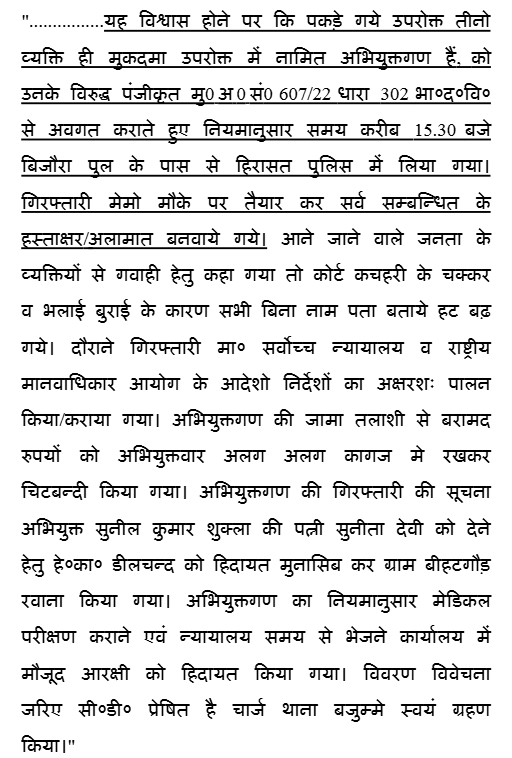
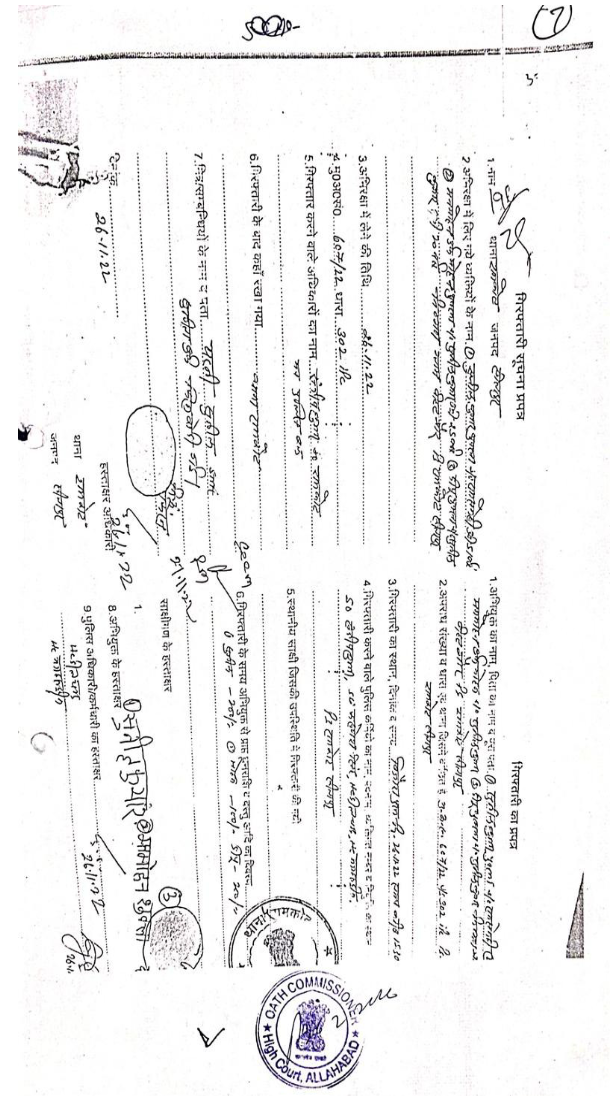
4. The instant application has been filed by the applicant on the sole ground to the effect that the reasons of arrest were not communicated in writing to the applicant, as required under Article 22(1) of the Constitution of India and also statutory provision i.e. Section 50 of Cr.P.C.
5. This Court considered the facts of the case, as brought to the notice of this Court by the parties' counsel, which includes the following:-
(i) The FIR in issue i.e. FIR No. 0607 of 2022 was lodged by the informant/Smt. Munish Kumari Shukla (wife of deceased/Manish Kumar Shukla and real sister-in-law (Bhabhi) of deceased/Munendra Shukla) on 25.11.2022 at about 16.25 hours in regard to incident alleged to have taken place on 25.11.2022 at about 12.00 hours making allegations against Sunil Kumar Shukla s/o Ramsanehi (real brother-in- law (Jeth) of informant) and Manmohan @ Mohan Shukla, Deepu Shukla & Gopal Shukla, all sons of Sunil Kumar Shukla, so as to attract the offences as indicated under Section 302 IPC.
(ii) It is to be noted that as per the case setup in the FIR, the accused namely Sunil Kumar Shukla s/o Ramsanehi (real brother-in-law (Jeth) of informant) and Manmohan @ Mohan Shukla, Deepu Shukla & Gopal Shukla, all sons of Sunil Kumar Shukla, caused fatal injuries with 'Farsha' and 'Kulhadi' to Manish Kumar Shukla (husband of informant) and Munendra Shukla (brother-in-law (Devar) of informant).
(iii) As per the FIR, the aforesaid incident was seen by Jay Prakash Shukla (son of informant), aged about 12 years at the time of alleged incident. As such, he is the eye-witness of the incident.
(iv) The statement of Jay Prakash Shukla was recorded on 25.11.2022 by the Investigating Officer (in short "I.O.").
(v) A perusal of the copy of statement of Jay Prakash Shukla, on record, as Annexure No. SA-1 to the supplementary affidavit dated 23.02.2026 indicates that fatal injuries with 'Farsha' to Manish Kumar Shukla (father of Jay Prakash Shukla) and Munendra Shukla (uncle of Jay Prakash Shukla) was caused by Sunil Kumar Shukla (applicant herein) and due to the injuries sustained both of them died on the spot.
(vi) A perusal of copies of statement(s) of independent witnesses namely Sonu s/o Ram Naresh, Rampal s/o Jagmohan, Ashok s/o Raghunath, Sudheer s/o Baburam, Umesh s/o Arjun, Manoj s/o Ramautar and Amrish s/o Loknath, on record, as Annexure No. 3 to the instant bail application would indicate that these witnesses have assigned specific role to the applicant of causing fatal injuries with 'Farsha' to deceased(s) namely Manish Kumar Shukla and Munendra Shukla.
(vii) The co-accused namely Manmohan Alias Mohan has already been released on bail by this Court vide order dated 07.10.2025 passed in Criminal Misc. Bail Application No. 6833 of 2024. Another co-accused namely Deepu Shukla has also been released on bail by this Court vide order dated 13.11.2025 passed in Criminal Misc. Bail Applicati
AI
Absence of written grounds of arrest does not mandate bail absent prejudice; substantial compliance via awareness suffices in serious offences, especially pre-'henceforth' rulings.


(1) Arrest – Constitutional Safeguards – A police officer cannot casually arrest a person against whom commission of an offence punishable with imprisonment for more than seven years is alleged – The....


The failure to communicate grounds of arrest constitutes a violation of constitutional rights under Articles 21 and 22(1), rendering the arrest illegal and necessitating bail even amidst statutory re....

Non-furnishing of arrest grounds does not automatically invalidate the arrest unless demonstrable prejudice is proven. The court prioritizes substantial compliance over strict formality in arrest pro....

The constitutional requirement of communicating grounds of arrest is essential, and failure to do so renders the arrest and subsequent remand illegal.

The right to be informed of the grounds of arrest is fundamental under Article 22(1), and failure to communicate such grounds renders the arrest and subsequent remand illegal.

The requirement to inform an arrested person of the grounds for their arrest, as mandated by Article 22(1) of the Constitution, is a mandatory condition that must be adhered to, failing which the arr....



An indispensable Tool for Legal Professionals, Endorsed by Various High Court and Judicial Officers
Please visit our Training & Support
Center or Contact Us for assistance

Scan Me!
India’s Legal research and Law Firm App, Download now!


For Daily Legal Updates, Join us on :



 Back to top


