
 Back
Back





HIGH COURT OF JUDICATURE AT ALLAHABAD
CHANDRA KUMAR RAI, J.
Chandrapal Singh And Others - Petitioners
Versus
Deputy Director Of Consolidation And Others – Respondents
WRIT - B No. - 4404 of 2025
Decided On : 06-05-2026
| Table of Content |
|---|
| 1. procedural background and factual context of consolidation proceedings. (Para 1 , 2 , 3 , 4 , 8 , 9) |
| 2. parties' contentions regarding the legal effect of missing court records. (Para 5 , 6) |
| 3. requirement to reconstruct missing records rather than abating proceedings. (Para 7 , 10 , 11 , 12 , 13 , 14 , 15) |
JUDGMENT :
CHANDRA KUMAR RAI, J.
1. Heard Mr. H.N. Singh, learned Senior Counsel assisted by Mr. Salilendu Kumar Upadhyay, learned counsel for the petitioners, Mr. Mahendra Kumar Tripathi, learned counsel for respondent nos.4 & 6 and learned Standing Counsel for the State-respondents.
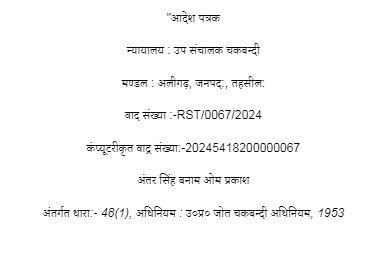
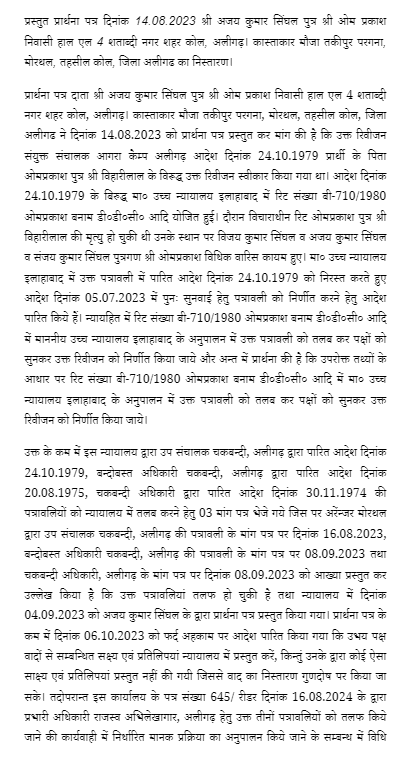
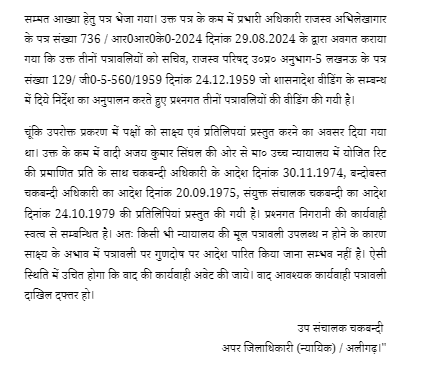
2. Brief facts of the case are that the dispute relates to plot nos. 25, 34, 86, 90, 91/1 situated in Village - Takipur, Pargana - Morthal, Tahsil- Koil, District - Aligarh. Consolidation operation started in the village in question in the year 1973. Against the basic year entry of the plot in question one objection was filed by respondent no.7 - Bhagwat Swaroop, which was rejected by the Consolidation Officer vide order dated 30.11.1974. Against the order of Consolidation Officer, appeal under Section 11 (1) of U.P. Consolidation of Holdings Act, 1953 (hereinafter referred to as "U.P.C.H. Act") was filed by respondent no. 4, which was dismissed vide order dated 20.9.1975. Revision under Section 48 of U.P.C.H. Act filed by respondent no. 7 was allowed by Deputy Director of Consolidation vide order dated 27.5.1978. Against the order dated 27.5.1978 passed by Deputy Director of Consolidation, the Writ Petition No. 6442 of 1978, which is stated to be pending before this Court, was filed by Om Prakash (father of respondent nos.4 to 6). Father of petitioner nos.1 to 5 and grand father of petitioner nos.7 & 8 also filed an objection under Section 9-A (2) of U.P.C.H. Act claiming right on the basis of adverse possession over gata no. 27 for more than 12 years. The objection of petitioners' predecessor was contested by the father of respondent nos.4 to 6. Consolidation Officer rejected the objection vide order dated 30.11.1974, appeal filed by predecessor of petitioners was dismissed vide order dated 20.9.1975. Revision under Section 48 of U.P.C.H. Act filed by predecessor of petitioners was allowed vide order dated 24.10.1979. In the aforementioned revision petitioner nos.1 to 8 were substituted as heirs and legal representative of Atar Singh. Against the revisional order dated 24.10.1979, Om Prakash (father of respondent nos.4 to 6) filed a Writ-B No.710 of 1980. The aforementioned writ petition was decided vide judgement dated 5.7.2023 setting aside the revisional order dated 24.10.1979 and remanded the matter back before Deputy Director of Consolidation to decide the revision afresh. Against the final judgement dated 5.7.2023 passed by this Court, a restoration application dated 14.8.2023 was filed before this Court which was rejected vide order dated 12.5.2025. In pursuance of the remand order of this Court matter was proceeded before Deputy Director of Consolidation, Aligarh and vide order dated 3.2.2025 the proceeding of revision was abated by Deputy Director of Consolidation / Additional District Magistrate (judicial), Aligarh on the ground that original records are not available as well as the parties have not produced the documents / record, which are in their possession so that the record of the proceeding can be reconstructed. Hence this writ petition on behalf of the petitioners for the following reliefs:
"i. Issue a writ, order or direction in the nature of CERTIORARI quashing the impugned order dated 03.02.2025 passed by the Deputy Director of Consolidation, Aligarh, District- Aligarh.
ii. Issue a writ, order or direction in thenature of CERTIORARI quashing the proceeding of the Case No.RST/0087/2025, pending before the Deputy Director of Consolidation, Aligarh, District-Aligarh.
iii. Issue a writ, order or direction in the nature of MANDAMUS commanding/directing to Deputy Director of Consolidation, Aligarh, District-Aligarh t
AI

The court ruled that title objections under the U.P. Consolidation of Holdings Act must be decided on merit, emphasizing the need for proper jurisdiction and evidence rather than relying on alleged c....

The Deputy Director of Consolidation's remand for a fresh hearing was justified to ensure fairness, given the significant delay and procedural irregularities in prior decisions.
The court affirmed the principle that title objections must be decided on merit rather than based on previous compromises, ensuring fair opportunity for parties to present evidence.
Revisional jurisdiction under consolidation laws requires adherence to legal procedures, especially concerning time-barred claims and the provision of interim protection.
The Deputy Director of Consolidation has the authority to decide revisions based on existing evidence and should not remand cases unnecessarily.
Revisions involving the same parties and disputes must be consolidated for efficient resolution under the U.P. Consolidation of Holdings Act.
The Deputy Director of Consolidation has the authority to decide appeals on their merits rather than remanding to subordinate authorities, emphasizing the need for a comprehensive review under Sectio....
Failure to provide a hearing and frame issues as required by the U.P. Consolidation of Holdings Act renders the adjudication void.
Objections to consolidation proceedings must be filed within statutory timelines; orders made by consolidation authorities are upheld unless shown to be illegal or lacking jurisdiction.



An indispensable Tool for Legal Professionals, Endorsed by Various High Court and Judicial Officers
Please visit our Training & Support
Center or Contact Us for assistance

Scan Me!
India’s Legal research and Law Firm App, Download now!


For Daily Legal Updates, Join us on :



 Back to top


