Back
Back





2025 Supreme(All) 4036
HIGH COURT OF JUDICATURE AT ALLAHABAD
Vikas Budhwar, J.
Chandra Mohan - Petitioner
Versus
State Of U.P And Others - Respondent
WRIT - A No. - 18999 of 2025
Decided On : 17-12-2025
For the Petitioner: Arya Gautam, Atipriya Gautam, Vinod Kumar Mishra
For the Respondent: C.S.C.
An inquiry officer's jurisdiction is limited to recording findings of fact regarding charges. Recommending a specific punishment in the inquiry report constitutes a jurisdictional overreach, as the sole discretion to determine and impose penalties lies with the disciplinary authority.
Headnote:(A) Service Law - Departmental Proceedings - Role of Inquiry Officer - An inquiry officer is entrusted with the task of conducting the inquiry and recording findings on whether charges are proved - Recommendation of a specific punishment by the inquiry officer constitutes an overreach of jurisdiction - The discretion to impose a penalty resides solely with the disciplinary authority - (Paras 5, 11, 13)
(B) Disciplinary Action - Procedural propriety - When a statute mandates a procedure to be followed in a specific manner, deviation from said manner vitiates the entire proceedings - Proposing a specific penalty in the inquiry report improperly influences the disciplinary authority and causes legal prejudice to the charged individual - (Paras 12, 13)
Facts of the case:
A public servant was charged with unauthorized absence during a period of security duty. A formal departmental inquiry was conducted, during which the inquiry officer recommended, alongside the findings of guilt, specifically that the individual be dismissed from service based on defined rules. The disciplinary authority accepted this recommendation and passed an order of dismissal. Subsequent administrative appeals and revisions were unsuccessful, leading to the filing of the present challenge.
Findings of Court:
The court observed that the inquiring authority exceeded its jurisdiction by recommending a punishment. The role of an inquiry officer is limited to examining evidence and reporting on the veracity of charges. By suggesting a specific category of penalty, the officer improperly exercised a function vested exclusively in the disciplinary authority. This procedural lapse constitutes a fundamental error that vitiates the entire disciplinary process.
Issues: The primary issue was whether an inquiry officer holds the authority to recommend a specific quantum of punishment in the inquiry report and whether such an inclusion renders the subsequent dismissal order legally unsustainable.
Ratio Decidendi: The court held that the inquiry officer's mandate is restricted to determining the proof of allegations. Proposing a specific punishment is an encroachment on the disciplinary authority's discretionary power, which is meant to be exercised independently after reviewing the findings. Consequently, the entire disciplinary process was found to be tainted by this jurisdictional error.
Result: Petition allowed; impugned orders quashed; matter remitted to the disciplinary authority for conducting a fresh inquiry through a different officer.
| Table of Content |
|---|
| 1. chronology of departmental inquiry and service history. (Para 1 , 2 , 3 , 4 , 8) |
| 2. parties' contentions on the jurisdiction of the inquiry officer. (Para 5 , 6) |
| 3. statutory framework governing u.p. police departmental proceedings. (Para 7 , 9 , 10) |
| 4. inquiry officer cannot propose specific punishments exceeding investigative scope. (Para 11 , 12 , 13) |
| 5. quashing of orders and remand for fresh inquiry. (Para 14 , 15) |
JUDGMENT :
VIKAS BUDHWAR, J.
1. Heard Sri Vijay Gautam learned Senior Counsel assisted by Ms. Arya Gautam holding brief of Ms. Atipriya Gautam, learned counsel for the petitioner and Sri R.S. Umrao, learned Standing Counsel, who appears for State-respondents.
2. Instructions have been supplied by Sri R.S. Umrao, learned Additional Chief learned Standing Counsel, submits that he is well equipped with the instructions and the instructions are self-sufficient for disposal of the writ petition and he does not propose to file any further affidavit and the petition be decided on the basis of the documents available on record, thus with the consent of the parties, writ petition is being decided at the fresh stage.
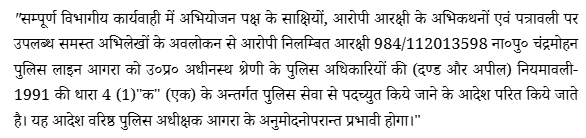
3. The case of the writ petitioner is that he was initially appointed on the post of constable in the year 2011. However, while he was posted as a Constable at Reserved Police Lines, Agra, on 02.07.2016, an allegations came to be leveled against him during the course of VIP movement that the petitioner was absent from reserved police lines without taking any prior permission from the higher authorities. Owing to the same, a charge-sheet came to be served on the petitioner. The petitioner was placed under suspension on 14.09.2016, and thereafter, a preliminary inquiry was conducted, and a report came to be submitted on 13.10.2016. A departmental charge sheet came to be served, and post appointment of the Inquiry Officer, the Inquiry Officer tendered his inquiry report on 23.6.2017, proposing the punishment of dismissal, while referring to the specific provisions contained under Rule 4(1)(a)(i) of the UP Police Officers of the Subordinate Ranks (Punishment and Appeal) Rules, 1991. Thereafter, a show cause notice came to be issued and thereafter the impugned punishment order came to be passed on 29.12.2017 by the Senior Superintendent of Police, Agra, dismissing the services of the petitioner against which the writ petitioner preferred an appeal which came to be rejected by the appellate authority on 25.3.2025, Inspector General of Police, Agra Range, Agra against which the writ petitioner preferred a revision, which came to be rejected on 23.7.2025 by the Additional Director General of Police, Agra Zone, Agra.
4. Questioning the dismissal, appellate as well as the revisional order, the present writ petition has been preferred.
5. Learned Counsel for the writ petitioner has sought to argue that first of all none of the charges so sought to be leveled against the writ petitioner have any legs to stand, the writ petitioner was not unauthorisedly absent. Further, according to him, the core and fundamental question which goes to the root of the matter is that the Inquiry Officer exceeded his authority and jurisdiction while proposing a punishment that too referring to a specific provisions of the rules for imposition of penalty and the said inquiry report stood concurred by the disciplinary authority and the punishment of dismissal came to be passed which on appeal and revision resulted to the detriment of the writ petitioner in negativity. Submission is that the only task entrusted to the Inquiry Officer is to conduct inquiry on the allegations leveled in the charge sheet, while coming to a conclusion whether the charge is proved or not and it is for the disciplinary authority to impose punishment out of the variety of punishments which are classified as minor or major. Reliance has been placed upon the decision of the Hon'ble Supreme Court in the case of State of Uttaranchal v. Kharak Singh , 2008 (8) SCC