Back


2026 Supreme(All) 1498
HIGH COURT OF JUDICATURE AT ALLAHABAD, LUCKNOW
Irshad Ali, J.
Siraj Ahmad - Petitioner
Versus
Union of India and others - Respondents
WRIT - C No. - 1000173 of 1998
Decided On : 25-09-2026
Important Points
Subject
Taxation Law - Indirect Tax / Central Excise
Act Referred
CENTRAL EXCISE RULES: R.174, R.9(2)
ADDITIONAL DUTIES OF EXCISE GOODS OF SPECIAL IMPORTANCE ACT: S.3(3)
CONSTITUTION OF INDIA: Art.226
FINANCE ACT: S.76
Headnote
(B) Suppression of facts - Does not include every omission; requires deliberate non-disclosure of correct information to escape payment of duty (Para 99) - Where facts are known to both parties, the omission by one to do what they might have done does not render it suppression (Para 99) - Procedural deficiencies in statutory declarations or failure to obtain a separate registration do not automatically establish a wilful mental element required for invoking the extended limitation period, especially when the authority is aware of the manufacturing activity (Paras 98, 100).
(C) Ambiguity in law - Where there is reasonable doubt or genuine ambiguity concerning the applicability of duty, the extended period of limitation is not attracted in the absence of material establishing a deliberate act to evade payment (Paras 102-105).
Facts of the case:
A small-scale manufacturer of unbranded tobacco products claimed exemption from basic excise duty based on annual turnovers remaining below the prescribed threshold. The manufacturer had submitted declarations to the authorities disclosing the manufacturing activity. Subsequently, the department issued a show cause notice demanding Additional Excise Duty (AED) for a past period, invoking the extended period of limitation by alleging wilful suppression and failure to register specifically for AED.
Findings of Court:
The authorities were aware of the existence and nature of the manufacturing unit since the initial declaration. Procedural lapses, such as the absence of a specific undertaking in a declaration form or failure to obtain separate registration, do not constitute wilful suppression with intent to evade duty. Furthermore, internal departmental instructions issued later indicated that there was ambiguity regarding the levy of AED on unbranded tobacco during the relevant period, supporting the assessee's bona fide belief in the exemption.
Issues: Whether the extended period of limitation under the proviso to Section 11-A(1) of the Central Excise Act could be validly invoked against a manufacturer who had disclosed their activity and claimed a bona fide exemption, given the department's knowledge of the unit.
Ratio Decidendi: The extended period of limitation is an exception that requires a high threshold of proof regarding the intent to evade duty. Mere non-payment or procedural failures do not equate to wilful suppression when the department has actual knowledge of the manufacturing activity. Substantive liability to pay duty is legally distinct from the procedural requirement of limitation; the latter cannot be bypassed without establishing the specific statutory ingredients of fraud or wilful suppression. Subsequent discovery of the quantum of clearances during a search does not prove that the underlying manufacturing activity was suppressed.
Result: The writ petition succeeds and is allowed.
For the Petitioner: R.k.srivastava, Paritosh Shukla, Sukh Deo Singh, Vikas Singh, Virendra Singh
For the Respondent: A.S.G.I., Kuldeep Srivastava
JUDGMENT :
IRSHAD ALI, J.
1. Heard Sri Sukh Deo Singh along with Sri Paritosh Shukla, learned counsel for the petitioner and Sri Kuldeep Srivastava, learned counsel for the respondent.
2. The present writ petition has been filed on following prayer:
“i. issue a writ, order or direction in the nature of mandamus directing the opposite parties not to charge any additional excise duty and the penalty on the unbranded Sada Kimam and the unbranded Kali Patti cheqing tobacco sol / cleared by the petitioner from 09.04.1994 to 26.07.1996 in pursuance to the notice dated 14.03.1997 and the order dated 20.10.1997.
ii. issue a writ, order or direction in the nature of mandamus directing the opposite parties not to levy or any Additional Excise Duty and penalty in pursuance of the impugned orders dated 14.03.1997 (Annexure no.5) dated 20.10.1997 (Annexure-12).
iii. issue a writ, order or direction in the nature of certiorari to quash the order dated 18.11.1997 (Annexure No.15), 20.10.1997 (Annexure No.12) and the notice dated 14.03.1997 (Annexure No.5).
iv. issue an ad-interim-order in favour of the petitioner.
v. issue such other orders or directions as it may deem just and proper in the circumstances of the case.
vi. award the cost of the petition to the petitioner.”
3. Factual matrix of the case is that the petitioner is engaged in the manufacture and sale of unbranded Sada Kimam and unbranded Kali Patti Zarda tobacco at his small-scale factory, namely, M/s Siraj Tobacco Company, situated at Village Ramabhari, Tehsil Biswan, District Sitapur. Sada Kimam is obtained by boiling tobacco leaves and storing the resultant material in drums, whereas the remaining tobacco leaves, after drying, are known as Kali Patti Zarda. The manufacturing process is carried out manually with the aid of labour in the petitioner's small-scale unit.
4. That the aforesaid products, in their crude and unprocessed form, are supplied by the petitioner to other manufacturers/processors, who thereafter process, refine and finish the same and sell them under their respective brand names. The petitioner himself sells the aforesaid products without any brand name.
5. The petitioner commenced manufacture and sale of unbranded Sada Kimam and unbranded Kali Patti Zarda in his factory with effect from April, 1994. Since the annual turnover/clearance of the petitioner remained below Rs.30 lakhs during the relevant financial years, the petitioner was entitled to the benefit of exemption from payment of excise duty under the exemption notification issued by the Central Government under Section 5-A of the Central Excise Act, 1944 read with the Central Excise Tariff Act, 1985.
6. In accordance with Rule 174 of the Central Excise Rules, 1944, the petitioner submitted his declaration dated 08.04.1994 on 09.04.1994 before the Superintendent, Central Excise, Range-I, Sitapur, disclosing his manufacturing activity and claiming the applicable exemption. Similar declarations dated 07.04.1995 and 11.04.1996 were also submitted for the financial years 1995-96 and 1996-97. Thus, the manufacturing activity of the petitioner and the nature of the goods manufactured by him were throughout within the knowledge of the jurisdictional Central Excise authorities.
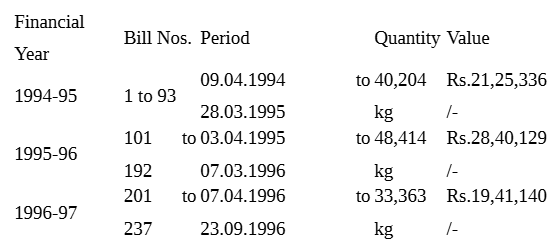
7. Since the petitioner's sale proceeds during the financial years 1994-95, 1995-96 and 1996-97 did not exceed Rs.30 lakhs in any financial year, the jurisdictional authorities did not demand or recover excise duty from the petitioner. The petitioner was neither required to obtain registration nor informed that any separate registration was required for payment of Additional Excise Duty (AED).
8. On 03.10.1996, the petitioner's factory was visited by a team of Central Excise officers headed by the Superintendent, Central Excise (Preventive), Sitapur and the Superintendent, Central Excise, Range-I, Sitapur. During the search and seizure, stock of unbranded Sada Kimam and Kali Patti Zarda was taken into possession and a panchnama was prepared. The de