1. Appeal against order rejecting temporary injunction in suit for permanent injunction to protect long-standing possession. (Para 2 , 3 , 4 , 5 , 6 , 7 , 8 , 9 , 10 , 11 , 12 , 13 , 14 , 36 , 37 , 38 , 39 )
 Back
Next 





2026 Supreme(All) 1519
HIGH COURT OF JUDICATURE AT ALLAHABAD, LUCKNOW
PRASHANT KUMAR, J.
Rekha Saxena and Another - Appellants
Versus
Roman Catholic Diocese, Allahabad Pvt. Ltd. Thru. Director General the Bishop and Another – Respondents
First Appeal From Order No. 354 of 2025
Decided On : 23-09-2026
Important Points
A person in settled possession is entitled to protection against forcible dispossession even by the true owner; eviction must occur through due process of law, and a decree cancelling a title deed without an explicit order for eviction does not authorize forceful removal from possession.
Subject
Civil Law - Injunctions & Property Law
Act Referred
Headnote
(A) Code of Civil Procedure, 1908 - Order XXXIX, Rules 1 & 2 and Section 94(c) - Temporary Injunction - Registration Act, 1908 - Section 47 - Operation of registered documents - A temporary injunction is an interim relief granted to preserve the subject matter of litigation, requiring a prima facie case, balance of convenience, and likelihood of irreparable injury (Paras 44, 48, 49). The appellate court shall not interfere with the discretionary order of the trial court unless it is arbitrary, capricious, perverse, or ignores settled principles of law (Paras 51, 52).
(B) Property Law - Settled Possession - Possession is valid against everyone except the person who has the true legal right to possess it. A person in settled possession is entitled to protect such possession even against the true owner; the true owner must take recourse to law and cannot forcibly evict the possessor without due process of law (Paras 54, 55). In the absence of a specific decree or order for eviction, a party cannot be dispossessed from premises without following the procedure established by law (Para 57).
Facts of the case:
The appellants' predecessor-in-interest purchased property via a registered Power of Attorney. Though the Power of Attorney was revoked, the revocation was registered after the sale deed was executed. A subsequent suit decided by a court resulted in the cancellation of the sale deed, but the decree did not grant possession or order the removal of the appellants from the property. The appellants have been in continuous, peaceful, and settled possession since 1987. When the respondents attempted to dispossess them, the appellants filed for a permanent injunction and temporary injunction. The Trial Court rejected the application for temporary injunction on the ground that the appellants lacked title.
Findings of Court:
The court found that the appellants established a prima facie case based on their admitted settled possession since 1987. Since the previous decree only cancelled the sale deed and did not order eviction, the respondents could not forcibly dispossess the appellants. The balance of convenience and the risk of irreparable injury favored the appellants, as the property served as their residential house.
Issues: Whether the appellants were entitled to a temporary injunction to protect their possession during the pendency of the suit, given that the sale deed had been cancelled by a prior decree but no order for eviction had been passed.
Ratio Decidendi: The court ruled that the majesty of law cannot be supplanted by force; due process must be followed for eviction even if the occupant is a trespasser in settled possession. Because the previous decree was limited to the cancellation of the sale deed and didn't include an order for dispossession, and because the respondents admitted the appellants' possession in their pleadings, the requirements for a temporary injunction—prima facie case, balance of convenience, and irreparable injury—were satisfied.
Result: Appeal allowed and temporary injunction granted.
Legal Category Hierarchy
- practice and procedure
- property law
Advocates Appeared:
For the Appellants : Sridhar Awasthi
For the Respondents: Madhav Om, Akshata Singh, Bipin Dutt Dixit, Dharmendra Kumar Trivedi, Samir Om.
Table of Contents
2. Appellants claim possession since 1987; respondents contend sale deed cancelled and no prima facie case or title. (Para 15 , 16 , 17 , 18 , 19 , 20 , 21 , 22 , 23 , 24 , 25 , 26 , 27 , 28 , 29 , 30 , 31 , 32 , 33 , 34 , 35 )
3. Appellants have long, continuous, peaceful possession since 1987, admitted by respondents, establishing prima facie case for injunction. (Para 56 , 57 , 58 , 59 , 60 , 61 , 62 , 63 )
4. A person in settled possession cannot be forcibly dispossessed except by due process of law, irrespective of title. (Para 54 , 55 , 56 , 57 )
5. Appeal allowed; impugned order set aside; temporary injunction granted in favour of appellants during pendency of suit. (Para 64 , 65 , 66 , 67 , 68 , 69 )
6. What are the essential tests for granting a temporary injunction under Order XXXIX Rules 1 and 2 CPC?
The plaintiff must establish a prima facie case, balance of convenience in their favour, and that refusal would cause irreparable injury. (Para 44 , 45 , 46 , 47 , 48 , 49 , 50 , 53 )
7. What is the scope of appellate interference with a trial court's discretionary order on temporary injunction?
An appellate court should not interfere unless the exercise of discretion is arbitrary, capricious, perverse, or contrary to settled legal principles. (Para 51 , 52 )
8. Is a person in settled possession entitled to protect such possession even against the rightful owner?
Yes, a person in settled possession can protect it against even the true owner, who must follow due process of law for eviction. (Para 54 , 55 , 56 , 57 )
9. Does a registered document operate from the date of execution or the date of registration?
Under Section 47 of the Registration Act, 1908, a registered document operates from the date of execution, not the date of registration. (Para 29 , 30 )
10. What is the objective of an interlocutory or temporary injunction?
To preserve the subject matter of litigation and prevent the trial from becoming futile by maintaining status quo until final disposal. (Para 42 , 43 , 44 , 45 , 46 , 47 )
JUDGMENT :
PRASHANT KUMAR, J.
1. Heard Sri Sridhar Awasthi assisted by Sri Aryan Arora, learned counsel for the appellants and Sri Amrendra Nath Tripathi, learned Senior Advocate assisted Ms. Akshata Singh along with Sri Bipin Dutt Dixit and Dharmendra Kumar Trivedi, learned counsel appearing for the respondents and perused the record.
2. The instant First Appeal From Order has been preferred under Order XLIII, Rule 1(r) read with Section 104 of the Code of Civil Procedure, 1908 (hereinafter referred as ‘C.P.C.’), against the impugned order dated 03.07.2025 passed by the Civil Judge (S.D.), Raebareli (hereinafter referred as ‘Trial Court’) in Regular Suit No.238 of 2023 ( Rekha Saxena and another Vs. The Roman Catholic Diosease of Allahabad Private Ltd. and another ), whereby application under Order XXXIX Rule 1 & 2 of C.P.C. filed by the Appellants-Plaintiffs has been dismissed.
Factual Matrix :
3. On 02.06.1987, a registered Power of Attorney was executed in favour of one Augustine Paul authorizing him to execute sale deed in respect of the property in dispute, however this registered Power of Attorney was subsequently stated to be cancelled on 18.09.1987.
4. In exercise of the registered Power of Attorney Mr. Augstine Paul had executed a sale deed on 22.09.1987 in favour of mother-in-law (namely Late Savitri Srivastava) of the appellant no.1 and subsequently the house over said land was constructed. At that point of time, the buyer (appellants’ mother-in-law) was not aware about the cancellation of the Power of Attorney.
5. Subsequently, the cancellation of the Power of Attorney was registered on 29.09.1987.
6. A suit was filed by the respondents being the Original Suit No.100 of 1991 in the Court of Civil Judge, Raebareli, seeking cancellation of the said sale deed, on the ground that the Power of Attorney was revoked and subsequently registered.
7. Later since construction was raised over the land in question, the suit was amended and modified with a further prayer for removal of the construction and delivery of the possession.
8. The said suit was decided ex-parte on 21.04.2001 wherein the civil court held as follows:
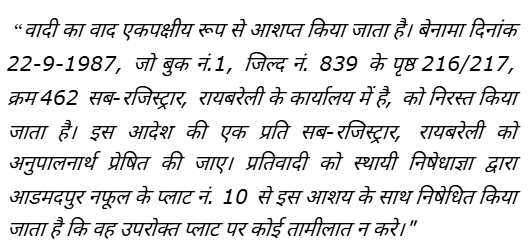
9. Though, the suit was amended with prayers for removal of construction and delivery of possession but the Trial Court only granted the relief of cancellation of sale deed and restraining Appellants' mother-in-law from raising any further construction. No relief for possession or removal of appellants from possession were granted.
10. Decree of ex-parte judgement dated 21.04.2001 was prepared on 07.04.2023, and on the basis of the decree, the respondents tried to evict and dispossess the appellants, who are in continuous and peaceful settled possession of land in question since 1987 through predecessor in interest.
11. Being aggrieved by the action of the respondents, the appellants preferred a suit for permanent injunction being Regular Suit No.238 of 2023 before the Court of Civil Judge (Senior Division), Raebareli, seeking permanent injunction and protection of possession of the appellants from the premises in question.
12. Along with the suit for permanent injunction, an application under Order XXXIX, Rules 1 & 2 C.P.C. was also filed by the appellants seeking the temporary injunction to restrain the respondents from interfering from their peaceful possession over the suit property.
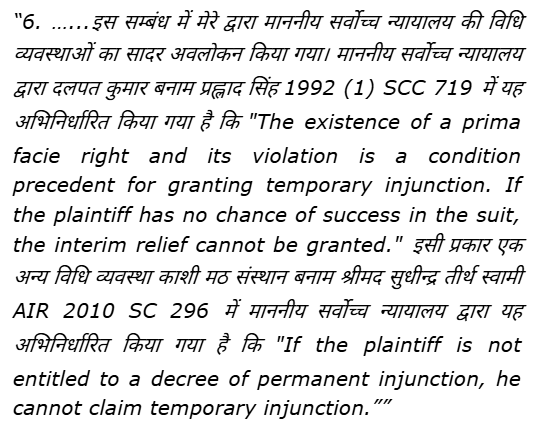
13. The respondents filed an objection to the application filed under Order XXXIX Rules 1 & 2 C.P.C. and also filed written statements in the said suit. The respondents submitted that the suit was not maintainable as the appellants-plaintiffs had no title of the suit property.
14. After hearing the parties, the Trial Court rejected the application which was filed under Order XXXIX, Rules 1 & 2 vide its impugned order dated 03.07.2025, which has been assailed by the appellants by filing the instant appeal under Order XLIII, Rule 1(r) read with Section 104 of the C.P.C.
Submissions of learned counsels for the parties :
15. Shri Sridhar Awasthi