1. Habeas corpus petition challenging arrest of persons found in a fake cyber call centre as illegal. (Para 3 , 4 , 13 )
 Back
Next 


2026 Supreme(All) 1565
HIGH COURT OF JUDICATURE AT ALLAHABAD LUCKNOW
RAJNISH KUMAR, BABITA RANI, JJ.
Karolyn @ Caroline Kharnaior Thru. Her Father Paramjit Singh Chhabra and others - Petitioners
Versus
State of U.P. Thru. Prin. Secy. Home Lko. and others - Respondents
HABEAS CORPUS WRIT PETITION No. - 279 of 2026
Decided On : 15-09-2026
Important Points
Substantial compliance in communicating grounds of arrest through signed contemporaneous documents, such as recovery memos, satisfies constitutional and statutory requirements; technical procedural omissions, like missing police diary entries for relative notifications, do not render an arrest illegal if communication is proven by other evidence.
Subject
Criminal Law - Habeas Corpus
Act Referred
CONSTITUTION OF INDIA: Art.21, Art.22(1), Art.226
BHARATIYA NYAYA SANHITA: S.3(5), S.318(4), S.319(2), S.336(3), S.337, S.338, S.339, S.340(2), S.61(2)
INFORMATION TECHNOLOGY ACT: S.66(c)
BHARATIYA NAGARIK SURAKSHA SANHITA: S.47, S.48
TELECOMMUNICATION ACT: S.42(2)
BHARATIYA NYAYA SANHITA: S.3(5), S.318(4), S.319(2), S.336(3), S.337, S.338, S.339, S.340(2), S.61(2)
INFORMATION TECHNOLOGY ACT: S.66(c)
BHARATIYA NAGARIK SURAKSHA SANHITA: S.47, S.48
TELECOMMUNICATION ACT: S.42(2)
Headnote
(A) Constitution of India - Articles 21 and 22(1) - Bharatiya Nagarik Suraksha Sanhita (BNSS), 2023 - Sections 36, 47 and 48 - communication of grounds of arrest - substantial compliance vs. procedural irregularity - failure to record information of arrest in general diary.
(B) The requirement to communicate the grounds of arrest under Article 22(1) of the Constitution and BNSS is mandatory; however, if grounds are furnished via a signed, contemporaneous document such as a recovery memo, it constitutes substantial compliance and the arrest cannot be declared illegal on the basis of a missing formal arrest memo (Paras 27, 31).
(C) Procedural omissions in recording the notification of relatives in the police station book under Section 48 of BNSS do not automatically render an arrest illegal if it is established through other evidence, such as call detail records, that the nominated persons were informed (Para 39).
(D) A remand order passed by a Magistrate on a printed proforma, despite lacking comprehensive recorded satisfaction regarding the specific compliance of BNSS provisions, remains valid if substantial compliance regarding the furnishing of grounds of arrest is established (Para 40).
Facts of the case:
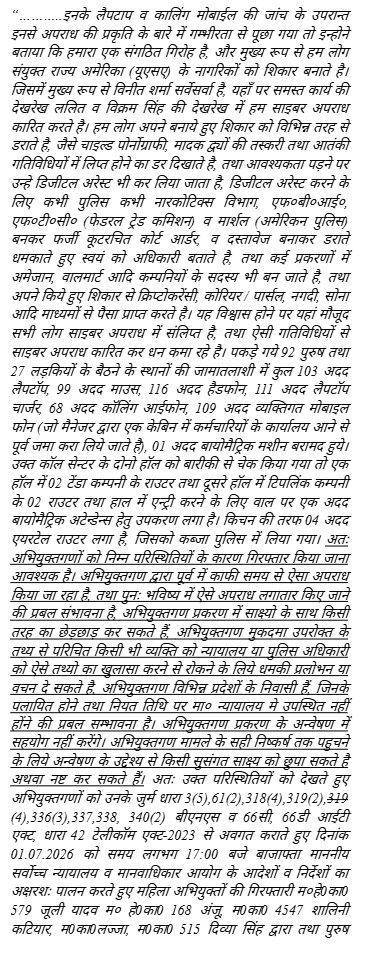
Following a raid on an illegal cyber call center involved in defrauding foreign nationals, 119 individuals were arrested. The petitioners challenged the legality of their arrest and subsequent remand, contending that they were detained beyond 24 hours, were not provided with arrest memos or specific written grounds for arrest, and that their family members were not notified in accordance with the statutory mandate under BNSS.
Findings of Court:
The court found that the scale of the raid and the volume of seized electronic equipment justified the time taken for processing. It held that the recovery memo, which was signed by the petitioners and detailed the modus operandi and grounds for arrest, provided sufficient communication of the reasons for detention. Additionally, the court noted that call detail records proved relatives had been informed, despite the lack of a corresponding entry in the police general diary.
Issues: Whether the absence of a formal arrest memo, the failure to provide a separate written document specifying grounds of arrest, and the failure to record notifications to family members in the police register rendered the arrests and judicial remands illegal.
Ratio Decidendi: Legal proceedings prioritize substantial compliance over technical or procedural compliance. A technical defect in an arrest memo does not invalidate an arrest if the grounds were communicated and acknowledged through another contemporaneous document. Similarly, a procedural failure to record a notification in a police register is an irregularity rather than an illegality if the notification is proven to have occurred through other means.
Result: The petition is hereby dismissed.
Legal Category Hierarchy
- crime and sentencing
- practice and procedure
- constitutional law
Advocates:
Petitioner: Sagar Singh and Ishan Baghel
Respondent: G.A.
Petitioner: Sagar Singh and Ishan Baghel
Respondent: G.A.
Table of Contents
2. Petitioners argued arrest without grounds; State claimed compliance through recovery and arrest memos. (Para 7 , 9 , 10 , 14 )
3. Grounds of arrest detailed in recovery memo, furnished and signed, constitute substantial compliance. (Para 14 , 16 , 17 , 25 , 26 , 31 , 39 )
4. Substantial compliance with constitutional mandate to inform grounds of arrest suffices; non-compliance renders arrest illegal. (Para 23 , 28 , 29 , 31 )
5. Habeas corpus petition dismissed; arrest not illegal; procedural irregularities not fatal. (Para 41 )
6. Is it mandatory to communicate grounds of arrest in writing to the arrestee?
Yes, the constitutional mandate under Article 22(1) requires grounds of arrest to be communicated in writing to the arrestee in the language he understands. (Para 20 , 21 , 22 , 23 )
7. What constitutes sufficient compliance when grounds of arrest are not in the arrest memo?
Grounds of arrest detailed in a contemporaneously prepared and signed recovery memo, furnished to the arrestee, constitutes substantial compliance. (Para 14 , 16 , 17 , 25 , 26 , 28 , 31 )
8. Does failure to record information to family members in the general diary render an arrest illegal?
No, procedural omission to record information in the general diary does not automatically render the foundational arrest illegal if evidence of calls made exists. (Para 33 , 34 , 36 , 37 , 39 )
9. Can a remand order be set aside for non-compliance of Section 48 BNSS?
Non-compliance of Section 48 BNSS without demonstrable prejudice does not automatically vitiate a valid remand order. (Para 34 , 40 )
JUDGMENT :
1. Heard, Sri Ishan Baghel, learned counsel for the petitioners and Sri Anant Pratap Singh, learned AGA along with Sri Girjesh Dwivedi, learned AGA.
2. This Habeas Corpus Writ Petition has been filed by the petitioners, namely, Karolyn @ Caroline Kharnaior, Celiona Syiemlih @ Celiona Kharnaior, V. Malswamutuwangi, Sushmita Datta, Riya Lamba, Muskan Lamba, Terisha Magar Thapa, Apsara, Susmita Chakravarti, Nikita Thapa, Ankita Chhetri, Alice, Pooja Das and Amandeep Kaur @ Amandeep Kaur Chhabra under Article 226 of the Constitution of India, challenging their arrest as illegal and unlawful on various grounds with following prayers:
(i) Issue a writ, order or direction in the nature of Habeas Corpus, thereby commanding the Respondent(s) to forthwith release the petitioners, from the unlawful custody;
(ii) Quash/Set Aside the remand order dated 02.07.2026, passed by the Learned Remand Magistrate, Lucknow, in relation to FIR No.-0078/2026, U/s 3(5), 61 (2), 318(4), 319(2), 336(3), 337,338,339, 340(2) BNS & U/s. 66C & 66D IT Act & U/s. 42(2) TELECOMMUNICATION ACT , PS- Cyber Crime, District-Lucknow, (Annexure No.03) or any such order passed in pursuance of the arrest of the petitioners declaring the arrest illegal;
(iii) Issue a writ, order or direction in the nature of Mandamus, summoning the entire case, relevant General Diary and the arrest memo;
(iv) Direct the Respondents to pay compensation to the detenues, for their failure to protect the fundamental liberty of the detenues, which is guaranteed under the Constitution of India;
(v) Issue, any other writ, order or direction, which this Hon'ble Court may deem fit and proper in the facts and circumstances of the case, in favour of the Petitioners/detenues, and
(vi) Award the cost of the instant Writ Petition in favour of petitioners/detenues.
Factual Matrix
3. The brief facts of the case to decide the issue of illegal detention in the instant petition are as follows:-
(i) On 30/06/2026, Sub-inspector Prashant Kumar Verma received information from a secret informer that an illegal and fraud cyber call centre was operating from 11th floor of the Summit Building, Vibhuti Khand, Lucknow, where foreign nationals were being made target of cyber fraud, therefore, the officials decided to conduct a raid on the alleged illegal call centre and for this purpose, some additional force was called for assistance in the raid.
(ii) When Sub-Inspector Prashant Kumar Verma, along with other members of the police force raided the call centre at about 10:30 PM on 30.06.2026, they found that several persons were conjointly running a fake call centre through which they obtained personal bank details of the foreign nationals and duped them of their money while impersonating as member of United State Treasury, Federal Trade Commission, United State District Court, FBI, etc.
(iii) It is alleged that the said call centre had three teams, namely, dialler, banker, and closure. The call centre even had vendors residing in the United States collaborating in the cyber fraud. The manager and the operation manager through a WhatsApp group, namely Maha Kumbh, used to send these vendors FAS based toll- free number and the vendors used to send pop-up messages to the mobile phones and laptops of U.S. citizens. In these messages, the Centre used to be projected as a popular company of USA, including Amazon, Microsoft and Netflix, etc. When the receiver of pop-up message used to call the toll-free number displayed, the dialler team used to receive calls and tell the caller that their account was hacked or was used for unauthorized transactions. Thereafter, the call used to be forwarded to the bank team. This banker's team used to tell the callers that their account can be permanently blocked or their information can be used on the dark web and under the pretext, the banking team used to obtain information about the balance available in the bank accounts of the callers. Lastly, the closure team used to come into the pict