
Use our app for the best experience
Available for Android & iOS

Information Technology Act, 2000
ACT NO. 21 OF 2000
[9th June, 2000.]
An Act to provide legal recognition for transactions carried out by means of electronic data interchange and other means of electronic communication, commonly referred to as "electronic commerce", which involve the use of alternatives to paper-based methods of communication and storage of information, to facilitate electronic filing of documents with the Government agencies and further to amend the Indian Penal Code, the Indian Evidence
Act, 1872, the Banker’s Books Evidence Act, 1891 and the Reserve Bank of India Act, 1934 and for matters connected therewith or incidental thereto.
WHEREAS the General Assembly of the United Nations by resolution A/RES/51/162, dated the 30th January, 1997 has adopted the Model Law on Electronic Commerce adopted by the United Nations Commission on I
Read full ActOmitted by the Information Technology (Amendment) Act, 2008 (10 of 2009), s. 48 (w.e.f. 27-10-2009).
Section 91 is a procedural provision that appears in multiple statutes in India, including the Code of Criminal Procedure (Cr.P.C.), the Indian Companies Act, the Maharashtra Co-operative Societies Act, the Tenancy Act, the Army Act, the Finance Act, the Income Tax Act, the Evidence Act, and the Bharatiya Nyaya Sanhita (BNS). Its scope, applicability, and interpretation vary depending on the statute and the context in which it is invoked. The following commentary summarizes the essential ingredients, scope, punishment, and key judicial interpretations of Section 91 across these statutes, based on the provided sources.
The Central Government may, for the purposes of providing expert opinion on electronic form evidence before any court or other authority specify, by notification in the Official Gazette, any Department, body or agency of the Central Government or a State Government as an Examiner of Electronic Evidence.
Explanation.—For the purposes of this section, “electronic form evidence” means any information of probative value that is either stored or transmitted in electronic form and includes computer evidence, digital audio, digital video, cell phones, digital fax machines.]
Omitted by the Information Technology (Amendment) Act, 2008 (10 of 2009), s. 50 (w.e.f. 27-10-2009).
Omitted by s. 50, ibid. (w.e.f. 27-10-2009).
Omitted by s. 48, ibid. (w.e.f. 27-10-2009).
Omitted by s. 48, ibid. (w.e.f. 27-10-2009).
Omitted by s. 48, ibid. (w.e.f. 27-10-2009).

(1) Where any law provides for—
(a) the filing of any form, application or any other document with any office, authority, body or agency owned or controlled by the appropriate Government in a particular manner;
(b) the issue or grant of any licence, permit, sanction or approval by whatever name called in a particular manner;
(c) the receipt or payment of money in a particular manner,
then, notwithstanding anything contained in any other law for the time being in force, such requirement shall be deemed to have been satisfied if such filing, issue, grant, receipt or payment, as the case may be, is effected by means of such electronic form as may be prescribed by the appropriate Government.
(2) The appropriate Government may, for the purposes of sub-section (1), by rules, prescribe—
(a) the manner and format in which such electronic records shall be filed, created or iss
(1) This Act may be called the Information Technology Act, 2000.
(2) It shall extend to the whole of India and, save as otherwise provided in this Act, it applies also to any offence or contravention thereunder committed outside India by any person.
(3) It shall come into force on such date, [17th October, 2000, vide notification No. G.S.R. 788 (E), dated 17th October, 2000, see Gazette of India, Extraordinary, Part II, sec. 3(ii).] as the Central Government may, by notification, appoint and different dates may be appointed for different provisions of this Act and any reference in any such provision to the commencement of this Act shall be construed as a reference to the commencement of that provision.
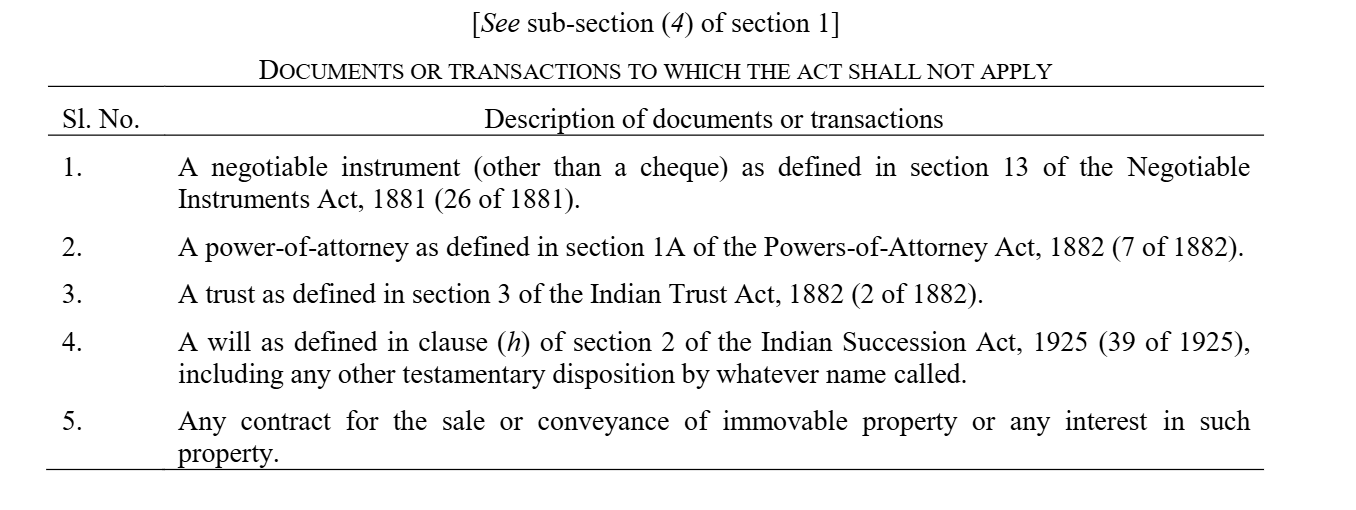
Subs. by Act 10 of 2009, s. 3, for sub-section (4) (w.e.f. 27-10-2009).[(4) Nothing in this Act shall apply to documents or transactions specified in the First Schedule:
Provided that the Central Government may, by notification in the Official Gazet
(1) Subject to the provisions of this section any subscriber may authenticate an electronic record by affixing his digital signature.
(2) The authentication of the electronic record shall be effected by the use of asymmetric crypto system and hash function which envelop and transform the initial electronic record into another electronic record.
Explanation.–For the purposes of this sub-section, ―hash function‖ means an algorithm mapping or translation of one sequence of bits into another, generally smaller, set known as ―hash result‖ such that an electronic record yields the same hash result every time the algorithm is executed with the same electronic record as its input making it computationally infeasible–
(a) to derive or reconstruct the original electronic record from the hash result produced by the algorithm;
(b) that two electronic records can produce the same hash result using the algorit
(1) Where any law provides that documents, records or information shall be retained for any specific period, then, that requirement shall be deemed to have been satisfied if such documents, records or information are retained in the electronic form, if—
(a) the information contained therein remains accessible so as to be usable for a subsequent reference;
(b) the electronic record is retained in the format in which it was originally generated, sent or received or in a format which can be demonstrated to represent accurately the information originally generated, sent or received;
(c) the details which will facilitate the identification of the origin, destination, date and time of despatch or receipt of such electronic record are available in the electronic record:
Provided that this clause does not apply to any information which is automatically generated solely for the purpose of
Where any law provides that information or any other matter shall be authenticated by affixing the signature or any document shall be signed or bear the signature of any person, then, notwithstanding anything contained in such law, such requirement shall be deemed to have been satisfied, if such information or matter is authenticated by means of 1[electronic signature] affixed in such manner as may be prescribed by the Central Government.
Explanation.—For the purposes of this section, “signed”, with its grammatical variations and cognate expressions, shall, with reference to a person, mean affixing of his hand written signature or any mark on any document and the expression “signature” shall be construed accordingly.
1. Subs. by Act 10 of 2009, s. 2, for “digital signatures” (w.e.f. 27-10-2009).
The Central Government may, for the purposes of this Act, by rules, prescribe—
(a) the type of 1[electronic signature];
(b) the manner and format in which the 1[electronic signature] shall be affixed;
(c) the manner or procedure which facilitates identification of the person affixing the 1[electronic signature];
(d) control processes and procedures to ensure adequate integrity, security and confidentiality of electronic records or payments; and
(e) any other matter which is necessary to give legal effect to 1[electronic signatures].
1. Subs. by Act 10 of 2009, s. 2, for “digital signature” (w.e.f. 27-10-2009).
Where any law provides that any rule, regulation, order, bye-law, notification or any other matter shall be published in the Official Gazette, then, such requirement shall be deemed to have been satisfied if such rule, regulation, order, bye-law, notification or any other matter is published in the Official Gazette or Electronic Gazette:
Provided that where any rule, regulation, order, by-law, notification or any other matter is published in the Official Gazette or Electronic Gazette, the date of publication shall be deemed to be the date of the Gazette which was first published in any form.
Nothing contained in sections 6, 7 and 8 shall confer a right upon any person to insist that any Ministry or Department of the Central Government or the State Government or any authority or body established by or under any law or controlled or funded by the Central or State Government should accept, issue, create, retain and preserve any document in the form of electronic records or effect any monetary transaction in the electronic form.
Where any law provides that information or any other matter shall be in writing or in the typewritten or printed form, then, notwithstanding anything contained in such law, such requirement shall be deemed to have been satisfied if such information or matter is—
(a) rendered or made available in an electronic form; and
(b) accessible so as to be usable for a subsequent reference.
2 [Where in any law for the time being in force, there is a provision for audit of documents, records or information, that provision shall also be applicable for audit of documents, records or information processed and maintained in the electronic form.]
2. Ins. by s. 8, ibid. (w.e.f. 27-10-2009).
(1) In this Act, unless the context otherwise requires,—
(a) “access” with its grammatical variations and cognate expressions means gaining entry into, instructing or communicating with the logical, arithmetical, or memory function resources of a computer, computer system or computer network;
(b) “addressee” means a person who is intended by the originator to receive the electronic record but does not include any intermediary;
(c) “adjudicating officer” means an adjudicating officer appointed under sub-section (1) of section 46;
(d) "affixing 1[electronic signature]" with its grammatical variations and cognate expressions means adoption of any methodology or procedure by a person for the purpose of authenticating an electronic record by means of digital signature;
2[(da) ―Appellate Tribunal‖ means the Appellate Tribunal referred to in sub-section (1) of sec
The Controller may perform all or any of the following functions, namely:—
(a) exercising supervision over the activities of the Certifying Authorities;
(b) certifying public keys of the Certifying Authorities;
(c) laying down the standards to be maintained by the Certifying Authorities;
(d) specifying the qualifications and experience which employees of the Certifying Authority should possess;
(e) specifying the conditions subject to which the Certifying Authorities shall conduct their business;
(f) specifying the contents of written, printed or visual materials and advertisements that may be distributed or used in respect of a 2[electronic signature] Certificate and the public key;
(g) specifying the form and content of a 2[electronic signature] Certificate and the key;
(h) specifying
Ins. by s. 6, ibid. (w.e.f. 27-10-2009).[(1) Notwithstanding anything contained in section 3, but subject to the provisions of sub-section (2), a subscriber may authenticate any electronic record by such electronic signature or electronic authentication technique which—
(a) is considered reliable; and
(2) For the purposes of this section any electronic signature or electronic authentication technique shall be considered reliable if—
(a) the signature creation data or the authentication data are, within the context in which they are used, linked to the signatory or, as the case may be, the authenticator and to no other person;
(b) the signature creation data or the authentication data were, at the time of signing, under the control of the signatory or, as the case may be, the authenticator and of no other person;
(c) any
1 (1) The appropriate Government may, for the purposes of this Chapter and for efficient delivery of services to the public through electronic means authorise, by order, any service provider to set up, maintain and upgrade the computerised facilities and perform such other services as it may specify, by notification in the Official Gazette.
Explanation.—For the purposes of this section, service provider so authorised includes any individual, private agency, private company, partnership firm, sole proprietor firm or any such other body or agency which has been granted permission by the appropriate Government to offer services through electronic means in accordance with the policy governing such service sector.
(2) The appropriate Government may also authorise any service provider authorised under sub-section (1) to collect, retain and appropriate such service charges, as may be prescribed by the appropriate Government for the purpose of providing such services
(1) Every Certifying Authority shall disclose in the manner specified by regulations—
(a) its 1[electronic signature] Certificate 2***;
(b) any certification practice statement relevant thereto;
(c) notice of the revocation or suspension of its Certifying Authority certificate, if any; and
(d) any other fact that materially and adversely affects either the reliability of a 1[electronic signature] Certificate, which that Authority has issued, or the Authority’s ability to perform its services.
(2) Where in the opinion of the Certifying Authority any event has occurred or any situation has arisen which may materially and adversely affect the integrity of its computer system or the conditions subject to which a 1[electronic signature] Certificate was granted, then, the Certifying Authority shall—
(a) use reasonable efforts to notify any person who is like
A Certifying Authority while issuing a Digital Signature Certificate shall certify that—
(a) it has complied with the provisions of this Act and the rules and regulations made thereunder;
(b) it has published the Digital Signature Certificate or otherwise made it available to such person relying on it and the subscriber has accepted it;
(c) the subscriber holds the private key corresponding to the public key, listed in the Digital Signature Certificate;
1[(ca) the subscriber holds a private key which is capable of creating a digital signature;
(cb) the public key to be listed in the certificate can be used to verify a digital signature affixed by the private key held by the subscriber;]
(d) the subscriber's public key and private key constitute a functioning key pair;
(e) the information contained in the Digital
(1) Where the originator has not 3[stipulated] that the acknowledgment of receipt of electronic record be given in a particular form or by a particular method, an acknowledgment may be given by—
(a) any communication by the addressee, automated or otherwise; or
(b) any conduct of the addressee, sufficient to indicate to the originator that the electronic record has been received.
(2) Where the originator has stipulated that the electronic record shall be binding only on receipt of an acknowledgment of such electronic record by him, then unless acknowledgment has been so received, the electronic record shall be deemed to have been never sent by the originator.
(3) Where the originator has not stipulated that the electronic record shall be binding only on receipt of such acknowledgment, and the acknowledgment has not been received by the originator within the time specified or agreed or, if no time has been specifie
(1) A subscriber shall be deemed to have accepted a Digital Signature Certificate if he publishes or authorises the publication of a Digital Signature Certificate—
(a) to one or more persons;
(b) in a repository; or
otherwise demonstrates his approval of the Digital Signature Certificate in any manner.
(2) By accepting a Digital Signature Certificate the subscriber certifies to all who reasonably rely on the information contained in the Digital Signature Certificate that—
(a) the subscriber holds the private key corresponding to the public key listed in the Digital Signature Certificate and is entitled to hold the same;
(b) all representations made by the subscriber to the Certifying Authority and all material relevant to the information contained in the Digital Signature Certificate are true;
(c) all information in the Digital Signature Certific
(1) Every subscriber shall exercise reasonable care to retain control of the private key corresponding to the public key listed in his Digital Signature Certificate and take all steps to prevent its disclosure 4***.
(2) If the private key corresponding to the public key listed in the Digital Signature Certificate has been compromised, then, the subscriber shall communicate the same without any delay to the Certifying Authority in such manner as may be specified by the regulations.
Explanation.–For the removal of doubts, it is hereby declared that the subscriber shall be liable till he has informed the Certifying Authority that the private key has been compromised.
4. The words “to a person not authorised to affix the digital signature of the subscriber” omitted by notification No. S.O.1015(E) (w.e.f. 19-9-2002).
(1) Subject to the provisions of sub-section (2), the Certifying Authority which has issued a Digital Signature Certificate may suspend such Digital Signature Certificate,—
(a) on receipt of a request to that effect from—
(i) the subscriber listed in the Digital Signature Certificate; or
(ii) any person duly authorised to act on behalf of that subscriber;
(b) if it is of opinion that the Digital Signature Certificate should be suspended in public interest.
(2) A Digital Signature Certificate shall not be suspended for a period exceeding fifteen days unless the subscriber has been given an opportunity of being heard in the matter.
(3) On suspension of a Digital Signature Certificate under this section, the Certifying Authority shall communicate the same to the subscriber.
(1) Where a Digital Signature Certificate is suspended or revoked under section 37 or section 38, the Certifying Authority shall publish a notice of such suspension or revocation, as the case may be, in the repository specified in the Digital Signature Certificate for publication of such notice.
(2) Where one or more repositories are specified, the Certifying Authority shall publish notices of such suspension or revocation, as the case may be, in all such repositories.
Where any Digital Signature Certificate the public key of which corresponds to the private key of that subscriber which is to be listed in the Digital Signature Certificate has been accepted by a subscriber, 1*** the subscriber shall generate 2[that key] pair by applying the security procedure.
1. The word “then” omitted by notification No. S.O. 1015(E) (w.e.f. 19-9-2002).
2. Subs. ibid., for “the key” (w.e.f. 19-9-2002).
3[In respect of Electronic Signature Certificate the subscriber shall perform such duties as may be prescribed.]
3. Ins. by Act 10 of 2009, s. 19 (w.e.f. 27-10-2009).
5. Subs. by Act 10 of 2009, s. 20, for “PENALTIES AND ADJUDICATION” (w.e.f. 27-10-2009).
(1) The Central Government may, by notification in the Official Gazette, appoint a Controller of Certifying Authorities for the purposes of this Act and may also by the same or subsequent notification appoint such number of Deputy Controllers 3[, Assistant Controllers, other officers and employees] as it deems fit.
3. Subs. by s.12, ibid., for “and Assistant Controllers” (w.e.f. 27-10-2009).
(2) The Controller shall discharge his functions under this Act subject to the general control and directions of the Central Government.
(3) The Deputy Controllers and Assistant Controllers shall perform the functions assigned to them by the Controller under the general superintendence and control of the Controller.
(4) The qualifications, experience and terms and conditions of service of Controller, Deputy Controllers 1[,Assistant Controllers, other officers and employees] shall be such as may be prescribed by the Central Government.
(5) The Head Office
—Every Certifying Authority shall,—
(a) make use of hardware, software and procedures that are secure from intrusion and misuse;
(b) provide a reasonable level of reliability in its services which are reasonably suited to the performance of intended functions;
(c) adhere to security procedures to ensure that the secrecy and privacy of the 1[electronic signatures] are assured; 3***
4[(ca) be the repository of all electronic signature Certificates issued under this Act;
(cb) publish information regarding its practices, electronic signature Certificates and current status of such certificates; and ]
(d) observe such other standards as may be specified by regulations.
1. Subs. by Act 10 of 2009, s. 2, for “Digital Signature” (w.e.f. 27-10-2009).
3. The word “and” omitted by s. 15, ibid. (w.e.f. 27-10-2009).
4. Ins. by s.
—(1) Without prejudice to the provisions of sub-section (1) of section 69, the Controller or any person authorised by him shall, if he has reasonable cause to suspect that 2[any contravention of the provisions of this Chapter] has been committed, have access to any computer system, any apparatus, data or any other material connected with such system, for the purpose of searching or causing a search to be made for obtaining any information or data contained in or available to such computer system.
(2) For the purposes of sub-section (1), the Controller or any person authorised by him may, by order, direct any person in charge of, or otherwise concerned with the operation of, the computer system, data apparatus or material, to provide him with such reasonable technical and other assistance as he may consider necessary.
2. Subs. by s. 14, ibid., for “any contravention of the provisions of this Act, rules and regulations made thereunder” (w.e.f. 27-10-2009).
<(1) Subject to the provisions of sub-section (2), any person may make an application, to the Controller, for a licence to issue 1[electronic signature] Certificates.
(2) No licence shall be issued under sub-section (1), unless the applicant fulfils such requirements with respect to qualification, expertise, manpower, financial resources and other infrastructure facilities, which are necessary to issue 1[electronic signature] Certificates as may be prescribed by the Central Government.
(3) A licence granted under this section shall—
(a) be valid for such period as may be prescribed by the Central Government;
(b) not be transferable or heritable;
(c) be subject to such terms and conditions as may be specified by the regulations.
1. Subs. by Act 10 of 2009, s. 2, for “Digital Signature” (w.e.f. 27-10-2009).
(1) Subject to such conditions and restrictions as may be specified by regulations, the Controller may with the previous approval of the Central Government, and by notification in the Official Gazette, recognise any foreign Certifying Authority as a Certifying Authority for the purposes of this Act.
(2) Where any Certifying Authority is recognised under sub-section (1), the 2[electronic signature] Certificate issued by such Certifying Authority shall be valid for the purposes of this Act.
(3) The Controller may, if he is satisfied that any Certifying Authority has contravened any of the conditions and restrictions subject to which it was granted recognition under sub-section (1) he may, for reasons to be recorded in writing, by notification in the Official Gazette, revoke such recognition.
2. Subs. by s. 2, ibid., for “Digital Signature” (w.e.f. 27-10-2009).
—(1) Where the licence of the Certifying Authority is suspended or revoked, the Controller shall publish notice of such suspension or revocation, as the case may be, in the data base maintained by him.
(2) Where one or more repositories are specified, the Controller shall publish notices of such suspension or revocation, as the case may be, in all such repositories:
Provided that the data base containing the notice of such suspension or revocation, as the case may be, shall be made available through a web site which shall be accessible round the clock:
Provided further that the Controller may, if he considers necessary, publicise the contents of data base in such electronic or other media, as he may consider appropriate.
—(1) The Controller or any officer authorised by him in this behalf shall take up for investigation any contravention of the provisions of this Act, rules or regulations made thereunder.
(2) The Controller or any officer authorised by him in this behalf shall exercise the like powers which are conferred on Income-tax authorities under Chapter XIII of the Income-tax Act, 1961 (43 of 1961), and shall exercise such powers, subject to such limitations laid down under that Act.
(1) Every Certifying Authority whose licence is suspended or revoked shall immediately after such suspension or revocation, surrender the licence to the Controller.
(2) Where any Certifying Authority fails to surrender a licence under sub-section (1), the person in whose favour a licence is issued, shall be guilty of an offence and shall be punished with imprisonment which may extend up to six months or a fine which may extend up to ten thousand rupees or with both.
—Every Certifying Authority shall ensure that every person employed or otherwise engaged by it complies, in the course of his employment or engagement, with the provisions of this Act, rules, regulations and orders made thereunder.
Every Certifying Authority shall display its licence at a conspicuous place of the premises in which it carries on its business.
An electronic signature shall be deemed to be a secure electronic signature if—
(i) the signature creation data, at the time of affixing signature, was under the exclusive control of signatory and no other person; and
(ii) the signature creation data was stored and affixed in such exclusive manner as may be prescribed.
Explanation.—In case of digital signature, the “signature creation data” means the private key of the subscriber.
2. Subs. by s 11, ibid., for sections 15 and 16 (w.e.f. 27-10-2009).
(1) Every application for issue of a licence shall be in such form as may be prescribed by the Central Government.
(2) Every application for issue of a licence shall be accompanied by—
(a) a certification practice statement;
(b) a statement including the procedures with respect to identification of the applicant;
(c) payment of such fees, not exceeding twenty-five thousand rupees as may be prescribed by the Central Government;
(d) such other documents, as may be prescribed by the Central Government.
2Where in a contract formation, the communication of proposals, the acceptance of proposals, the revocation of proposals and acceptances, as the case may be, are expressed in electronic form or by means of an electronic records, such contract shall not be deemed to be unenforceable solely on the ground that such electronic form or means was used for that purpose.
2. Ins. by s. 9, ibid. (w.e.f. 27-10-2009).
The Controller may, on receipt of an application under sub-section (1) of section 21, after considering the documents accompanying the application and such other factors, as he deems fit, grant the licence or reject the application:
Provided that no application shall be rejected under this section unless the applicant has been given a reasonable opportunity of presenting his case.
An electronic record shall be attributed to the originator—
(a) if it was sent by the originator himself;
(b) by a person who had the authority to act on behalf of the originator in respect of that electronic record; or
(c) by an information system programmed by or on behalf of the originator to operate automatically.
The Central Government may, for the purposes of sections 14 and 15, prescribe the security procedures and practices:
Provided that in prescribing such security procedures and practices, the Central Government shall have regard to the commercial circumstances, nature of transactions and such other related factors as it may consider appropriate.]
An application for renewal of a licence shall be—
(a) in such form;
(b) accompanied by such fees, not exceeding five thousand rupees, as may be prescribed by the Central Government and shall be made not less than forty-five days before the date of expiry of the period of validity of the licence.
Where any security procedure has been applied to an electronic record at a specific point of time, then such record shall be deemed to be a secure electronic record from such point of time to the time of verification.
—The Controller may, in writing, authorise the Deputy Controller, Assistant Controller or any officer to exercise any of the powers of the Controller under this Chapter.
Omitted by the Information Technology (Amendment) Act, 2008 (10 of 2009), s. 13 (w.e.f. 27-10-2009).
If any person without permission of the owner or any other person who is in charge of a computer, computer system or computer network,—
(a) accesses or secures access to such computer, computer system or computer network 7[or computer resource];
6. Subs. by s. 21, ibid., for “Penalty” (w.e.f. 27-10-2009).
7. Ins. by s. 21, ibid. (w.e.f. 27-10-2009).
(b) downloads, copies or extracts any data, computer data base or information from such computer, computer system or computer network including information or data held or stored in any removable storage medium;
(c) introduces or causes to be introduced any computer contaminant or computer virus into any computer, computer system or computer network;
(d) damages or causes to be damaged any computer, computer system or computer network, data, computer data base or any other programmes residing in such computer, computer sys
(1) For the purpose of adjudging under this Chapter whether any person has committed a contravention of any of the provisions of this Act or of any rule, regulation, 1[ direction or order made thereunder which renders him liable to pay penalty or compensation,] the Central Government shall, subject to the provisions of sub-section (3), appoint any officer not below the rank of a Director to the Government of India or an equivalent officer of a State Government to be an adjudicating officer for holding an inquiry in the manner prescribed by the Central Government.
2[(1A) The adjudicating officer appointed under sub-section (1) shall exercise jurisdiction to adjudicate matters in which the claim for injury or damage does not exceed rupees five crore:
Provided that the jurisdiction in respect of the claim for injury or damage exceeding rupees five crores shall vest with the competent court.]
(2) The adjudicating officer shall, after giving the person refer
(1) Save as otherwise agreed to between the originator and the addressee, the despatch of an electronic record occurs when it enters a computer resource outside the control of the originator.
(2) Save as otherwise agreed between the originator and the addressee, the time of receipt of an electronic record shall be determined as follows, namely:—
(a) if the addressee has designated a computer resource for the purpose of receiving electronic records,—
(i) receipt occurs at the time when the electronic record enters the designated computer resource; or
(ii) if the electronic record is sent to a computer resource of the addressee that is not the designated computer resource, receipt occurs at the time when the electronic record is retrieved by the addressee;
(b) if the addressee has not designated a computer resource along with specified timings, if any, receipt occurs when the
(1) The Controller may, if he is satisfied after making such inquiry, as he may think fit, that a Certifying Authority has—
(a) made a statement in, or in relation to, the application for the issue or renewal of the licence, which is incorrect or false in material particulars;
(b) failed to comply with the terms and conditions subject to which the licence was granted;
2[(c) failed to maintain the procedures and standards specified in section 30;]
(d) contravened any provisions of this Act, rule, regulation or order made thereunder, revoke the licence:
Provided that no licence shall be revoked unless the Certifying Authority has been given a reasonable opportunity of showing cause against the proposed revocation.
(2) The Controller may, if he has reasonable cause to believe that there is any ground for revoking a licence under sub-section (1), by order suspend such lic
3Where a body corporate, possessing, dealing or handling any sensitive personal data or information in a computer resource which it owns, controls or operates, is negligent in implementing and maintaining reasonable security practices and procedures and thereby causes wrongful loss or wrongful gain to any person, such body corporate shall be liable to pay damages by way of compensation to the person so affected.
3. Ins. by s. 22, ibid. (w.e.f. 27-10-2009).
Explanation.–For the purposes of this section,–
(i) "body corporate" means any company and includes a firm, sole proprietorship or other association of individuals engaged in commercial or professional activities;
(ii) "reasonable security practices and procedures‖ means security practices and procedures designed to protect such information from unauthorised access, damage, use, modification, disclosure or impairment, as may be specified in an agreement between
(1) Any person may make an application to the Certifying Authority for the issue of a 1[electronic signature] Certificate in such form as may be prescribed by the Central Government.
(2) Every such application shall be accompanied by such fee not exceeding twenty-five thousand rupees as may be prescribed by the Central Government, to be paid to the Certifying Authority:
Provided that while prescribing fees under sub-section (2) different fees may be prescribed for different classes of applicants.
(3) Every such application shall be accompanied by a certification practice statement or where there is no such statement, a statement containing such particulars, as may be specified by regulations.
(4) On receipt of an application under sub-section (1), the Certifying Authority may, after consideration of the certification practice statement or the other statement under sub-section (3) and after making such enquiries as it may deem fit, grant the 1[elec
Whoever, intentionally or knowingly captures, publishes or transmits the image of a private area of any person without his or her consent, under circumstances violating the privacy of that person, shall be punished with imprisonment which may extend to three years or with fine not exceeding two lakh rupees, or with both.
Explanation.—For the purposes of this section—
(a) “transmit” means to electronically send a visual image with the intent that it be viewed by a person or persons;
(b) “capture”, with respect to an image, means to videotape, photograph, film or record by any means;
(c) “private area” means the naked or undergarment clad genitals, public area, buttocks or female breast:
(d) “publishes” means reproduction in the printed or electronic form and making it available for public;
(e) ―under circumstances violating privacy‖ means circumstance
(1) Any contravention under this 2[Act] may, either before or after the institution of adjudication proceedings, be compounded by the Controller or such other officer as may be specially authorised by him in this behalf or by the adjudicating officer, as the case may be, subject to such conditions as the Controller or such other officer or the adjudicating officer may specify:
Provided that such sum shall not, in any case, exceed the maximum amount of the penalty which may be imposed under this Act for the contravention so compounded.
(2) Nothing in sub-section (1) shall apply to a person who commits the same or similar contravention within a period of three years from the date on which the first contravention, committed by him, was compounded.
Explanation.—For the purposes of this sub-section, any second or subsequent contravention committed after the expiry of a period of three years from the date on which the contravention was previously compounded s
If any person who is required under this Act or any rules or regulations made thereunder to—
(a) furnish any document, return or report to the Controller or the Certifying Authority fails to furnish the same, he shall be liable to a penalty not exceeding one lakh and fifty thousand rupees for each such failure;
(b) file any return or furnish any information, books or other documents within the time specified therefor in the regulations fails to file return or furnish the same within the time specified therefor in the regulations, he shall be liable to a penalty not exceeding five thousand rupees for every day during which such failure continues;
(c) maintain books of account or records, fails to maintain the same, he shall be liable to a penalty not exceeding ten thousand rupees for every day during which the failure continues.
—4[(1) The Telecom Disputes Settlement and Appellate Tribunal established under section 14 of the Telecom Regulatory Authority of India Act, 1997 (24 of 1997), shall, on and from the commencement of Part XIV of Chapter VI of the Finance Act, 2017 (7 of 2017), be the Appellate Tribunal for the purposes of this Act and the said Appellate Tribunal shall exercise the jurisdiction, powers and authority conferred on it by or under this Act.]
(2) The Central Government 5[shall specify, by notification] the matters and places in relation to which the 2[Appellate Tribunal] may exercise jurisdiction.
3. Subs. by s. 169, ibid., for “Establishment of Appellate Tribunal” (w.e.f. 26-5-2017).
4. Subs. by s. 169, ibid., for sub-section (1) (w.e.f. 26-5-2017).
5. Subs. by s. 169, ibid., for “shall also specify, in the notification referred to in sub-section (1)” (w.e.f. 26-5-2017).
2. Subs. by Act 7 of 2017, s. 169, for “Cyber Appellate Tribunal” (w.e.f. 26-
Whoever publishes or transmits or causes to be published or transmitted in the electronic form, any material which is lascivious or appeals to the prurient interest or if its effect is such as to tend to deprave and corrupt persons who are likely, having regard to all relevant circumstances, to read, see or hear the matter contained or embodied in it, shall be punished on first conviction with imprisonment of either description for a term which may extend to three years and with fine which may extend to five lakh rupees and in the event of second or subsequent conviction with imprisonment of either description for a term which may extend to five years and also with fine which may extend to ten lakh rupees.
Whoever publishes or transmits or causes to be published or transmitted in the electronic form any material which contains sexually explicit act or conduct shall be punished on first conviction with imprisonment of either description for a term which may extend to five years and with fine which may extend to ten lakh rupees and in the event of second or subsequent conviction with imprisonment of either description for a term which may extend to seven years and also with fine which may extend to ten lakh rupees.
.—If any person, dishonestly or fraudulently, does any act referred to in section 43, he shall be punishable with imprisonment for a term which may extend to three years or with fine which may extend to five lakh rupees or with both.
6. Subs. by s. 32, ibid., for sections 66 and 67 (w.e.f. 27-10-2009).
Explanation.—For the purposes of this section,—
(a) the word “dishonestly” shall have the meaning assigned to it in section 24 of the Indian Penal Code (45 of 1860);
(b) the word “fraudulently” shall have the meaning assigned to it in section 25 of the Indian Penal Code (45 of 1860).
Whoever dishonestly receive or retains any stolen computer resource or communication device knowing or having reason to believe the same to be stolen computer resource or communication device, shall be punished with imprisonment of either description for a term which may extend to three years or with fine which may extend to rupees one lakh or with both.
Whoever, fraudulently or dishonestly make use of the electronic signature, password or any other unique identification feature of any other person, shall be punished with imprisonment of either description for a term which may extend to three years and shall also be liable to fine which may extend to rupees one lakh.
Whoever, by means of any communication device or computer resource cheats by personation, shall be punished with imprisonment of either description for a term which may extend to three years and shall also be liable to fine which may extend to one lakh rupees.
Whoever knowingly or intentionally conceals, destroys or alters or intentionally or knowingly causes another to conceal, destroy, or alter any computer source code used for a computer, computer programme, computer system or computer network, when the computer source code is required to be kept or maintained by law for the time being in force, shall be punishable with imprisonment up to three years, or with fine which may extend up to two lakh rupees, or with both.
Explanation.—For the purposes of this section, “computer source code” means the listing of programmes, computer commands, design and layout and programme analysis of computer resource in any form.
Any person aggrieved by any decision or order of the 1[Appellate Tribunal] may file an appeal to the High Court within sixty days from the date of communication of the decision or order of the 1[Appellate Tribunal] to him on any question of fact or law arising out of such order:
Provided that the High Court may, if it is satisfied that the appellant was prevented by sufficient cause from filing the appeal within the said period, allow it to be filed within a further period not exceeding sixty days.
1. Subs. by Act 7 of 2017, s. 169, for “Cyber Appellate Tribunal” (w.e.f. 26-5-2017).
—No order of the Central Government appointing any person as the 7[Chairperson or the Member] of a 2[Appellate Tribunal] shall be called in question in any manner and no act or proceeding before a 1[Appellate Tribunal] shall be called in question in any manner on the ground merely of any defect in the constitution of a 1[Appellate Tribunal].
7. Subs. by s. 29, ibid., for “Presiding Officer” (w.e.f. 27-10-2009).
2. Subs. by Act 7 of 2017, s. 169, for “Cyber Appellate Tribunal” (w.e.f. 26-5-2017)
No court shall have jurisdiction to entertain any suit or proceeding in respect of any matter which an adjudicating officer appointed under this Act or the 1[Appellate Tribunal] constituted under this Act is empowered by or under this Act to determine and no injunction shall be granted by any court or other authority in respect of any action taken or to be taken in pursuance of any power conferred by or under this Act.
1. Subs. by Act 7 of 2017, s. 169, for “Cyber Appellate Tribunal” (w.e.f. 26-5-2017).
—If the Members of a Bench consisting of two Members differ in opinion on any point, they shall state the point or points on which they differ, and make a reference to the Chairperson of the 2[Appellate Tribunal] who shall hear the point or points himself and such point or points shall be decided according to the opinion of the majority of the Members who have heard the case, including those who first heard it.]
2. Subs. by Act 7 of 2017, s. 169, for “Cyber Appellate Tribunal” (w.e.f. 26-5-2017)
.—A 4[penalty imposed or compensation awarded] under this Act, if it is not paid, shall be recovered as an arrear of land revenue and the licence or the 5[electronic signature] Certificate, as the case may be, shall be suspended till the penalty is paid.
3. Subs. by Act 10 of 2009, s. 31, for “penalty” (w.e.f. 27-10-2009).
4. Subs. by s. 31, ibid., for “penalty imposed” (w.e.f. 27-10-2009).
5. Subs. by s. 2, ibid., for “Digital Signature” (w.e.f. 27-10-2009).
—While adjudging the quantum of compensation under this Chapter, the adjudicating officer shall have due regard to the following factors, namely:—
(a) the amount of gain of unfair advantage, wherever quantifiable, made as a result of the default;
(b) the amount of loss caused to any person as a result of the default;
(c) the repetitive nature of the default.
Whoever contravenes any rules or regulations made under this Act, for the contravention of which no penalty has been separately provided, shall be liable to pay a compensation not exceeding twenty-five thousand rupees to the person affected by such contravention or a penalty not exceeding twenty-five thousand rupees.
The appellant may either appear in person or authorise one or more legal practitioners or any of its officers to present his or its case before the 1[Appellate Tribunal].
1. Subs. by Act 7 of 2017, s. 169, for “Cyber Appellate Tribunal” (w.e.f. 26-5-2017)
The provisions of the Limitation Act, 1963 (36 of 1963), shall, as far as may be, apply to an appeal made to the 1[Appellate Tribunal].
1. Subs. by Act 7 of 2017, s. 169, for “Cyber Appellate Tribunal” (w.e.f. 26-5-2017)
6 Omitted by the Finance Act, 2017 (7 of 2017), s. 169 (w.e.f. 26-5-2017).
6. Subs. by Act 10 of 2009, s. 26, for sections 49 to 52 (w.e.f. 27-10-2009).
Omitted by s. 169, ibid. (w.e.f. 26-5-2017).
Omitted by s. 169, ibid. (w.e.f. 26-5-2017).
Omitted by the Finance Act, 2017 (7 of 2017), s. 169 (w.e.f. 26-5-2017).
Omitted by s. 169, ibid. (w.e.f. 26-5-2017).
Omitted by s. 169, ibid. (w.e.f. 26-5-2017).
Omitted by the Finance Act, 2017 (7 of 2017), s. 169 (w.e.f. 26-5-2017).
Omitted by s. 169, ibid. (w.e.f. 26-5-2017).
Omitted by s. 169, ibid. (w.e.f. 26-5-2017).
Omitted by s. 169, ibid. (w.e.f. 26-5-2017).
Whoever,—
(a) publishes or transmits or causes to be published or transmitted material in any electronic form which depicts children engaged in sexually explicit act or conduct; or
(b) creates text or digital images, collects, seeks, browses, downloads, advertises, promotes, exchanges or distributes material in any electronic form depicting children in obscene or indecent or sexually explicit manner; or
(c) cultivates, entices or induces children to online relationship with one or more children for and on sexually explicit act or in a manner that may offend a reasonable adult on the computer resource; or
(d) facilitates abusing children online, or
(e) records in any electronic form own abuse or that of others pertaining to sexually explicit act with children,
shall be punished on first conviction with imprisonment of either description for a term which may extend to five years and with fine which may extend to ten lakh rupees and in t
(1) The Central Government shall, by notification in the Official Gazette, appoint an agency of the Government to be called the Indian Computer Emergency Response Team.
(2) The Central Government shall provide the agency referred to in sub-section (1) with a Director General and such other officers and employees as may be prescribed.
(3) The salary and allowances and terms and conditions of the Director-General and other officers and employees shall be such as may be prescribed.
(4) The Indian Computer Emergency Response Team shall serve as the national agency for performing the following functions in the area of cyber security,—
(a) collection, analysis and dissemination of information on cyber incidents;
(b) forecast and alerts of cyber security incidents;
(c) emergency measures for handling cyber security incidents;
(d) coordination of cyber incidents response
2[(1) Where the Central Government or a State Government or any of its officers specially authorised by the Central Government or the State Government, as the case may be, in this behalf may, if satisfied that it is necessary or expedient so to do, in the interest of the sovereignty or integrity of India, defence of India, security of the State, friendly relations with foreign States or public order or for preventing incitement to the commission of any cognizable offence relating to above or for investigation of any offence, it may subject to the provisions of sub-section (2), for reasons to be recorded in writing, by order, direct any agency of the appropriate Government to intercept, monitor or decrypt or cause to be intercepted or monitored or decrypted any information generated, transmitted, received or stored in any computer resource.
(2) The procedure and safeguards subject to which such interception or monitoring or decryption may be carried out, shall be su
(1) Whoever,—
(A) with intent to threaten the unity, integrity, security or sovereignty of India or to strike terror in the people or any section of the people by—
(i) denying or cause the denial of access to any person authorised to access computer resource; or
(ii) attempting to penetrate or access a computer resource without authorisation or exceeding authorised access; or
(iii) introducing or causing to introduce any computer contaminant,
and by means of such conduct causes or is likely to cause death or injuries to persons or damage to or destruction of property or disrupts or knowing that it is likely to cause damage or disruption of supplies or services essential to the life of the community or adversely affect the critical information infrastructure specified under section 70; or
(B) knowingly or intentionally penetrates or accesses a computer resource without authorisation or
(1) The Central Government may, to enhance cyber security and for identification, analysis and prevention of intrusion or spread of computer contaminant in the country, by notification in the Official Gazette, authorise any agency of the Government to monitor and collect traffic data or information generated, transmitted, received or stored in any computer resource.
(2) The intermediary or any person in-charge or the computer resource shall, when called upon by the agency which has been authorised under sub-section (1), provide technical assistance and extend all facilities to such agency to enable online access or to secure and provide online access to the computer resource generating, transmitting, receiving or storing such traffic data or information.
(3) The procedure and safeguards for monitoring and collecting traffic data or information, shall be such as may be prescribed.
(4) Any intermediary who intentionally or knowingly contravenes the provis
(1) The 1[Appellate Tribunal] shall not be bound by the procedure laid down by the Code of Civil Procedure, 1908 (5 of 1908) but shall be guided by the principles of natural justice and, subject to the other provisions of this Act and of any rules, the 1[Appellate Tribunal] shall have powers to regulate its own procedure including the place at which it shall have its sittings.
(2) The 1[Appellate Tribunal] shall have, for the purposes of discharging its functions under this Act, the same powers as are vested in a civil court under the Code of Civil Procedure, 1908 (5 of 1908), while trying a suit, in respect of the following matters, namely:—
(a) summoning and enforcing the attendance of any person and examining him on oath;
(b) requiring the discovery and production of documents or other electronic records;
(c) receiving evidence on affidavits;
(d) issuing commissions for
(1) No person shall publish a 1[electronic signature] Certificate or otherwise make it available to any other person with the knowledge that—
(a) the Certifying Authority listed in the certificate has not issued it; or
(b) the subscriber listed in the certificate has not accepted it; or
(c) the certificate has been revoked or suspended,
unless such publication is for the purpose of verifying a 1[electronic signature] created prior to such suspension or revocation.
(2) Any person who contravenes the provisions of sub-section (1) shall be punished with imprisonment for a term which may extend to two years, or with fine which may extend to one lakh rupees, or with both.
(1) The Controller may, by order, direct a Certifying Authority or any employee of such Authority to take such measures or cease carrying on such activities as specified in the order if those are necessary to ensure compliance with the provisions of this Act, rules or any regulations made thereunder.
1[(2) Any person who intentionally or knowingly fails to comply with any order under sub-section (1) shall be guilty of an offence and shall be liable on conviction to imprisonment for a term not exceeding two years or a fine not exceeding one lakh rupees or with both.]
1. Subs. by Act 10 of 2009, s. 33, for sub-section (2) (w.e.f. 27-10-2009).
Save as otherwise provided in this Act or any other law for the time being in force, if any person who, in pursuance of any of the powers conferred under this Act, rules or regulations made thereunder, has secured access to any electronic record, book, register, correspondence, information, document or other material without the consent of the person concerned discloses such electronic record, book, register, correspondence, information, document or other material to any other person shall be punished with imprisonment for a term which may extend to two years, or with fine which may extend to one lakh rupees, or with both.
3[(1) The Central Government may, by notification published in the Official Gazette, designate any organisation of the Government as the national nodal agency in respect of Critical Information Infrastructure Protection.
3. Ins. by s. 36, ibid. (w.e.f. 27-10-2009).
(2) The national nodal agency designated under sub-section (1) shall be responsible for all measures including Research and Development relating to protection of Critical Information Infrastructure.
(3) The manner of performing functions and duties of the agency referred to in sub-section (1) shall be such as may be prescribed.
Whoever makes any misrepresentation to, or suppresses any material fact from the Controller or the Certifying Authority for obtaining any licence or 1[electronic signature] Certificate, as the case may be, shall be punished with imprisonment for a term which may extend to two years, or with fine which may extend to one lakh rupees, or with both.
1. Subs. by Act 10 of 2009, s. 2, for “Digital Signature” (w.e.f. 27-10-2009).
(1) Subject to the provisions of sub-section (2), the provisions of this Act shall apply also to any offence or contravention committed outside India by any person irrespective of his nationality.
(2) For the purposes of sub-section (1), this Act shall apply to an offence or contravention committed outside India by any person if the act or conduct constituting the offence or contravention involves a computer, computer system or computer network located in India.
(1) Intermediary shall preserve and retain such information as may be specified for such duration and in such manner and format as the Central Government may prescribe.
(2) any intermediary who intentionally or knowingly contravenes the provisions of sub-section (1) shall be punished with an imprisonment for a term which may extend to three years and also be liable to fine.]
1No compensation awarded, penalty imposed or confiscation made under this Act shall prevent the award of compensation or imposition of any other penalty or punishment under any other law for the time being in force.
1. Subs. by Act 10 of 2009, s. 38, for Section 77 (w.e.f. 27-10-2009).
Whoever knowingly creates, publishes or otherwise makes available a 1[electronic signature] Certificate for any fraudulent or unlawful purpose shall be punished with imprisonment for a term which may extend to two years, or with fine which may extend to one lakh rupees, or with both.
(1) Notwithstanding anything contained in any law for the time being in force but subject to the provisions of sub-sections (2) and (3), an intermediary shall not be liable for any third party information, data, or communication link made available or hosted by him.
(2) The provisions of sub-section (1) shall apply if—
(a) the function of the intermediary is limited to providing access to a communication system over which information made available by third parties is transmitted or temporarily stored or hosted; or
(b) the intermediary does not—
(i) initiate the transmission,
(ii) select the receiver of the transmission, and
(iii) select or modify the information contained in the transmission;
(c) the intermediary observes due diligence while discharging his duties under this Act and also observes such other guidelines as the Cen
(1) Save as provided in sub-section (2), any person aggrieved by an order made by controller or an adjudicating officer under this Act may prefer an appeal to a 1[Appellate Tribunal] having jurisdiction in the matter.
(2) No appeal shall lie to the 1[Appellate Tribunal] from an order made by an adjudicating officer with the consent of the parties.
(3) Every appeal under sub-section (1) shall be filed within a period of forty-five days from the date on which a copy of the order made by the Controller or the adjudicating officer is received by the person aggrieved and it shall be in such form and be accompanied by such fee as may be prescribed:
Provided that the 1[Appellate Tribunal] may entertain an appeal after the expiry of the said period of forty-five days if it is satisfied that there was sufficient cause for not filing it within that period.
(4) On receipt of an appeal under sub-section (1), the 1[Appellate Tribunal] may, after giving the par
3(1) The provisions of this Act, for the time being in force, shall apply to, or in relation to, electronic cheques and the truncated cheques subject to such modifications and amendments as may be necessary for carrying out the purposes of the Negotiable Instruments Act, 1881 (26 of 1881) by the Central Government, in consultation with the Reserve Bank of India, by notification in the Official Gazette.
(2) Every notification made by the Central Government under sub-section (1) shall be laid, as soon as may be after it is made, before each House of Parliament, while it is in session, for a total period of thirty days which may be comprised in one session or in two or more successive sessions, and if, before the expiry of the session immediately following the session or the successive sessions aforesaid, both Houses agree in making any modification in the notification or both Houses agree that the notification should not be made, the notification shall thereafter hav
1[66A. Punishment for sending offensive messages through communication service, etc.—Any person who sends, by means of a computer resource or a communication device,—
(a) any information that is grossly offensive or has menacing character; or
(b) any information which he knows to be false, but for the purpose of causing annoyance, inconvenience, danger, obstruction, insult, injury, criminal intimidation, enmity, hatred or ill will, persistently by making use of such computer resource or a communication device;
(c) any electronic mail or electronic mail message for the purpose of causing annoyance or inconvenience or to deceive or to mislead the addressee or recipient about the origin of such messages,
shall be punishable with imprisonment for a term which may extend to three years and with fine.
Explanation.—For the purposes of this section, terms “electronic mail” and “electronic mail mess
(1) A Certifying Authority may revoke a Digital Signature Certificate issued by it—
(a) where the subscriber or any other person authorised by him makes a request to that effect; or
(b) upon the death of the subscriber; or
(c) upon the dissolution of the firm or winding up of the company where the subscriber is a firm or a company.
(2) Subject to the provisions of sub-section (3) and without prejudice to the provisions of sub-section (1), a Certifying Authority may revoke a Digital Signature Certificate which has been issued by it at any time, if it is of opinion that—
(a) a material fact represented in the Digital Signature Certificate is false or has been concealed;
(b) a requirement for issuance of the Digital Signature Certificate was not satisfied;
(c) the Certifying Authority's private key or security system was compromise
(1) Notwithstanding anything contained in the Code of Criminal Procedure, 1973 (2 of 1974), any police officer, not below the rank of a 1[Inspector], or any other officer of the Central Government or a State Government authorised by the Central Government in this behalf may enter any public place and search and arrest without warrant any person found therein who is reasonably suspected of having committed or of committing or of being about to commit any offence under this Act.
Explanation.—For the purposes of this sub-section, the expression “public place” includes any public conveyance, any hotel, any shop or any other place intended for use by, or accessible to the public.
(2) Where any person is arrested under sub-section (1) by an officer other than a police officer, such officer shall, without unnecessary delay, take or send the person arrested before a magistrate having jurisdiction in the case or before the officer-in-charge of a police station.
(1) Where the Central Government or any of its officers specially authorised by it in this behalf is satisfied that it is necessary or expedient so to do, in the interest of sovereignty and integrity of India, defence of India, security of the State, friendly relations with foreign States or public order or for preventing incitement to the commission of any cognizable offence relating to above, it may subject to the provisions of sub-section (2), for reasons to be recorded in writing, by order, direct any agency of the Government or intermediary to block for access by the public or cause to be blocked for access by the public any information generated, transmitted, received, stored or hosted in any computer resource.
(2) The procedure and safeguards subject to which such blocking for access by the public may be carried out, shall be such as may be prescribed.
(3) The intermediary who fails to comply with the direction issued under sub-section (1) shall be pun
1[(1) The Appropriate Government may, by notification in the Official Gazette, declare any computer resource which directly or indirectly affects the facility of Critical Information Infrastructure, to be a protected system.
Explanation.—For the purposes of this section, “Critical Information Infrastructure” means the computer resource, the incapacitation or destruction of which, shall have debilitating impact on national security, economy, public health or safety.]
(2) The Appropriate Government may, by order in writing, authorise the persons who are authorised to access protected systems notified under sub-section (1).
(3) Any person who secures access or attempts to secure access to a protected system in contravention of the provisions of this section shall be punished with imprisonment of either description for a term which may extend to ten years and shall also be liable to fine.
2[(4) The Central Government shall prescribe the information se
Any computer, computer system, floppies, compact disks, tape drives or any other accessories related thereto, in respect of which any provision of this Act, rules, orders or regulations made thereunder has been or is being contravened, shall be liable to confiscation:
Provided that where it is established to the satisfaction of the court adjudicating the confiscation that the person in whose possession, power or control of any such computer, computer system, floppies, compact disks, tape drives or any other accessories relating thereto is found is not responsible for the contravention of the provisions of this Act, rules, orders or regulations made thereunder, the court may, instead of making an order for confiscation of such computer, computer system, floppies, compact disks, tape drives or any other accessories related thereto, make such other order authorised by this Act against the person contravening of the provisions of this Act, rules, orders or regulations
(1) If any difficulty arises in giving effect to the provisions of this Act, the Central Government may, by order published in the Official Gazette, make such provisions not inconsistent with the provisions of this Act as appear to it to be necessary or expedient for removing the difficulty:
Provided that no order shall be made under this section after the expiry of a period of two years from the commencement of this Act.
(2) Every order made under this section shall be laid, as soon as may be after it is made, before each House of Parliament.
No suit, prosecution or other legal proceeding shall lie against the Central Government, the State Government, the Controller or any person acting on behalf of him, 5[and adjudicating officers] for anything which is in good faith done or intended to be done in pursuance of this Act or any rule, regulation or order made thereunder.
5. Subs. by s. 169, ibid., for “the Chairperson Members, adjudicating officers and the staff of the Cyber Appellate Tribunal” (w.e.f. 26-5-2017).
Whoever attempts to commit an offence punishable by this Act or causes such an offence to be committed, and in such an attempt does any act towards the commission of the offence, shall, where no express provision is made for the punishment of such attempt, be punished with imprisonment of any description provided for the offence, for a term which may extend to one-half of the longest term of imprisonment provided for that offence, or with such fine as is provided for the offence, or with both.]
Whoever abets any offence shall, if the act abetted is committed in consequence of the abetment, and no express provision is made by this Act for the punishment of such abetment, be punished with the punishment provided for the offence under this Act.
Explanation.—An act or offence is said to be committed in consequence of abetment, when it is committed in consequence of the instigation, or in pursuance of the conspiracy, or with the aid which constitutes the abetment.
The provisions of this Act shall have effect notwithstanding anything inconsistent therewith contained in any other law for the time being in force.
2[Provided that nothing contained in this Act shall restrict any person from exercising any right conferred under the Copyright Act, 1957 (14 of 1957) or the Patents Act, 1970 (39 of 1970).]
2. Ins. by s. 42, ibid. (w.e.f. 27-10-2009).
Notwithstanding anything contained in the Code of Criminal Procedure, 1973 (2 of 1974), a police officer not below the rank of 1[Inspector] shall investigate any offence under this Act.
1. Subs. by Act 10 of 2009, s. 39, for “Deputy Superintendent of Police” (w.e.f. 27-10-2009).
4The Controller, the Deputy Controller and the Assistant Controllers shall be deemed to be public servants within the meaning of section 21 of the Indian Penal Code (45 of 1860).]
4. Subs. by 7 of 2017, s. 169, for section 82 (w.e.f. 26-5-2017).
Notwithstanding anything contained in the Code of Criminal Procedure, 1973 (2 of 1974), the offence punishable with imprisonment of three years and above shall be cognizable and the offence punishable with imprisonment of three years shall be bailable.]
1 The Central Government may, for secure use of the electronic medium and for promotion of e-governance and e-commerce, prescribe the modes or methods for encryption.
1. Ins. by 10 of 2009, s. 45 (w.e.f. 27-10-2009).
The Central Government may give directions to any State Government as to the carrying into execution in the State of any of the provisions of this Act or of any rule, regulation or order made thereunder.
(1) The Central Government may, by notification in the Official Gazette and in the Electronic Gazette, make rules to carry out the provisions of this Act.
(2) In particular, and without prejudice to the generality of the foregoing power, such rules may provide for all or any of the following matters, namely:—
2. Subs. by s. 46, ibid, for clause (a) (w.e.f. 27-10-2009).
(aa) the procedure for ascertaining electronic signature or authentication under sub-section (3) of section 3A;
(ab) the manner in which any information or matter may be authenticated by means of electronic signature under section 5;]
(b) the electronic form in which filing, issue, grant or payment shall be effected under sub-section (1) of section 6;
(a) the particulars relating to maintenance of data base containing the disclosure record of every Certifying Authority under clause 1[(n)] of section 18;
(b) the conditions and restrictions subject to which the Controller may recognise any foreign Certifying Authority under sub-section (1) of section 19;
(c) the terms and conditions subject to which a licence may be granted under clause (c) of sub-section (3) of section 21;
(b) for matters specified in sub-section (2) of section 6;
2* * * * *
(3) Every rule made by the State Government under this section shall be laid, as soon as may be after it is made, before each House of the State Legislature where it consists of two Houses, or where such Legislature consists of one House, before that House.
2. Clause (c) omitted by Act 10 of 2009, s. 47 (w.e.f. 27-10-2009).
A court of competent jurisdiction may compound offences, other than offences for which the punishment for life or imprisonment for a term exceeding three years has been provided, under this Act:
Provided that the court shall not compound such offence where the accused is, by reason of his previous conviction, liable to either enhanced punishment or to a punishment of a different kind:
Provided further that the court shall not compound any offence where such offence affects the socio economic conditions of the country or has been committed against a child below the age of 18 years or a woman.
(2) The person accused of an offence under this Act may file an application for compounding in the court in which offence is pending for trial and the provisions of sections 265B and 265C of the Code of Criminal Procedure, 1973 (2 of 1974) shall apply.
2Save as otherwise provided in this Act or any other law for the time being in force, any person including an intermediary who, while providing services under the terms of lawful contract, has secured access to any material containing personal information about another person, with the intent to cause or knowing that he is likely to cause wrongful loss or wrongful gain discloses, without the consent of the person concerned, or in breach of a lawful contract, such material to any other person, shall be punished with imprisonment for a term which may extend to three years, or with fine which may extend to five lakh rupees, or with both.]
2. Ins. by s. 37, ibid. (w.e.f. 27-10-2009).
(1) The Central Government shall, as soon as may be after the commencement of this Act, constitute a Committee called the Cyber Regulations Advisory Committee.
(2) The Cyber Regulations Advisory Committee shall consist of a Chairperson and such number of other official and non-official members representing the interests principally affected or having special knowledge of the subject-matter as the Central Government may deem fit.
(3) The Cyber Regulations Advisory Committee shall advise—
(a) the Central Government either generally as regards any rules or for any other purpose connected with this Act;
(b) the Controller in framing the regulations under this Act.
(4) There shall be paid to the non-official members of such Committee such travelling and other allowances as the Central Government may fix.

Elevate your legal practice with advanced AI-driven research and drafting solutions. Experience unmatched efficiency, precision, and security, tailored exclusively for legal professionals.


An indispensable Tool for Legal Professionals, Endorsed by Various High Court and Judicial Officers
Please visit our Training & Support
Center or Contact Us for assistance

India’s Legal research and Law Firm App, Download now!


For Daily Legal Updates, Join us on :




 Back to top



 AI Assistant


