
 Back
Back





HIGH COURT OF UTTARAKHAND AT NAINITAL
SHARAD KUMAR SHARMA, J.
Prem Chandra Singhal - Appellant
Versus
State Of Uttarakhand And Others - Respondents
Second Appeal No. 53 of 2015
Decided On : 21-08-2019
| Table of Content |
|---|
| 1. second appellate court cannot travel beyond lower courts' pleadings and findings. (Para 1) |
| 2. plaintiff claims title via 1977 sale deed, sues for construction removal. (Para 2 , 3 , 4) |
| 3. defendants claim state land under u.p. road side land control act. (Para 5 , 6) |
| 4. road act restricts construction, does not confer state ownership. (Para 7 , 8) |
| 5. lower courts decided without framing issues on road act. (Para 9 , 10) |
| 6. remanded for road act consideration with pleadings, issues, evidence. (Para 11 , 12 , 13) |
| 7. post-remand appellate court ignored directions on road act. (Para 14 , 15) |
| 8. no issue framing makes judgment perverse, violates section 100 cpc. (Para 16 , 17 , 18) |
| 9. appeal allowed; remanded to frame points and decide afresh. (Para 19 , 20) |
JUDGMENT :
Sharad Kumar Sharma, J.
There are certain circumstances, under which, the Court at times is also cornered from taking any particular specific view while adjudicating a lis between the parties and that difficulty is, particularly, faced by the Courts, while exercising its superior power of Appeal, as vested in it under Section 100 of the C.P.C., particularly, when the issue, which otherwise ought to have been a subject matter of determination of the controversy under Section 9 or 96 of Code of Civil Procedure is either not considered by the Trial Court or the Appellate Court, then, while exercising the powers under Section 96 of the C.P.C., in such cases, the Second Appellate Court is constraint that the Second Appellate Court could not have substituted the finding beyond the finding, which has been recorded by the Trial Court or the Appellate Court, while adjudicating a lis, as it is settled law that the Second Appellate Court cannot travel beyond the case as pleaded and argued before the Courts below and, which has been taken into consideration while deciding the case.
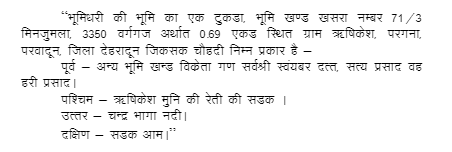
2. This is one of those peculiar case, dealing with the peculiar circumstance, which has chanced in the present Second Appeal. Though, this Court despite of being conscious of the fact that the suit itself, which has been instituted by the plaintiff/appellant, herein, being Suit of 1979 was registered as Suit No. 61 of 1979, Prem Chandra Singhal Vs. State of U.P. and others , which was instituted as back as on 10th March, 1979, wherein, the plaintiff/appellant has sought a relief in the nature of a decree of mandatory injunction as against the defendants/respondent, herein, to the effect that by the decree to be rendered by the Court, they may be evicted from the property, in question, and after the removal of the construction, which has been raised by the defendant/respondents, over the dispute land, they may also be directed to hand over with the vacant possession of property, which as per the plaint averments is shown to be detailed in appendix-2, in the description of the property as given in the plaint, which the plaintiff/appellant claims to have acquired his rights over it, in pursuance to the sale deed dated 8th March, 1977, executed and registered in his favour, wherein, he contends that he has purchased a piece of land, lying in khasra No. 71/3, having an area of 3350 square yard, i.e. equivalent to about 0.69 acres situated in village Rishikesh, Pargana Parwadoon, Dehradun. The boundaries of the property in dispute for which the relief was sought by way of a suit for mandatory injunction was described at the foot of the plaint, which is quoted hereunder :-
3. It was the case of the plaintiff/appellant in the suit, that it was the property, which was falling to be within the area of the property, which was purchased by him by the sale deed dated 8th March, 1977, under the strength of which, he contends that the sale deed, which was executed in his favour on 08.03.1977, it was based on the agreement for sale, which was executed by the predecessors/owners in favour of the plaintiff/appellant on 4th March, 1977, and as a consequence of the execution of the sale deed, he was placed in
AI
Second Appellate Court cannot decide unframed issues on land control act applicability despite pleadings; failure to frame points post-remand renders judgment perverse, requiring fresh remand to firs....

The Second Appellate Court cannot substitute findings of the lower courts without properly framed issues, emphasizing the need for procedural adherence in legal determinations.
Second Appellate Courts cannot substitute findings or decide based on unframed issues; procedural adherence is crucial for judicial fairness.


The plaintiff's entitlement to compensation under the Land Acquisition Act was established, and the plea of limitation and acquiescence raised by the defendants was rejected by the court.

The First Appellate Court must comply with procedural requirements and evaluate evidence from both parties; failure to do so renders its findings perverse.


The court affirmed the Plaintiffs' easementary rights based on historical use and legal documentation, emphasizing the significance of such rights in property law.

Concurrent findings of fact by lower courts should not be disturbed in a second appeal unless a substantial question of law arises, which was not applicable in this case.



An indispensable Tool for Legal Professionals, Endorsed by Various High Court and Judicial Officers
Please visit our Training & Support
Center or Contact Us for assistance

Scan Me!
India’s Legal research and Law Firm App, Download now!


For Daily Legal Updates, Join us on :



 Back to top


