
 Back
Back





IN THE HIGH COURT OF MADHYA PRADESH AT JABALPUR
Maninder S. Bhatti, J.
Ashish Kumar Agrawal S/o Shri Laxmi Narayan - Appellant
Vs.
Nitesh Kumar Goyal S/o Shri Nagarmal Goyal - Respondent
Misc. Criminal Case No. 45244 of 2019
Decided On : 26-04-2024
ORDER :
This application under Section 378(4) of Code of Criminal Procedure has been filed by the applicant seeking leave to file an appeal against the judgment of acquittal dated 24.09.2019 passed by Judicial Magistrate First Class, Balaghat in Complaint Case No. 3386 of 2014 whereby the respondent No.1 has been acquitted of the offence under Section 138 of the Negotiable
Instruments Act.
2. Learned counsel for the applicant contends that the trial Court was approached by the present applicant by way of a complaint under Section 138 of N.I. Act and it was averred in the complaint that a sum of Rs.10 Lakhs was to be recovered from the respondent No.1 and therefore, the respondent No.1 in order to pay the said amount, issued a cheque of Rs.10 Lakhs dated 28.03.2013. The said cheque was dishonoured and resultantly the respondent No.1 was liable to be dealt with under Section 138 of N.I. Act. However, the trial Court while passing the impugned judgment concluded that as the present applicant did not clarify towards what debt or liability, the cheque of Rs.10 Lakhs was issued, therefore, proceeded to dismiss the complaint. It is contended by the counsel that under the provisions of Negotiable Instruments Act, there is a presumption in favour of the holder of the cheque once a cheuqe is in the hand of the holder and the same is submitted for encashment, upon being dishonoured the complainant gets a right to file a complaint. The complainant/present applicant by filing the complaint in the present case, discharged the primary burden of the fact that he was holder of the cheque in due course. Therefore, the respondent No.1 was duty bound to rebut the said presumption which in the present case was not done by the respondent No.1. It is further contended by the counsel that in the present case, during pendency of the complaint as well, some payments towards the total outstanding were made by the respondent No.1 therefore, the respondent No.1 could not have escaped from his liability to pay the amount mentioned in the cheque. Thus, counsel submits that the impugned judgment deserves to be set-aside.
3. Per contra, learned counsel for the respondent/State opposed the prayer.
4. Heard the submissions advanced on behalf of the applicant and perused the record.
5. A perusal of the record it reflects that the present applicant approached the trial Court by filing a complaint and in paragraph 2 of the complaint following averments were made :-
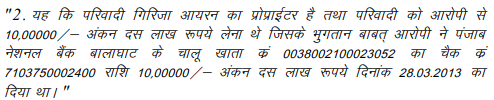
6. A peruusal of the aforesaid paragraph reveals that no averments were made by the present applicant as to how the present applicant was entitled to recover Rs.10 Lakhs from the respondent No.1. There is no mention in the entire paragraph 2 that the cheque was issued to the present applicant towards any debt or enforceable liability. Undisputedly, the paragraph 2 of the complaint is silent as regards this aspect of the matter.
7. After filing of complaint, the complainant was also examined and the complainant in paragraph 9 of his cross-examination again admitted that he has not explained in the complaint as to for which purpose a sum of Rs.10,00000/-were given to the respondent No.1. The present applicant further admitted that he had not disclosed in the complaint that as to when and in relation to what and why the amount of Rs.10,00000/- was given to respondent No.1.
8. Paragraph 9 of the statement of the complainant/applicant is also reproduced as under:-
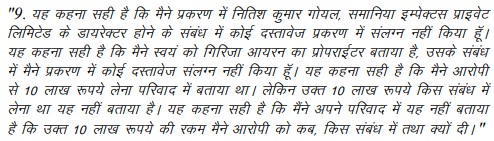
9. A collective reading of paragraph 2 of the complaint as well as paragraph 9 of the cross-examination of the complainant's statement makes it abundantly clear that the complaint itself was lacking in particular which was required to be asseverated in order to bring the complaint within the ambit of Section 138 of N.I. Act. It was bare minimum requirement that at least in one line, the applicant ought to have stated that the cheque was given for some enforceable debt or liability. Upon being cross-examined as detailed hereinabove, the applicant did not make
AI
The complainant must establish the existence of a legally enforceable debt to sustain a conviction under Section 138 of the Negotiable Instruments Act.

The complainant must establish the existence of a legally enforceable debt for a conviction under Section 138 of the Negotiable Instruments Act; failure to do so results in acquittal.

The presumption under Section 139 of the NI Act establishes that a cheque is issued for a legally enforceable debt, placing the burden on the accused to rebut this presumption with a probable defense....

Dishonour of cheque – Accused had to prove by cogent evidence that there was no debt or liability.

The presumption under Section 139 of the NI Act is rebuttable, transferring the burden to the complainant if sufficient evidence creates doubt in the case.

The presumption under Section 139 of the Negotiable Instruments Act is mandatory, placing the burden on the accused to rebut the existence of a legally enforceable debt.

Dishonour of cheque – Whereas prosecution must prove guilt of an accused beyond all reasonable doubt, standard of proof so as to prove a defence on part of accused is preponderance of probabilities.

The presumption under Section 139 of the NI Act is rebuttable, and the burden of proof lies on the accused to establish a probable defense against the existence of a legally enforceable debt.

The presumption of liability under the NI Act is rebuttable, and the burden of proof lies on the complainant to establish the existence of a legally enforceable debt.



An indispensable Tool for Legal Professionals, Endorsed by Various High Court and Judicial Officers
Please visit our Training & Support
Center or Contact Us for assistance

Scan Me!
India’s Legal research and Law Firm App, Download now!


For Daily Legal Updates, Join us on :



 Back to top


