
 Back
Back





IN THE HIGH COURT OF MADHYA PRADESH AT GWALIOR
G. S. Ahluwalia, J.
Nitin Sharma – Petitioner
Versus
Dr Mohan Yadav Mukhymantri The State Of Madhya Pradesh And Others – Respondent
Writ Petition No. 2393 of 2025
Decided On : 13-02-2025
| Table of Content |
|---|
| 1. petitioner's brother's medical treatment led to allegations of negligence. (Para 2) |
| 2. legal standards for negligence in medical practice. (Para 4 , 5 , 6) |
| 3. petition dismissed due to lack of expert evidence. (Para 8) |
ORDER :
G. S. Ahluwalia, J.
This petition under Article 226 of the Constitution of India has been filed seeking the following reliefs:-
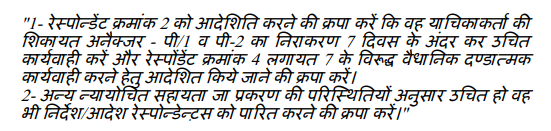
2. It is submitted by petitioner himself that brother of petitioner is a handicapped person and as B.P. Stent which was installed inside the body of brother of petitioner had stopped working, therefore, he took his brother to Kamla Raja Government Hospital, Gwalior. Accordingly, he was admitted on 27.12.2023. Since condition of his brother was deteriorating, therefore, he was referred to Neuro Surgery Department. Dr. Anand Sharma who was posted in Neuro Surgery Department suggested the petitioner to admit his brother in a private hospital. Since financial condition of petitioner is not good, therefore, he did not admit his brother in a private hospital. However, Dr. Aditya Shrivastava and Dr. Avinash Sharma refused to admit his brother in the Neuro Surgery Department and also suggested that petitioner should take his brother to a private hospital. Accordingly, under compulsion, petitioner got his brother admitted in Jay Arogya Hospital, Gwalior in general surgery department. It is alleged that during the admission of his brother in Neury Surgery Department, the condition of his brother deteriorated. Petitioner took his brother to OPD on 08.01.2024, but Dr. Ashish Shrivastava did not come to OPD. Because of negligent attitude of the doctors of a government hospital, petitioner took his brother to government AIIMS Hospital, New Delhi and as the petitioner had not taken any appointment, therefore, his brother could not be treated at AIIMS hospital. Thereafter, petitioner took his brother to Civil Hospital, Gujarat where his brother remained admitted for a period of one month and he was operated thrice. Thus, it is submitted that on account of negligent act of doctors of Jay Arogya Hospital, Gwalior life of brother of petitioner had come in danger. Thus, it is prayed that legal action should be taken against them. During course of arguments, it was contended by petitioner that FIR should be registered against the doctors who are negligent in performance of their dutues.
3. Considered the submissions made by petitioner.
4. Before considering the facts of the case, this Court would like to consider the law governing the field of registration of criminal offence against doctors.
5. The Supreme Court in the case of Jacob Mathew Vs. State of Punjab reported in (2005) 6 SCC 1 has held as under:-
“48. We sum up our conclusions as under:-
(1) Negligence is the breach of a duty caused by omission to do something which a reasonable man guided by those considerations which ordinarily regulate the conduct of human affairs would do, or doing something which a prudent and reasonable man would not do. The definition of negligence as given in Law of Torts, Ratanlal & Dhirajlal (edited by Justice G.P. Singh), referred to hereinabove, holds good. Negligence becomes actionable on account of injury resulting from the act or omission amounting to negligence attributable to the person sued. The essential components of negligence are three: 'duty', 'breach' and 'resulting damage'.
(2) Negligence in the context of medical profession necessarily calls for a treatment with a difference. To infer rashness or negligence on the part of a professional, in particular a doctor, additional considerations apply. A case of occupational negligence is different from one of professional negligence. A simple lack of care, an error of judgment or an accident, is not proof of negligence on the part of a medical professional. So long as a doctor follows a practice acceptable to the medical profession of that day, he cannot be held liable for negligence merely because a better alternative course or method of treatment
AI
Negligence allegations against medical professionals require expert opinion before any FIR can be registered, as per guidelines established by the Supreme Court.

Medical negligence requires substantial expert evidence to warrant prosecution; mere allegations without solid proof are insufficient.

Medical negligence accusations must be substantiated by clear evidence; mere allegations, without expert consensus on negligence, are insufficient for criminal liability.

Medical professionals cannot be prosecuted for negligence unless there is gross negligence established through expert opinion; mere errors or lack of consent do not suffice.


Criminal prosecution for medical negligence requires evidence of gross negligence, not merely attendance during emergencies, and must be substantiated with expert testimony.

Criminal negligence requires substantial proof of gross negligence; mere allegations do not suffice for prosecution under IPC, particularly in medical cases.

To establish criminal negligence against medical professionals, evidence of gross negligence is essential. Mere errors in judgment are insufficient for prosecution.



An indispensable Tool for Legal Professionals, Endorsed by Various High Court and Judicial Officers
Please visit our Training & Support
Center or Contact Us for assistance

Scan Me!
India’s Legal research and Law Firm App, Download now!


For Daily Legal Updates, Join us on :



 Back to top


