
 Back
Back





IN THE HIGH COURT OF MADHYA PRADESH AT INDORE
SANJEEV S KALGAONKAR, J.
Sakesh - Appellant
Versus
Mahesh And Others - Respondent
Second Appeal No.3249 of 2019
Decided On : 25-08-2025
| Table of Content |
|---|
| 1. dispute over sale-deed and property rights (Para 3 , 4) |
| 2. claim of mahesh's adoption and property rights (Para 8) |
| 3. second appeal restrictions under section 100 cpc (Para 10 , 11 , 12 , 19) |
| 4. effect of compromise decree and its binding nature (Para 14 , 15 , 18) |
| 5. final decision and order of dismissal (Para 20 , 21 , 22) |
ORDER :
SANJEEV S KALGAONKAR, J.
1. The record of the Court of first instance and the First Appellate Court have been received.
2. Heard learned counsel for the appellant on admission of appeal and the substantial questions of law.
3. The respondents Mahesh, his mother Parvatibai and son Aniruddh had filed a civil suit assailing the sale-deed dated 22.12.2009 executed by defendant No.2 Rameshchandra @ Ashok Kumar in favour of defendant No.1 Sakesh Soni and praying for declaring it null and void to the extent of area of disputed property and declaration of joint user of the passage situated between the ancestral properties of both the parties. The plaintiff claimed that his predecessor in the title, Chandulal and predecessor in the title of defendant, Chunnilal were contesting a civil suit with regard to the disputed property. In the Civil Suit No.31/1950, a compromise decree dated 13.02.1952 was passed, wherein it was decreed that the passage admeasuring 7 x 20 feet would be used by both the parties. The defendant no.2 had executed sale-deed of his house in favour of the respondent No.2 including the passage which was for common usage between the parties, therefore, the sale-deed is null and void to the extent of passage admeasuring 7 x 15 feet. Further, the well belonging to the plaintiff was shown as joint user in the sale-deed which was exclusive property of the plaintiff, therefore, the defendant Nos.1 and 2 have no right or title in the well.
4. The defendant Nos.2 and 3 in their written statement admitted that their predecessor in title, Chunnilal and predecessor in title of plaintiff, Chandulal were real brothers. The defendant No.2 had transferred the property which came to his share in the family partition, to the defendant No.1 by registered sale-deed. The plaintiffs are not title holder of the disputed property. There is non-joinder of other family members in the suit.
5. The purchaser/defendant No.1 Sakesh(the appellant herein) did not file any written statement.
6. Learned record of the Court of first instance on completion of trial vide judgment dated 23.12.2017, passed in RCSA No.42A/2010 passed the following decree :-
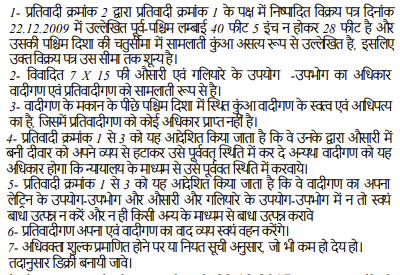
7. The judgment and decree dated 23.12.2017 was assailed in First Appeal No.RCA 13/2018 by defendant No.1 Sakesh. The first Appellate Court i.e. Vth Additional District Judge, Dhar(M.P.) vide judgment dated 20.08.2019 dismissed the appeal and affirmed the impugned judgment.
8. Learned counsel for the present appellant Sakesh referring to the evidence on record contends that the respondent/Plaintiff Mahesh was given in adoption to his uncle Mansukhlal. In a complaint filed under Section 138 of the Negotiable Instrument Act and the Vakalatnama filed in that matter, Mahesh had represented himself as son of Mansukhlal. The name of Mahesh was mutated on properties of Mansukhlal after his demise, therefore, Mahesh has lost his right, title or interest in the property of his biological father Purshottam. Mahesh had no right over the disputed property, therefore, he was not entitled to challenge the execution of sale deed by defendant No.2 in favour of defendant No.1. Plaintiff/Respondent No.1 Mahesh was not in possession of the property, therefore, he cannot claim joint user over the disputed property. Learned counsel for the appellant proposed the following substantial questions of law :
(a) Whether, the learned Judges of the Courts below grossly erred in not dismissing the suit on the ground that the suit proeprty was not properly described in the plaint ?
(b) Whether the learned Judges of the Courts below grossly erred in taking into account the document Ex-P/17 i.e. comprom
AI
A second appeal under Section 100 CPC is restricted to substantial questions of law, not factual re-evaluations. Valid proofs for claims such as adoption must meet statutory requirements for recognit....

Valid adoption requires proof of customary rituals and consent, with documentary evidence insufficient without corroborating proof of actual giving and taking.

Adoption – In the event of there being a registered document pertaining to adoption, there would be presumption that adoption has been made in accordance with law.


Registered adoption documents presume compliance with the law; the burden rests on the claimant to disprove, which may not simply rely on allegations of fraud.
A second appeal under Section 100 CPC must demonstrate a substantial question of law; inadequate proof invalidates an agreement to sell, with both courts correctly concluding the decree of possession....


Point of law: Capacity of a male Hindu to take in adoption-Any male Hindu who is of sound mind and is not a minor has the capacity to take a son or a daughter in adoption. Provided that, if he has a ....

Compliance with the conditions for a valid adoption under the Hindu Adoption and Maintenance Act, 1956 is essential to establish the legality of adoption and the right in the suit property.
Sale - Validity - Defendants were not interested or they did not try to bring their case before court and lead evidence in support of their case to with respect to sale deed being sham, bogus or frau....



An indispensable Tool for Legal Professionals, Endorsed by Various High Court and Judicial Officers
Please visit our Training & Support
Center or Contact Us for assistance

Scan Me!
India’s Legal research and Law Firm App, Download now!


For Daily Legal Updates, Join us on :



 Back to top


