
 Back





2025 Supreme(MP) 954
IN THE HIGH COURT OF MADHYA PRADESH AT JABALPUR
Sanjay Dwivedi, J.
Swami Datt Pyasi and Others – Petitioners
Versus
Smt.Vidya Bai and Others – Respondents
First Appeal No. 468 of 2014
Decided On : 17-06-2025
Important Points
Subject
Civil Law - Succession and Property Law
Act Referred
Headnote
(B) Evidence - Cross-examination - Burden of Proof - Where a document's execution is not specifically challenged or contested through effective cross-examination, the court must presume the document is duly proved - The effect of non-cross-examination of witnesses is that the substance of their testimony remains undisputed and accepted by the opposing party. (Paras 14, 15, 16, 19, 20)
(C) Appellate Interference - Scope - Findings of trial court - Appellate court must intervene and set aside findings if the trial court’s dismissal of evidence is perverse, illegal, or contrary to the material on record. (Paras 13, 21)
Facts of the case:
The plaintiffs-appellants filed a suit seeking a declaration of title to property based on a testamentary document. The trial court dismissed the suit, holding that the plaintiffs failed to meet the statutory requirements for proving the instrument. The appellants challenged this dismissal in the appellate court.
Findings of Court:
The appellate court observed that the trial court disregarded the fact that witnesses had confirmed the signatures and execution of the instrument, and no effective cross-examination was conducted by the defendants to challenge these claims. Consequently, the trial court's finding that the document was not proved was deemed perverse and legally unsustainable.
Issues: The primary issues concerned the validity of the testamentary document, whether the statutory formalities for its execution were satisfied, and the evidentiary effect of failing to cross-examine witnesses regarding the authenticity and execution of that document.
Ratio Decidendi: When the execution of a document is not specifically challenged during cross-examination, the law presumes the document is duly proved. Appellate intervention is appropriate when a trial court delivers a finding that is perverse by ignoring this principle and failing to weigh uncontested evidentiary testimony.
Result: Appeal allowed. The trial court's judgment is set aside and the suit is decreed in total.
For the Appellant :Shri Anuj Agrawal, Advocate and Ms. Ankita Singh Parihar
For the Respondent: Shri R.P. Khare
| Table of Content |
|---|
| 1. procedural history and appellate jurisdiction. (Para 1 , 2) |
| 2. factual foundation regarding will and property partition. (Para 3 , 4 , 5 , 6) |
| 3. summary of defendant contentions and framed trial issues. (Para 7 , 8) |
| 4. evidence assessment and validity of the will. (Para 9 , 10 , 11 , 12 , 13 , 14 , 15 , 16 , 17) |
| 5. legal requirements for proving execution of will under section 63. (Para 18 , 19 , 20) |
| 6. reversal of trial decision and decree of suit. (Para 21 , 22) |
ORDER :
SANJAY DWIVEDI, J.
On 08.02.2023, at the request of counsel for the parties, this case was listed for final hearing under the caption ‘Top of the List’ on 16.02.2023. On 16.02.2023, nobody appeared for the parties and, therefore, the case was adjourned for 22.02.2023 for final hearing. Again on 27.07.2023, the matter was taken up for hearing but it got adjourned on the request made by counsel for the appellant and thereafter the Court, considering the fact that the appeal is nine years old, adjourned the case with a direction that on the next date, it would be argued finally. On 17.08.2023, on behalf of the respondents, an application was filed for change of counsel and Shri Shriniwas Tiwari appeared on behalf of the respondents as the changed counsel and the case was fixed for 20.12.2023. On 21.09.2024, an application for urgent hearing was considered and the Court was pleased to direct for listing the case in the following week. On 28.02.2025, at the request of counsel for the appellants, the case was directed to be listed for final hearing on 05.03.2025 under the caption ‘Top of List’ and finally on 23.04.2025, with the consent of counsel for the parties, the case was finally heard.
2. This first appeal under Section 96 of the Code of Civil Procedure has been filed by the plaintiffs/appellants challenging the impugned judgment and decree dated 17.04.2014 passed by the Third Additional District Judge, Jabalpur in Civil Suit No.84/09 (Swami Datt Pyasi and others Vs. Smt.Vidya Bai and others) whereby the trial Court had dismissed the suit.
3. As per facts of the case, the plaintiffs/appellants filed a suit for declaration of title on the basis of ‘Will’ dated 28.10.1987 (Exhibit P/1) and also seeking permanent injunction and removal of encroachment over the suit land. However, the plaintiffs had also sought a declaration that the settlement-deed dated 21.08.2007 was executed by Smt. Vidya Bai (defendant No.1) in favour of her son namely Praveen Pyasi in respect of land ad-measuring 800 sq. ft. and marked as ‘A’, ‘B’, ‘C’ and ‘D’ with red colour in the plaint map be declared as null and void. As per the plaintiffs, this land in fact belonged to Dinesh Datt Pyasi.
4. As per the averments made in the plaint, late Bhaiyalal Pyasi had three sons namely Chhedilal Pyasi, Ram Datt Pyasi and Sarmanlal Pyasi. Bhaiyalal and his wife Smt. Meera Bai @ Revti Bai died in the year 1962 and 1972 respectively. Upon their demise, an oral partition took place amongst their sons in the year 1980 and each son took possession over their respective share. The genealogy of late Bhaiyalal Pyasi so as to make further facts convenient is as under:-
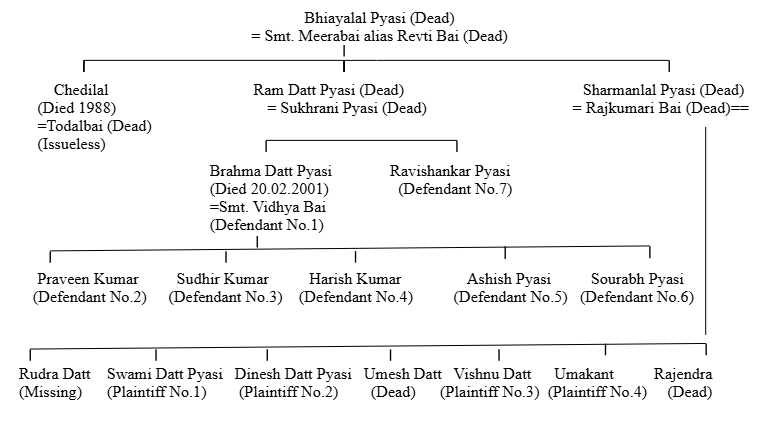
5. Chhedilal Pyasi, the eldest son of Bhaiyalal Pyasi married with Todal Bai in the year 1987 and both died issueless. During his lifetime Chhedilal Pyasi executed a Will on 28.10.1987 in favour of children of Sarmanlal Pyasi in presence of Shiv Kumar Choubey and Pramod Kumar Shukla who were the attesting witnesses of the Will dated 28.10.1987. Chhedilal died in the year 1988.
6. On 21.08.2007, Smt. Vidya Bai (defendant No.1) executed a settlement-deed in favour of her sons purporting to convey more property than she was entitled to under the partition. On the basis of the said partition and settlement-deed dated 21.08.2007, the defendants raised construction over the said land and, therefore, the plaintiffs filed the instant suit.
7. Defendant No.7 Ravi Shankar Pyasi and his legal heirs supported the claim of the plaintiffs and admitted












