


1. Petition under Article 226 challenging rejection of compassionate appointment due to brothers in government service. (Para 1 , 4 )
 Back
Back
Next 





2026 Supreme(MP) 216
IN THE HIGH COURT OF MADHYA PRADESH AT JABALPUR
VISHAL DHAGAT, J.
Sheetal Ladiya - Appellant
Versus
The State Of Madhya Pradesh And Others - Respondent
Writ Petition No. 31104 of 2026
Decided On : 10-08-2026
Advocates:
Advocate Appeared:
For the Appellant :Shri Kailash Chandra Ghildiyal - Senior Advocate with Ms. Warija Ghildiyal - Advocate
For the Respondent:Shri Dayaram Vishwakarma - Govt. Advocate
Advocate Appeared:
For the Appellant :Shri Kailash Chandra Ghildiyal - Senior Advocate with Ms. Warija Ghildiyal - Advocate
For the Respondent:Shri Dayaram Vishwakarma - Govt. Advocate
Compassionate appointment is not a right and must strictly adhere to the governing policy. Courts cannot rewrite policy terms or order inquiries into financial dependency to override disqualification clauses based on other family members' government employment, as this would constitute unauthorized legislation on policy matters.
Headnote:(A) Constitution of India - Articles 14, 16 and 226 - Compassionate Appointment Policy - Clause 4.1 - Challenge to rejection of compassionate appointment - Policy stipulates that if family members are in regular employment of the State Government or other specified bodies, other family members are disqualified - Petitioner contended that despite brothers being in service, they provide no financial assistance - Compassionate appointment is not a matter of right but must be governed strictly by the terms of the applicable policy (Para 5) - Judicial review under Article 226 does not permit the court to rewrite the terms of the policy or add additional conditions (Para 6).
(B) Scope of Judicial Review - Court cannot legislate on policy matters or modify, substitute, or alter provisions of a scheme - Ordering an inquiry into financial contribution of a family member in service would amount to adding a condition not present in the policy (Para 6) - Appointment on compassionate grounds is an exception to Articles 14 and 16 and must be granted only within the policy framework (Para 7).
Facts of the case:
A petition was filed challenging the rejection of an application for compassionate appointment. The rejection was based on a policy clause stating that the employment of two brothers in government service disqualified the petitioner. The petitioner argued that the brothers did not provide financial aid to the family and requested an inquiry into the financial dependency of the family members.
Findings of Court:
The petitioner is disqualified as per Clause 4 of the policy because the brothers are in regular government employment. The court cannot deviate from the policy or order an inquiry to supersede its clauses.
Issues: Whether the court can order an inquiry into the actual financial support provided by family members in government service to allow a compassionate appointment, despite a policy clause disqualifying such applicants.
Ratio Decidendi: Compassionate appointment is governed strictly by the established policy and is not a right. Courts cannot rewrite, modify, or add conditions to such policies through judicial review, nor can they order inquiries that would effectively supersede the policy's disqualification criteria.
Result: Writ petition filed by petitioner is dismissed.
Legal Category Hierarchy
- service law
- constitutional law
Table of Contents
2. Petitioner argued brothers in government service but no financial aid; sought inquiry into dependency. (Para 2 )
3. Writ petition dismissed; petitioner disqualified for compassionate appointment because brother in government service. (Para 9 , 10 )
4. Can a court add additional conditions to a compassionate appointment policy?
No, court cannot add or modify policy conditions; it must apply the policy as is. (Para 5 , 6 )
5. Is compassionate appointment a matter of right?
No, it is an exception to Articles 14 and 16 and must be granted strictly within the policy framework. (Para 7 )
6. Does employment of one family member disqualify another from compassionate appointment?
Yes, if policy states family member in government service bars consideration, no inquiry into financial depdency is allowed. (Para 6 )
7. What norms apply for deciding compassionate appointment applications?
Norms prevailing on the date of consideration apply; there is no right dehors the scheme. (Para 7 )
ORDER :
VISHAL DHAGAT, J.
Petitioner has filed this petition under Article 226 of the Constitution of India, challenging the impugned order dated 12.05.2026 filed as Annexure-P/1. By which, application of petitioner for grant of compassionate appointment was rejected on the ground that by paragraph- 4.1 of the policy, it was found that two brothers of petitioner were in government service.
2. Learned senior counsel appearing for petitioner submitted that brothers are in government service but they are not providing any financial aid to petitioner and other family members. Therefore, petitioner is entitled to get compassionate appointment. Learned senior counsel appearing for petitioner submitted that in some cases, orders were passed by the High Court directing the respondents-authorities to go into the question of dependency in financial aid to members concerned by brothers who are in service.
3. Heard learned senior counsel appearing for the petitioner.
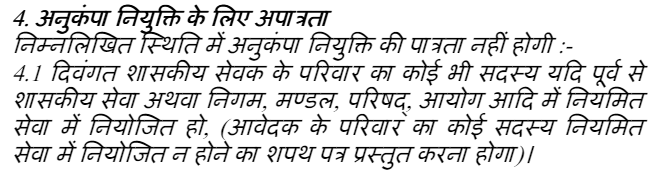
4. Policy of compassionate appointment is placed on record as Annexure-P/6 dated 29.09.2014. The relevant clause for consideration is Clause 4.1 of the policy, which is quoted as under :
5. The Apex Court in the case of State of Himachal Pradesh v. Parkash Chand , reported in (2019) 4 SCC 285 has held as under :
"9. The High Court has observed that the State should consider cases for appointment on compassionate basis by dealing with the applications submitted by sons, or as the case may be, daughters of the deceased government employees, even though, one member of the family is engaged in the service of the Government or an autonomous Board or Corporation. This direction of the judgment of the High Court virtually amounts to a mandamus to the State Government to disregard the terms which have been stipulated in Para 5(c) of its Policy dated 18-1-1990. The Policy contains a limited exception which is available only to a widow of a deceased employee who seeks compassionate appointment even though one of the children of the deceased employee is gainfully employed with the State. The basis for this exception is to deal with cases where the widow is not being supported financially by her children.
10. In the exercise of judicial review under Article 226 of the Constitution, it was not open to the High Court to rewrite the terms of the Policy. It is well settled that compassionate appointment is not a matter of right, but must be governed by the terms on which the State lays down the policy of offering employment assistance to a member of the family of a deceased government employee. [Umesh Kumar Nagpal v. State of Haryana [Umesh Kumar Nagpal v. State of Haryana, SBI v. Kunti Tiwary, Punjab National Bank v. Ashwini Kumar Taneja, SBI v. Somvir Singh, Mumtaz Yunus Mulani v. State of Maharashtra, Union of India v. Shashank Goswami, SBI v. Surya Narain Tripathi and Canara Bank v. M. Mahesh Kumar.]
11. For the above reasons, we are of the view that the judgment of the High Court is unsustainable. The High Court has virtually rewritten the terms of the Policy and has issued a direction to the State to consider applications which do not fulfil the terms of the Policy. This is impermissible.
6. If the prayer made by the senior advocate appearing for the petitioner is accepted, then Court will be adding additional condition to Clause-4.1 of the Policy. Court cannot add anything to the policy of compassionate appointment. Policy lays down that if family members are in government service, then compassionate appointment cannot be granted to other family members. If Court directs an inquiry to find out whether such a member is contributing to income of the family or not, same will be adding additional condition to Clause-4.1 of the Policy. The Court cannot legislate on the policy matters. No modification, substitution or alternation of any provision of the scheme can be made by Court.
7. Similarly, in case of State Bank of India and another Vs. Rajkumar reported in 2010 (11) SCC 661, it was held that c












