1. Petition under Article 227 against trial court's refusal to exhibit electronic CD in a civil suit with counter-claim; CD held inadmissible for non-compliance with Section 65-B certificate. (Para 1 , 2 , 3 , 4 , 5 , 6 )
 Back
Next 





2026 Supreme(MP) 424
IN THE HIGH COURT OF MADHYA PRADESH AT GWALIOR
Amit Seth, J.
Mangilal And Others – Petitioners
Versus
Nandkishore Sharma – Respondent
Misc. Petition No. 5888 of 2022
Decided On : 17-06-2026
Important Points
A certificate under Section 65-B(4) of the Evidence Act is mandatory for secondary electronic evidence. It must cumulatively satisfy all conditions in Section 65-B(2); mere assertions of non-tampering without certifying the device's regular use and proper operation are legally insufficient.
Subject
Civil Law - Law of Evidence
Act Referred
Headnote
(A) Indian Evidence Act, 1872 - Sections 65-A and 65-B - Information Technology Act, 2000 - Section 2 - Admissibility of electronic records - Production of a CD as secondary evidence - Mandatory requirement of a certificate under Section 65-B(4) when the original device is not produced - Certificate must satisfy all cumulative conditions under Section 65-B(2), specifically that the computer was regularly used for storing or processing information, information was fed in the ordinary course of activity, and the computer was operating properly - Mere assertion that no editing or alteration was carried out is insufficient to fulfill the statutory mandate (Paras 20, 23, 24).
(B) Code of Civil Procedure, 1908 - Order 13 Rule 4 -- Objection to the admissibility of a document should be raised when the document is tendered in evidence - The trial court is entitled to examine whether statutory mandates are fulfilled before permitting a document to be marked as an exhibit, especially upon specific objection (Paras 25, 26).
(C) Constitution of India - Article 227 - Scope of supervisory jurisdiction - High Court will not interfere with the order of a subordinate court if the view taken is a possible view, provided there is no palpable illegality or jurisdictional error (Para 28).
Facts of the case:
In a civil suit for declaration and permanent injunction, the defendants sought to introduce a CD containing video clips as evidence. A certificate under Section 65-B of the Evidence Act was filed along with an application to take the CD on record. While the application was initially allowed, the trial court subsequently refused to mark the CD as an exhibit during the examination of witnesses, ruling that the certificate did not fulfill the requirements of the law.
Findings of Court:
The CD is a computer output and constitutes secondary electronic evidence because the original device used for recording was not produced. The certificate provided by the witness was deficient as it failed to address the mandatory operational conditions of the computer system as prescribed under Section 65-B(2) of the Evidence Act.
Issues: Whether the trial court erred in refusing to mark the CD as an exhibit on the ground that the Section 65-B certificate was legally insufficient.
Ratio Decidendi: Compliance with Section 65-B(4) is a condition precedent for the admissibility of secondary electronic records. A certificate must describe the manner of production and certify the conditions under Section 65-B(2) to establish authenticity and reliability. A certificate that merely states no manipulation occurred without certifying the regular use and proper functioning of the device is inadequate.
Result: Petition dismissed.
Legal Category Hierarchy
- practice and procedure
-
constitutional law
-
high court jurisdiction
- supervisory jurisdiction under article 227 (Para 28)
-
high court jurisdiction
Advocates Appeared:
For the Petitioner:Shri Mahesh Goyal, Advocate
For the Respondent:Shri Naval Kumar Gupta, Senior Advocate with Shri Anugrah Gupta, Advocate
Table of Contents
2. Petitioners: once CD was taken on record, trial court erred in refusing to exhibit it; admissibility should await final hearing. Respondent: Section 65-B certificate is deficient, making CD inadmissible. (Para 7 , 8 , 9 , 10 , 11 , 12 )
3. Petition dismissed; impugned orders refusing to mark electronic CD as exhibit upheld; pending applications disposed of; no interference under Article 227. (Para 28 , 29 , 30 )
4. Is a certificate under Section 65-B(4) of the Evidence Act mandatory for admissibility of electronic records when the original device is not produced?
Yes. An electronic record such as a CD made by transferring footage from a mobile phone is computer output and secondary evidence; when the original device is not produced, mandatory compliance with Section 65-B(1) read with Section 65-B(4) is required, and the certificate is a condition precedent to admissibility. (Para 18 , 19 , 20 , 24 )
5. What are the required contents of a valid certificate under Section 65-B(4) of the Evidence Act?
It must identify the electronic record and describe the manner of its production, provide particulars of the device, and deal with all Section 65-B(2) conditions regarding regular use, regular feeding, proper operation and accurate reproduction. It must be signed by a person occupying a responsible official position. (Para 16 , 21 , 22 , 23 )
6. Does an order allowing an application to take an electronic record on record finally decide its admissibility as evidence?
No. Taking a document on record does not decide admissibility. When a document is tendered and an objection is raised, the court must decide admissibility under Order 13 Rule 4 CPC; if mandatory statutory requirements are not fulfilled, it may decline to mark the document as an exhibit. (Para 4 , 25 , 26 )
7. Can the same electronic record be exhibited later during the evidence of another witness after its admissibility has been rejected?
No, unless the defect in the earlier Section 65-B certificate has been cured by a fresh certificate satisfying the statutory requirements; otherwise the earlier rejection continues to govern and the subsequent order is not illegal. (Para 27 )
8. What is the scope of the High Court's interference under Article 227 with a trial court's order on admissibility of evidence?
The High Court does not interfere in supervisory jurisdiction under Article 227 when the view taken by the subordinate court is a possible view and the order does not suffer from palpable illegality or jurisdictional error. (Para 28 )
ORDER :
Amit Seth, J.
1. The instant Misc. Petition filed under Article 227 of the Constitution of India takes exception to the order dated 14.09.2022 (Annexure P/1) passed by the First Additional Civil Judge, Senior Division, Sabalgarh, District Morena, whereby during the course of evidence of Mangilal (DW/1), the prayer made by the petitioners seeking permission to get the CD marked as an exhibit has been rejected.
2. The petition also challenges the order dated 29.10.2022 passed by the same Court whereby, during the course of evidence of Rahul Solanki (DW/2), a similar prayer made by the petitioners for getting the same CD marked as an exhibit has been rejected on the ground that the said prayer already stood rejected during the course of evidence of Mangilal (DW/1).
3. Brief facts leading to filing of the petition are as under:-
3.1 The respondent/plaintiff instituted a suit for declaration and permanent injunction in respect of 2025 sq.ft. of land forming part of Survey No.1117/1 situated at Kasba Kailaras, Tehsil Kailaras, District Morena (M.P.). The petitioners/defendants herein have also filed their counter-claim in the said civil suit seeking a relief of declaration and permanent injunction on the ground that they have been in possession of the suit property since the year 1984.
4. During the course of trial, an application under Order 14 Rule 1 of the Code of Civil Procedure, 1908 [hereinafter referred to as "CPC"] was filed by the petitioners seeking to take on record a CD prepared by the videographer. Along with the said application, an certificate under Section 65-B of the Indian Evidence Act, 1872 [hereinafter referred to as "Evidence Act"] was also filed. The said application was allowed by the learned trial Court vide order dated 12.09.2022 with an observation that the admissibility of the said CD in evidence shall be considered at the stage of evidence.
5. The examination-in-chief of Mangilal (DW/1) was conducted on 14.09.2022 and during the course of his examination-in-chief, he sought leave of the learned trial Court to get the said CD marked as an exhibit, which prayer has been rejected by the learned trial Court on the ground that the certificate under Section 65-B of the Evidence Act furnished along with the said CD does not fulfil the requirements of law and, therefore, the said CD, being inadmissible in evidence, cannot be permitted to be marked as an exhibit.
6. During the course of examination-in-chief of Rahul Solanki (DW/2) recorded on 29.10.2022, a similar prayer was made on behalf of the petitioners with respect to the same CD, which was also rejected on the ground that the admissibility of the said CD in evidence already stood considered and rejected during the course of evidence of Mangilal (DW/1). These orders dated 14.09.2022 and 29.10.2022 are under challenge in the present petition.
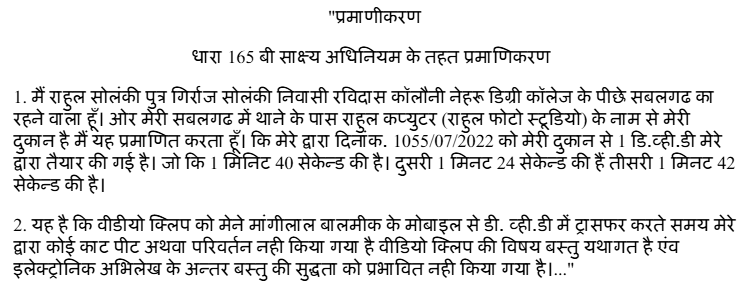
7. The learned counsel appearing for the petitioners submits that the certificate furnished along with the CD and in support of the application under Order 14 Rule 1 CPC (Annexure P/7) clearly certified that the deponent therein (DW/2) runs a shop in the name of Rahul Computer and had prepared the CD in his shop on the date mentioned therein. The length of the video clips are 1 minute 40 seconds, 1 minute 24 seconds and 1 minute 42 seconds and while transferring the said video clips from the mobile phone of Mangilal, he has neither altered nor edited the same and the subject matter of the video clips remained as it is.
8. He further submits that once the said documents were permitted to be taken on record vide order dated 12.09.2022, the same could not have been denied marking as exhibits during the course of evidence. He submits that whether the evidence sought to be tendered through the said CD is legally admissible or not was an issue which was required to be considered at the time of final hearing; however, at the stage of evidence, the learned trial Court erred in declining to mark the said CD as an exhibit.
9. He furt