


1. Conviction under Section 302 IPC for murder by burning — Appeal against conviction and sentence. (Para 2 , 6 )

 Back
Back





IN THE HIGH COURT OF MADHYA PRADESH AT GWALIOR
ANAND PATHAK, HIRDESH, JJ.
Ravi Valmik – Appellant
Versus
The State Of Madhya Pradesh – Respondent
Criminal Appeal No. 7834 Of 2022
Decided On : 10-02-2026
1. Conviction under Section 302 IPC for murder by burning — Appeal against conviction and sentence. (Para 2 , 6 )
2. Appellant argues conviction unsustainable; prosecution supports conviction based on dying declaration and evidence. (Para 7 , 8 , 9 , 10 )
3. Conviction modified from Section 302 to Section 304 Part II IPC; sentence reduced to ten years rigorous imprisonment. (Para 41 , 42 )
Yes, if the dying declaration inspires full confidence, is true and voluntary, and the deceased was in a fit state of mind to make the statement. (Para 21 , 22 , 23 , 25 )
Murder requires intention to cause death or bodily injury likely to cause death; Section 304 Part II applies when death is caused with knowledge but without intention. (Para 28 , 29 , 30 )
The act must be committed without premeditation, in a sudden fight, in heat of passion upon a sudden quarrel, and without undue advantage or cruel manner. (Para 30 , 32 , 33 )
When the act is reckless without murderous intent, as in a sudden domestic quarrel where the accused attempted to extinguish the fire. (Para 26 , 40 , 41 )
ORDER :
Hirdesh, J.
Instead of hearing on IA No.3062 of 2026, the third application filed on behalf of appellant- Ravi Valmik for suspension of jail sentence and grant of bail, with the consent of parties, this appeal is heard finally.
2. The instant criminal appeal under Section 372(2) of CrPC has been filed by appellant- Ravi Valmik, against the judgment of conviction and order of sentence dated 21-07-2022 passed by Fourth Additional Sessions Judge, Bhind (hereinafter it would be referred to as ''the trial Court'') in Sessions Trial No.66 of 2018 whereby, the appellant has been convicted under Section 302 of IPC and sentenced to undergo Life Imprisonment with a fine of Rs.5,000/-; with default stipulation.
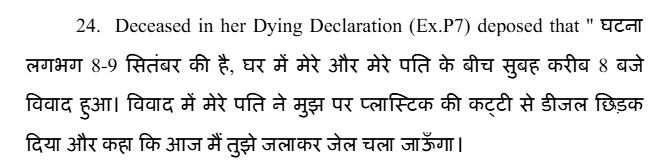
3. Prosecution story, in brief, is that on 04.11.2017, Police Post In-charge, Ramkumar Bhagat, at Police Post Machhand, Police Station Raun, District Bhind, received an information regarding burning of a woman, namely, Sushma Valmik in Village Laraul. ASI Ramprakash Parmar was sent to said village and enquired from villagers and specifically from those in Valmik Mohalla about the incident. It was found that Sushma had been burned before Diwali. Members of Sushma's maternal side arrived and admitted her in a burnt condition to Burn Unit of a hospital in Gwalior. Sushma was brought by a Dial 100 vehicle to the hospital for treatment. On 05.11.2017, Sushma was admitted to JA Hospital, Gwalior. On 06.11.2017, her Dying Declaration (Exhibit P7) was recorded by Executive Magistrate. In her Dying Declaration, Sushma deposed that on the date of incident, she was scolded by her husband Ravi (present appellant), mother-in-law Rambeti, and sister-in-law Meena for not collecting wood. Sushma deposed that Ravi poured diesel on her and set her on fire, while Rambeti and Meena instigated him to do so.
4. An investigation was conducted. On 23.11.2017, ASI Ramprakash Parmar recorded the statement of brother of Sushma- Majeet Singh, and the information was recorded in Roznamcha Sanha No. 59. On the basis of evidence collected and Dying Declaration, an FIR was registered under Section 307 read with Section 34 of IPC at Raun Police Station, vide Crime No.285/2017 on 23.11.2017. During investigation, it was found that on the basis of scolding and instigation, accused Ravi doused Sushma with diesel and set her on fire. Police prepared a spot map and collected various items from the scene of occurrence, including burnt hair, half-burnt pieces of a saree, and pieces of plastic. Additionally, matches and a plastic bottle containing remnants of diesel were found at the scene of occurrence. A panchnama (Exhibit P8) was prepared. On 26.11.2017, Sushma died in hospital due to complications from her burns. The death was reported to Police Station Kampoo, Gwalior, at 6:00 AM, and a merg No.0706/2017 under Section 174 CrPC was recorded at Police Station Kampoo. An inquest was conducted and a Safina form (Exhibit P-7A) was issued on 27.11.2017. The postmortem examination was carried out on the body of deceased at JA Hospital, Gwalior, and a sealed packet containing clothes, viscera, and salt was seized vide Exhibit P15. Thereafter, offence under Section 302 IPC was enhanced.
5. On 27.11.2017, police arrested appellant accused Ravi Valmik, vide arrest memo (Exhibit P9). The police recorded statements of witnesses Santosh and Dinesh on 05.01.2018, who confirmed seeing the victim in a burnt state but did not provide direct evidence how the incident occurred. A seizure panchnama (Exhibit P-6) was prepared on 10.01.2018 after deceased's clothes and viscera were sent for forensic examination. After examining viscera and other physical evidence, a report was sent to Forensic Science Laboratory (FSL). The investigation concluded that the cause of death was consistent with severe burns resulting from being set on fire. On 15.03.2018, charge-sheet was filed in the Court of Judicial Magistrate First Class, Lahar, District Bhind, against accused Ravi Valmik under Section 3
AI



An indispensable Tool for Legal Professionals, Endorsed by Various High Court and Judicial Officers
Please visit our Training & Support
Center or Contact Us for assistance

Scan Me!
India’s Legal research and Law Firm App, Download now!


For Daily Legal Updates, Join us on :



 Back to top