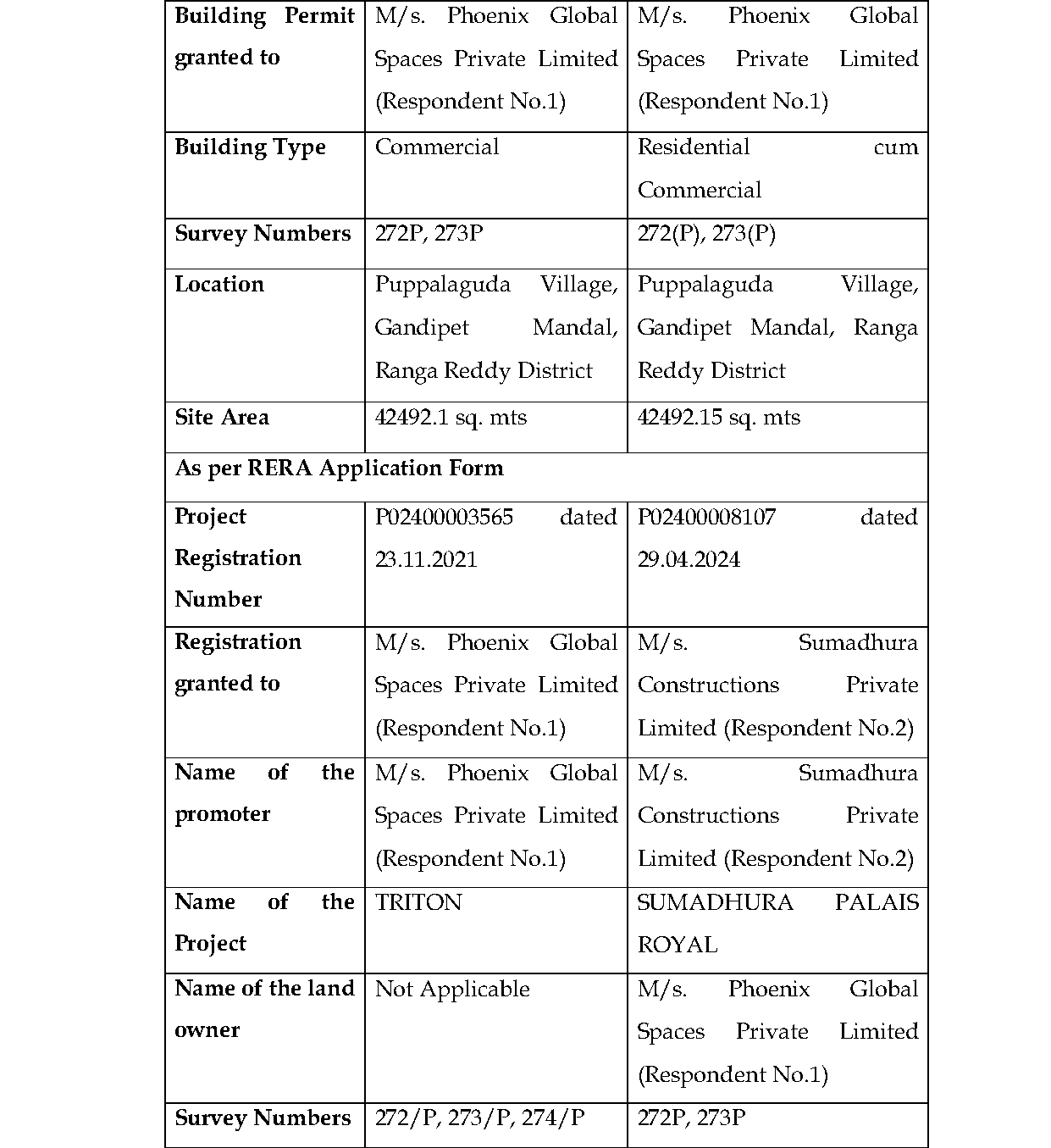
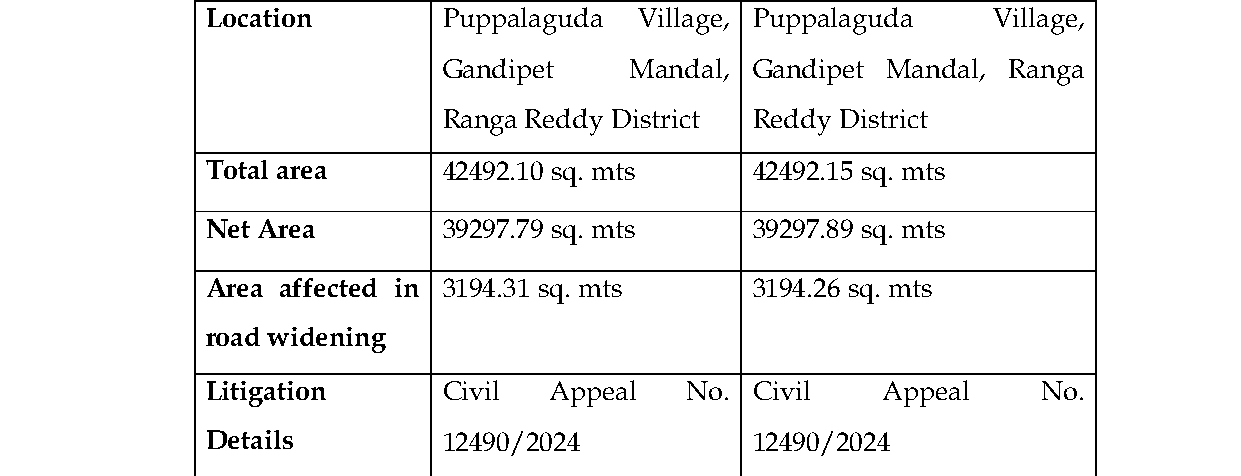
1. Complainant alleges unauthorized commercial real estate development in wetland/lake zones, asserting irregularities in registration and land use classification under the Real Estate (Regulation and Development) Act, 2016. (Para 1 , 2 , 3 , 4 , 5 , 6 )
 Back
Next 


2026 Supreme(Telangana) 1130
TELANGANA REAL ESTATE APPELLATE TRIBUNAL: HYDERABAD
A. Santhosh Reddy, Chairperson, P. Pradeep Kumar Reddy, Judicial Member, Vemula Sreekar, Administrative Member
Dr. Lubna Sarwath - Appellant
Versus
M/s Phoenix Global Spaces Private Limited, represented by its Authorised Representative - Respondent
T.A.No. 43 of 2025
Decided On : 29-10-2026
Advocates Appeared :
For the Appellant : Party-in-person
For the Respondent : Mr.P.Somashekar Reddy, Mr.K.Sukumar
Important Points
The judgment discusses the scope of 'aggrieved person' under Section 31(1) of RERA, weighing a restrictive interpretation requiring direct legal injury against a broader view that the Authority should initiate suo motu inquiries under Section 35 upon evidence of statutory violations.
Subject
Real Estate Law - Regulatory Compliance
Act Referred
Real Estate (Regulation and Development) Act, 2016: S.31(1), S.44(1), S.7, S.8, S.2(28), S.35, S.3(2), S.4(2)(f), S.5, S.80, S.81
Telangana Area Abolition of Inams Act, 1955: S.2B
Registration Act, 1908: S.22A
Telangana State Real Estate (Regulation and Development) Rules, 2017: R.34, R.30
Constitution of India: Art.21
Telangana Area Abolition of Inams Act, 1955: S.2B
Registration Act, 1908: S.22A
Telangana State Real Estate (Regulation and Development) Rules, 2017: R.34, R.30
Constitution of India: Art.21
Headnote
(A) Real Estate (Regulation and Development) Act, 2016 - Sections 2(zg) and 31(1) - Interpretation of ‘aggrieved person’ - The phrase ‘aggrieved person’ identifies individuals who are regulated or governed by the Act and have suffered an injury to a right conferred thereunder; a stranger without a direct legal interest or injury cannot maintain a complaint under Section 31(1), as the right to challenge an act or order requires the existence of a legal injury. (Paras 33-34)
(B) Real Estate (Regulation and Development) Act, 2016 - Section 35 - Suo Motu Powers - Where a complaint reveals plausible instances of flagrant violations of the Act, the Regulatory Authority has the power and duty to exercise its suo motu jurisdiction to conduct an inquiry, regardless of the complainant's locus standi, to ensure transparency and statutory compliance. (Dissent Paras 4.viii-xi)
(C) Registration Act, 1908 - Section 22A - Prohibited Properties - If project land is listed as prohibited property, preventing its registration and transfer, the promoter cannot pass valid title to allottees, rendering the project registration and subsequent development legally unsustainable. (Dissent Paras 4.iv-x)
(D) Real Estate (Regulation and Development) Act, 2016 - Section 4(2)(c) and (f) - Mandatory Compliance - Submission of geo-fencing data, land zoning certificates, and clear demarcation of land including latitude and longitude of end points are mandatory prerequisites for registration under Section 5; non-compliance renders the registration ineffective. (Dissent Paras 4.xix-xx)
Facts of the case:
A complaint was filed seeking the revocation of registration for two real estate projects on the grounds that the site encompasses a water body, is listed as prohibited property, and has overlapping registrations for the same area. The Regulatory Authority dismissed the complaint, holding that the complainant, not being an allottee, promoter, or agent, did not qualify as an ‘aggrieved person’. The complainant appealed this decision.
Findings of Court:
The majority held that the appellant lacked locus standi as an ‘aggrieved person’ and noted that the existence of the alleged water body had already been adjudicated as non-existent by a competent tribunal. In contrast, the dissenting member found that the properties were indeed on a prohibited list and that the Regulatory Authority failed to verify the overlapping nature of the projects and the lack of mandatory demarcation and zoning certificates.
Issues: Whether an individual without a direct interest in a project qualifies as an ‘aggrieved person’ under Section 31(1) of the Act and whether the Regulatory Authority must exercise suo motu powers when presented with evidence of statutory violations.
Ratio Decidendi: The majority reasoned that a person aggrieved must be denied something to which they are legally entitled under the Act. The dissent reasoned that the regulatory mechanism is intended to ensure accountability and that the Authority should not ignore reported contraventions on hyper-technical grounds of locus, especially when projects are situated on prohibited land or lack mandatory demarcation, as these errors affect public policy and protect prospective buyers.
Result: Appeal dismissed.
Legal Category Hierarchy
- administrative law
- practice and procedure
- real estate law
Table of Contents
2. Appellant challenges project registrations for alleged lake encroachment and procedural irregularities; Respondents contend Appellant lacks locus standi as an aggrieved person and NGT has already adjudicated lake existence. (Para 12 , 14 , 16 , 18 , 21 )
3. A divided Bench debated whether a non-allottee has locus standi as an aggrieved person; the majority dismissed the appeal, while the dissent found irregularities sufficient to require suo moto inquiry. (Para 26 , 27 , 32 , 34 , 36 , 38 , 39 , 4 , 5 )
4. Only a person aggrieved by a legal injury directly connected to their rights as an allottee, promoter, or agent has locus standi under Section 31 of the RERA Act. (Para 27 , 33 , 34 )
5. Majority upheld the rejection of the complaint due to lack of locus standi, while the dissent imposed interim restrictions pending regulatory compliance and site investigation. (Para 40 , 41 )
6. Who qualifies as an aggrieved person entitled to file a complaint under Section 31(1) of the Real Estate (Regulation and Development) Act, 2016?
An aggrieved person is someone whose rights as an allottee, promoter, real estate agent, or person governed by the Act have been infringed. A stranger or someone not connected to the project without a legal injury conferred by the Act does not have locus standi to maintain a complaint. (Para 27 , 33 , 34 )
7. Can the Regulatory Authority review project registrations if allegations of lake encroachment and land use misclassification are raised?
The majority held that issues regarding water body existence adjudicated by the NGT cannot be re-agitated before it. However, the dissent emphasized the Authority's duty under Section 35 to conduct suo moto inquiries when material irregularities in registration and documentation are presented, regardless of the complainant's status. (Para 36 , 37 , 38 , 39 , 4 )
8. Does granting project registrations on land listed in the prohibited list under Section 22A of the Registration Act, 1908, invalidate the registration?
The dissenting opinion concluded that granting registrations for projects on prohibited lands constituted a fundamental irregularity. It held that such permissions, lack of full disclosure, and potential overlap of projects require the Authority to conduct site inspections and verify statutory compliance before registration remains valid. (Para 4 , 5 )
ORDER :
A. Santhosh Reddy, J.
The captioned appeal arises from out of the Order, dated 27.03.2025, passed by the Telangana State Real Estate Regulatory Authority (hereinafter referred to as ‘the Regulatory Authority), in Complaint No. 33 of 2025, whereby the Complaint filed by the appellant/complainant has been disposed of holding that the reliefs sought by her cannot be granted.
2. The case of the appellant/complainant, in brief, as contained in the complaint is that in the year 1921, after construction of Osman Sagar Drinking Water Reservoir, Gandipet Raw Water Conduit was laid across the Narsingi Lake-2 outflow channel, so that the lake is not destroyed and continues to feed the ayacut area south of the lake. Subsequently, on 06.06.2005, the Revenue Registration Department issued G.O. Ms. No. 1092, dated 06.06.2005, imposing a prohibition on the registration of the Government lands situated in Puppalguda village, Rajendranagar Mandal, Ranga Reddy District, under Section 22A , on the grounds that such registrations would be contrary to public policy. Survey Nos. 271, 272, and 273 are among the 91 survey numbers included in the said notification. The Complainant further submitted that vide G.O.Ms. No. 33, dated 24.01.2013, issued by the Municipal Administration & Urban Development (MAUD) Department, it was stipulated that no construction shall be permitted within the Water Body Zone, and no building or development activity shall be allowed in the bed of any water body, including rivers, nalas, and the Full Tank Level (FTL) of lakes, ponds, cheruvus, kunta/shikam lands. Further, the identification of a water body, whether perennial or non-perennial, shall be determined based on Survey of India toposheets, revenue records, or other competent authorities. Complainant submitted that pursuant to the approval of the Metropolitan Development Plan-2031 for the Hyderabad Metropolitan Region under the Hyderabad Metropolitan Development Authority (HMDA) Master Plan, G.O. Ms.No. 33 at Para 1.1.8 reiterates that the Water Body Zone encompasses all water bodies, including rivers, streams, lakes, tanks, and kunta lands, as delineated in revenue village maps, topographical sheets of the Survey of India, and records maintained by the State Irrigation Department, Revenue Department, or other competent authorities. The boundaries of such water bodies correspond to the Full Tank Level (FTL) or High Flood Level (HFL), including both perennial and non-perennial parts wherever such distinction exists. Additionally, as per the list of lakes and water bodies identified within the HMDA jurisdiction, a total of 2,857 lakes were documented inside and outside the Outer Ring Road (ORR), including Narsingi Lake2, which was identified at coordinates 17°24’02.1"N 78°21’23.9"E and listed at Serial No. 248.
3. Complainant further submitted that W.P. No. 36396 of 2017 was pending before the High Court concerning the Occupancy Rights Certificate pertaining to Survey Nos. 271, 272, and 273 of Puppalguda Village, Gandipet Mandal, Ranga Reddy District. The Complainant submitted that, on 06.06.2019, in Civil Revision Petition No. 1241 of 2019, the High Court for the State of Telangana at Hyderabad, passed an order, on a petition filed under Section 2B of the Telangana Area Abolition of Inams Act, 1955, seeking to set aside the order, dated 18.05.2019, in Case No. F1/14927/2018, passed by the Joint Collector, Ranga Reddy District, as well as the earlier order, dated 07.02.2009 in No. L/4233/2008 issued by the Revenue Divisional Officer (RDO), Chevella Division, in relation to land in Survey Nos. 271, 272, and 273, admeasuring Ac. 8.11 Gts, situated in Puppalguda Village, Gandipet Mandal, Ranga Reddy District. That subsequently, on 05.09.2019, the Government issued G.O. Ms. No. 240 (MAUD Pig-III), including the IT Park/SEZ developed by Phoenix Group within Survey Nos. 271, 272, 273, 273/1, and 274 in Puppalguda under the jurisdiction of the Industrial Area Local Author