1. Appeal against conviction for murder and other offences arising from a land dispute leading to fatal assault. (Para 4 , 5 , 6 )
 Back
Next 





2026 Supreme(All) 728
HIGH COURT OF JUDICATURE AT ALLAHABAD LUCKNOW
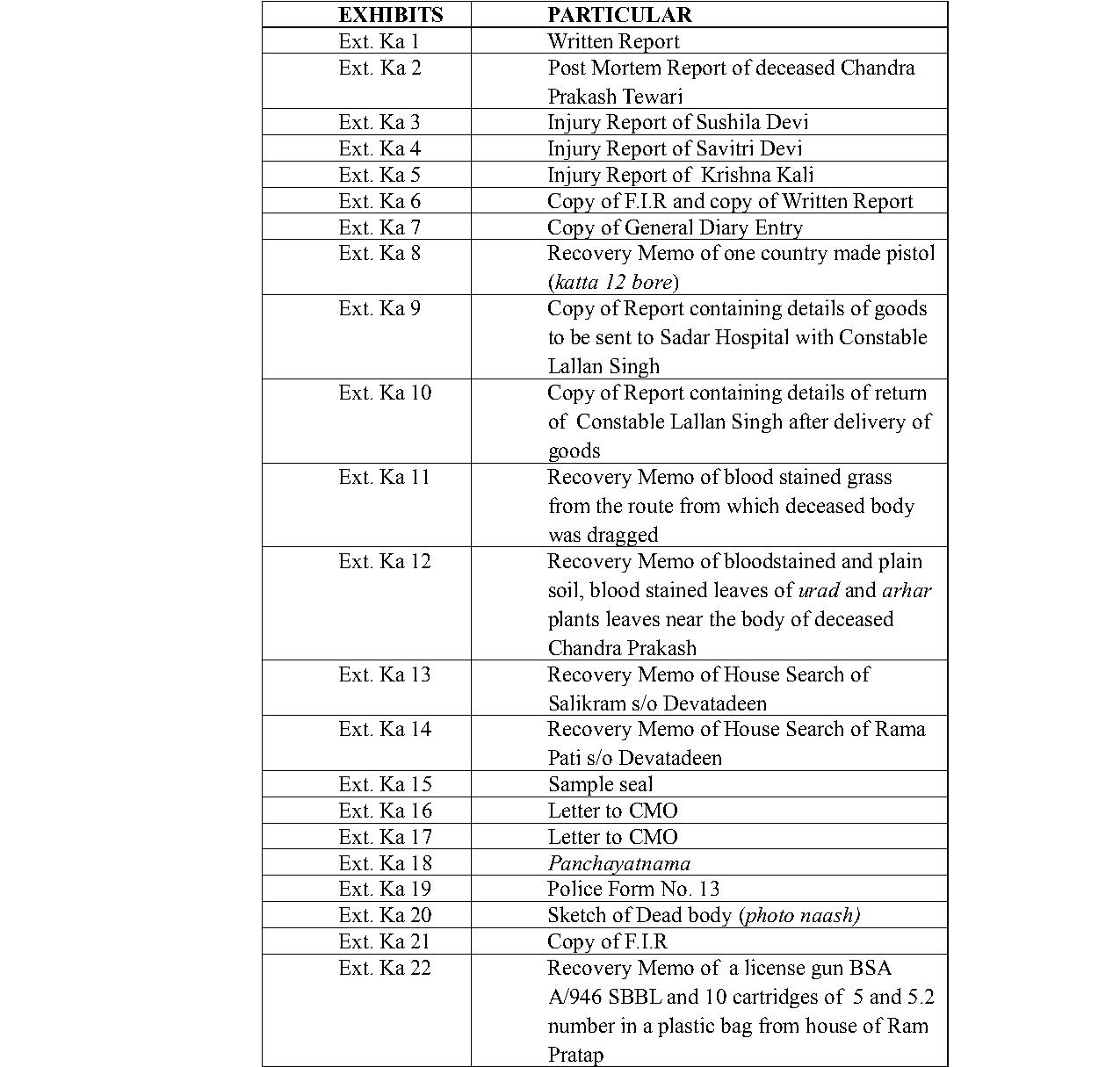
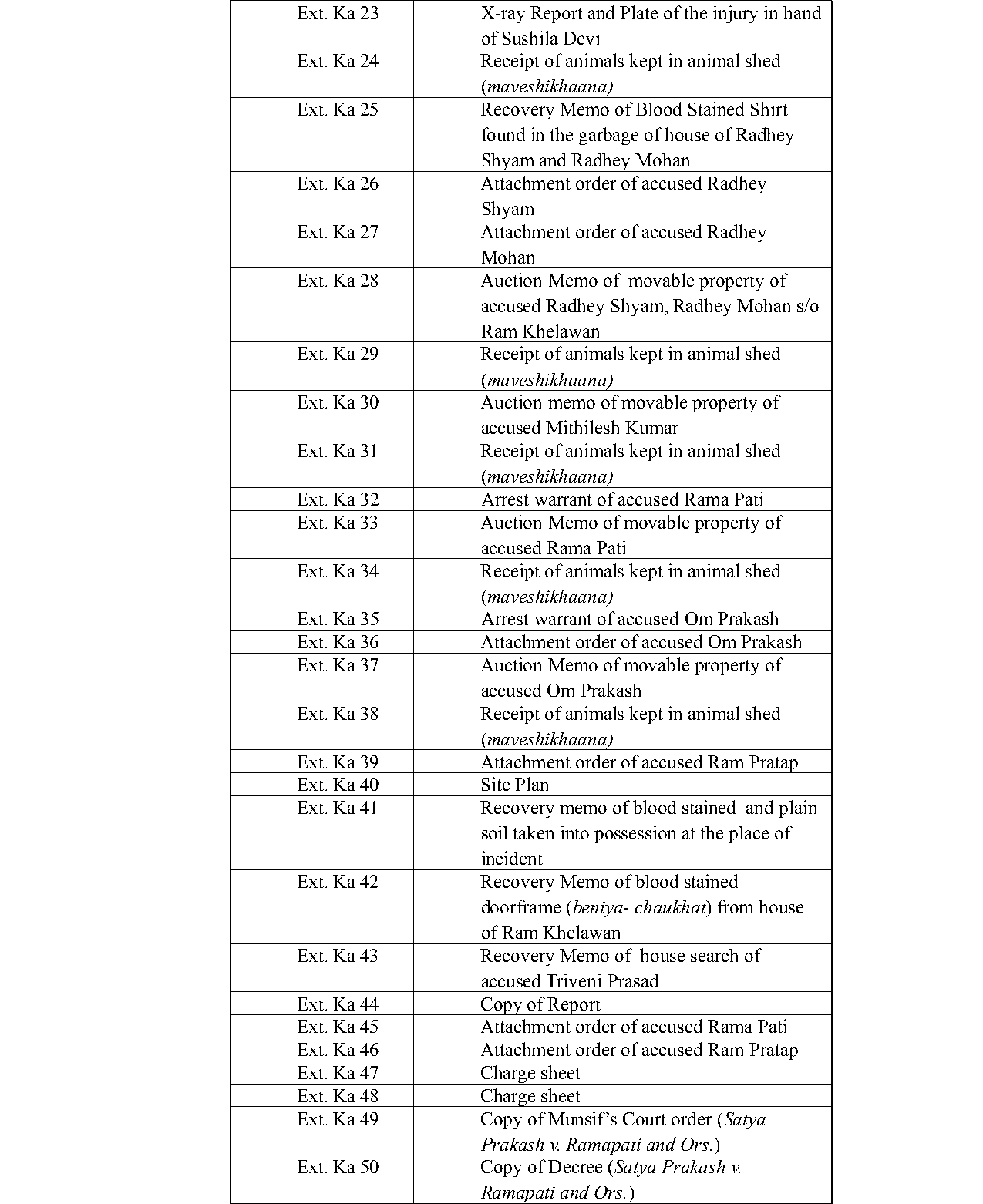
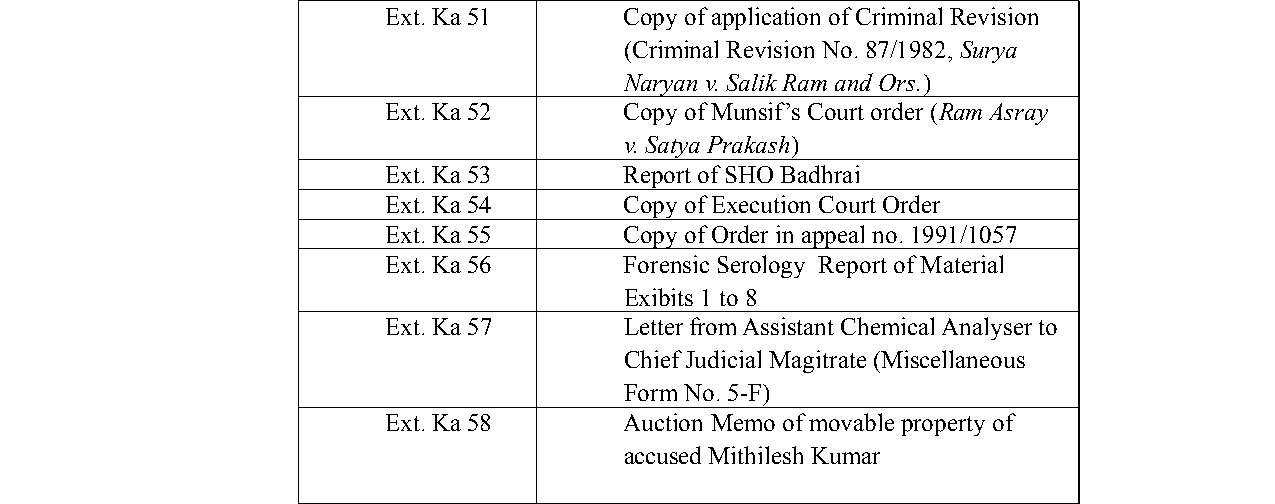
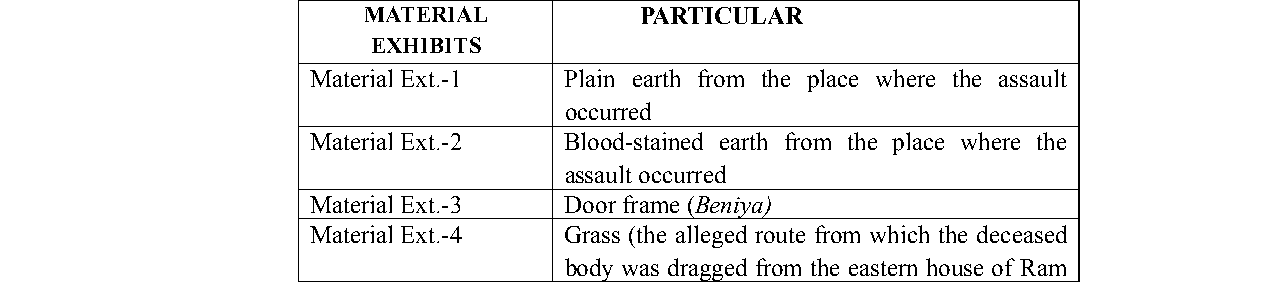
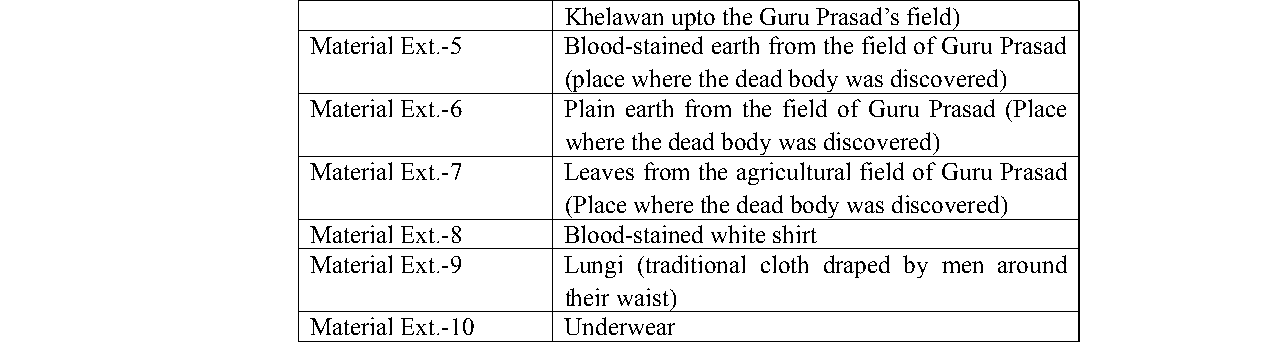
RAJNISH KUMAR, ZAFEER AHMAD, JJ.
Ram Pratap - Appellant
Versus
State of U.P. – Respondent
Criminal Appeal No. - 522 of 1983, Criminal Appeal No. 529 of 1983, Criminal Appeal No. 543 of 1983, Criminal Appeal No. 544 of 1983
Decided On : 20-04-2026
Advocates Appeared:
For the Appellant : S/Shri K.P. Singh, Santosh Kumar Tripathi, Shiv S.E. Chitambar
For the Respondent:Ld. Govt. Advocate, S/Shri Abhisek Awasthi, Abhishek Ranjan, Purnendu Chakravarty
For the Appellant : S/Shri K.P. Singh, Santosh Kumar Tripathi, Shiv S.E. Chitambar
For the Respondent:Ld. Govt. Advocate, S/Shri Abhisek Awasthi, Abhishek Ranjan, Purnendu Chakravarty
Liability under Section 149 IPC applies to all members of an unlawful assembly sharing a common object, regardless of individual overt acts. Section 201 IPC requires cogent proof of the act of removing evidence; mere suspicion regarding the body's recovery location is insufficient for conviction.
Headnote:(A) Indian Penal Code, 1860 - Sections 141, 146, 147, 148, 149, 201, 302, 323 and 325 - Unlawful assembly and common object - To constitute an unlawful assembly, there must be at least five persons with a common object to commit an offence - Assessing common object solely on overt acts of individual members is impermissible; the conduct of the gathering and circumstances of time and place are indicative - Once an unlawful assembly is established, Section 149 propounds vicarious liability where any member is guilty of an offence committed by others in prosecution of the common object, even if the member did not personally inflict the fatal injury, provided they had knowledge of the likelihood of such commission (Paras 59-64).
(B) Indian Penal Code, 1860 - Section 201 - Causing disappearance of evidence - Ingredients include: (i) commission of an offence, (ii) knowledge that an offence was committed, (iii) causing disappearance of evidence, and (iv) intention to screen the offender from legal punishment - Mere suspicion, however strong, cannot replace proof - The fact that a dead body was found at a place different from the alleged place of occurrence is not sufficient to hold that the accused caused disappearance of evidence in the absence of cogent evidence proving the act of removal and the requisite intention (Paras 48, 50-56).
(C) Evidence - Ocular and Medical - Testimony of an injured witness is accorded a higher degree of credibility as they are natural witnesses to the occurrence - Medical evidence is corroborative; it does not negate ocular testimony unless it completely rules out the prosecution version - Absence of external marks of injury does not negate the possibility of internal fractures if supported by medical opinion and X-ray evidence (Paras 43, 68-75).
Facts of the case:
Due to a pending land dispute, a group of individuals surrounded and assaulted a person with lathis. One individual remained armed with a firearm to threaten and prevent witnesses from intervening. The victim succumbed to head injuries. Although the body was recovered from a field away from the site of the assault, no direct evidence established that the accused had moved the body to conceal it. One of the accused was found to have been a juvenile at the time of the incident.
Findings of Court:
The court found the ocular testimonies of the witnesses, including an injured witness, to be reliable and corroborated by medical evidence. It held that an unlawful assembly was formed with the common object of assaulting the deceased, thereby attracting vicarious liability for all members under Section 149. However, the court found that the prosecution failed to prove the specific act of removing the body to screen the offenders.
Issues: 1. Whether the ocular evidence was reliable despite the recovery of the body from a different location. 2. Whether an accused who did not inflict a direct injury could be held liable under Section 149 IPC. 3. Whether the evidence supported a conviction under Section 201 IPC for causing disappearance of evidence. 4. The appropriate treatment of a convict who was a juvenile at the time of the offence but an adult at the time of the appeal.
Ratio Decidendi: Liability under Section 149 IPC attaches to all members of an unlawful assembly if the offence is committed in prosecution of the common object, regardless of individual roles in inflicting injury. Conviction under Section 201 IPC requires proof of a positive act of removing evidence with an intent to screen the offender, which cannot be inferred from the mere location of the body. The testimony of an injured witness is highly credible and prevails unless medically impossible.
Result: Appeals partly allowed; convictions under Sections 302 read with Section 149, 147, 325 read with Section 149, and 323 read with Section 149 affirmed; conviction under Section 201 set aside; for the juvenile, the period of detention already undergone is treated as sufficient.
Legal Category Hierarchy
- crime and sentencing
- practice and procedure
- criminal law
Table of Contents
2. Appellants challenged conviction citing lack of overt acts, contradictions in evidence, and failure to prove charge under Section 201 IPC. (Para 15 )
3. Ocular evidence from natural and injured witnesses found credible and consistent, establishing unlawful assembly and common object. (Para 37 , 38 , 39 , 40 , 41 , 42 , 43 , 44 , 45 )
4. For Section 149 IPC, a member need not commit an overt act; presence and facilitation with knowledge of common object suffices. (Para 28 , 34 , 59 , 60 , 61 , 62 , 63 , 64 )
5. Appeals partly allowed; conviction under Sections 302/149, 147, 325/149, 323/149 IPC affirmed; conviction under Section 201/149 IPC set aside. (Para 84 , 85 , 86 )
6. What is the standard for relying on ocular evidence in a criminal case?
Conviction can be based solely on ocular evidence if found cogent, reliable, and trustworthy; minor discrepancies are ignored. (Para 37 , 38 , 39 , 40 , 41 , 42 , 43 , 44 , 45 )
7. What are the essential ingredients for an offence under Section 201 IPC?
The prosecution must prove knowledge of an offence, causing disappearance of evidence, and intention to screen the offender from punishment. (Para 48 , 49 , 50 , 51 , 52 , 53 , 54 , 55 , 56 , 57 )
8. Can a member of an unlawful assembly be convicted under Section 149 IPC without committing an overt act?
Yes, if the member shared the common object or had knowledge that the offence was likely to be committed, vicarious liability attaches. (Para 28 , 34 , 59 , 60 , 61 , 62 , 63 , 64 , 65 , 66 , 67 )
9. Does a contradiction between ocular and medical evidence always vitiate the prosecution case?
No, unless the medical evidence completely rules out the prosecution version; ocular testimony, if credible, prevails. (Para 68 , 69 , 70 , 71 , 72 , 73 , 74 , 75 )
10. How should a court deal with a juvenile who has attained majority long after the offence?
Sending the now-adult to a reformative institution is not practicable; the period already undergone may be treated as sufficient. (Para 76 , 77 , 78 , 79 , 80 , 81 , 82 )
JUDGMENT :
Zafeer Ahmad, J.
1. Heard, Sri Nagendra Mohan learned Senior counsel assisted by Sri Shiv S.E. Chitambar, learned counsel for the appellants, Sri Purnendu Chakravarty learned Senior counsel assisted by Sri Pranjal Jain, learned counsel for the complainant and learned A.G.A. for the State. Perused the records.
2. The aforesaid criminal appeals arises out of the common judgment and order dated 18.07.1983 passed by IIIrd Additional District & Session Judge, Pratapgarh in Session Trial No. 227 of 1982 (State v. Rama Pati Misra & Ors.) arising out of case crime no. 146 of 1982, Police Station Badhrai,Sub-District Kunda, District Pratapgarh, whereby the appellants have been convicted and sentenced under Section 302 of Indian Penal Code (in short I.P.C.) r/w Section 149 I.P.C. for life imprisonment, under Section 325 I.P.C. r/w Section 149 I.P.C for one year of rigorous imprisonment, under Section 323 I.P.C r/w Section 149 I.P.C for six months rigorous imprisonment, under Section 201 I.P.C r/w 149 I.P.C for five years rigorous imprisonment. It has further been provided that appellant Ram Pratap has to undergo further sentence for one year rigorous imprisonment under Section 148 I.P.C..
3. Since all the aforesaid criminal appeals arise out of a common judgment and order dated 18.07.1983, as such same have been heard together and decided by a common order.
Prosecution Story in Nutshell:
4. The prosecution story, in brief, is that on 05.09.1982 complainant Shyam Shankar Tripathi s/o Surya Narayan r/o Gogaur, Police Station Badhrai, District Pratapgarh submitted a written report stating therein that a land dispute was pending between the informant’s uncle, Chandra Prakash Tiwari, son of Mewalal Tiwari, and Ramapati and Salik Ram Agayara of his village, on account of which the accused persons were harbouring enmity against the deceased. On 05.09.1982 at around 6:00 P.M., while the deceased was sitting at his door and talking to Salik Ram Pradhan and Pati Ram Upadhyay, Radhe Krishna s/o Ram Khelawan came and called him on the pretext that a peon from the Tehsil was calling for him. Thereafter when he reached the southern road near the house of Ram Khelawan, he was surrounded by Ramapati Mishra, Salik Ram Misra, Ram Khelawan, and Triveni Prasad Mishra (sons of Devata Din), Ram Khelawan (son of Suraj Din), Ram Asray Radhe Shyam, Radhey Mohan and Randhey Krishna (sons of Ram Khelawan), Mithlesh Kumar, Dhirendra Kumar and Rakesh Kumar (sons of Salik Ram) and Om Prakash (son of Triveni Prasad), who caught hold of him and started assaulting him with lathis. On hearing the cries of the deceased, the complainant along with his father Suryanarayan, Dhruv Prakash, Satya Prakash, Salik Ram (Pradhan), Pati Ram Upadhyay, Jagan , Jagdev, his two aunts (chachi) and one paternal aunt (bua) reached the spot and attempted to intervene but the accused persons threatened them of dire consequences and prevented them from rescuing the deceased. It is alleged that even the women, who tried to shield the deceased, were assaulted and forcibly pushed aside. It is further stated that Ram Pratap, brother-in-law of Ram Asrey, who was present at the spot with other associates, threatened the witnesses with firearms, due to which they could not come near. The accused persons continued to beat the deceased with lathis in the presence of the witnesses, as a result of which he succumbed to the injuries. It is also alleged that the accused persons attempted to conceal the dead body.
5. On the basis of the written report, an F.I.R was registered by Head Moharrir Irshad Ahmad and the corresponding GD entry was also made. The investigation of the case was entrusted to S.I. Raj Deo Yadav, who proceeded to the place of occurrence and reached there at around 1:45 A.M. on 06.09.1982. Upon arrival, the dead body was not found at the alleged place of occurrence; however, after a brief search, the same was recovered from the field of Gaya Prasad. Owing to insufficient light, the