Back
Back





2026 Supreme(AP) 1245
IN THE HIGH COURT OF ANDHRA PRADESH AT AMARAVATI
MAHESWARA RAO KUNCHEAM, J.
R V Panduranga Rao And others - Petitioners
Versus
Chairman District Level Committee The Krishna District Co-Op Central Bank, and others - Respondents
W.P.No.6220 of 2017
Decided On : 30-01-2026
For the Petitioner: Sri Y Koteswar Rao
For the Respondent: G.P for Cooperation
Dismissal of employee without lawful procedure and lack of reasoned justification contravenes principles of natural justice and employment laws.
Headnote:(A) Andhra Pradesh Co-operative Societies Act, 1964 - Section 116-AA - Writ Petition under Article 226 seeking to challenge dismissal order - Court held that dismissal was not in accordance with due process as required by Society's bye-laws, lacking prior approval and proper reasoning - Court emphasized the necessity of reasoned orders and adherence to natural justice principles. (Paras 17 - 45)
(B) Natural Justice - The failure to provide opportunity for a hearing before dismissing an employee is violative of principles of natural justice, rendering the order unsustainable. (Paras 18 - 26)
(C) Proportionality Doctrine - Dismissal based on actions classified as minor misconduct without due consultation and adherence to byelaws is excessive and arbitrary. (Paras 32 - 42)
Facts of the case:
The petitioners challenge the dismissal of R V Panduranga Rao from service for alleged misconduct without proper procedural adherence, which the Court noted as improper. (Paras 1 - 9)
Findings of Court:
The Court set aside the dismissal order due to violation of procedural requirements and ordered payment of dues to the petitioner’s legal representatives. (Paras 45)
Issues: Whether the dismissal orders and subsequent communication were legally sustainable?
Ratio Decidendi: The dismissal was arbitrary as it circumvents laid down procedures in Society’s bye-laws, thus disregarding both procedural and substantive justice. (Paras 26, 34)
Result: Writ petition allowed; orders set aside; payment of arrears and benefits directed.
| Table of Content |
|---|
| 1. dismissal of employee without due process. (Para 4 , 6 , 9) |
| 2. arguments against dismissal's legality. (Para 10 , 11 , 12 , 13 , 14) |
| 3. importance of procedural adherence and reasoned orders. (Para 18 , 24 , 26 , 28 , 36 , 42) |
| 4. court's decision to allow petition and set aside orders. (Para 34 , 45) |
ORDER :
MAHESWARA RAO KUNCHEAM, J.
This Writ Petition is filed under Article 226 of the Constitution of India seeking the following relief:
“….to issue order or orders, direction or directions, Writ or Writs, particularly one in the nature of Writ of Mandamus, declaring the order dated 03-11-2016 passed by the 1st respondent is illegal, arbitrary and violative of principles of natural justice and set aside the same and consequently direct the respondents to pay all other retiremental benefits of the petitioner…”
2. Heard Sri Y. Koteswara Rao, learned counsel for the petitioners and learned Government Pleader for Cooperation appearing for the respondent No.4. Notices to respondents No. 1 to 3 and 5 were served, but none represented on their behalf.
3. During the pendency of the writ petition, the petitioner No.1 died and consequently his legal representatives were brought on record as petitioner Nos.2 to 4, vide orders, dated 10.10.2025 in I.A.No.1 of 2021.
Brief facts of the case:
4. According to the petitioners, petitioner No.1(deceased) was appointed as a Secretary in respondent No.5 society long back. Due to ill health of his sister-in-law, petitioner No.1 applied for Casual Leave on 05.07.2006 and 06.07.2006 and sought extension of leave on medical grounds from time to time by way of telegrams and sending letters by registered post to respondent No.5. However, his requests for leave had not acted upon by respondent No.5 authorities in view of personal ill will against the 1st petitioner. Ultimately, when petitioner No.1 approached the 5th respondent in the month of December 2006 to join duty, respondent No.5 refused to allow the petitioner by stating that he was suspended on 26.08.2006.
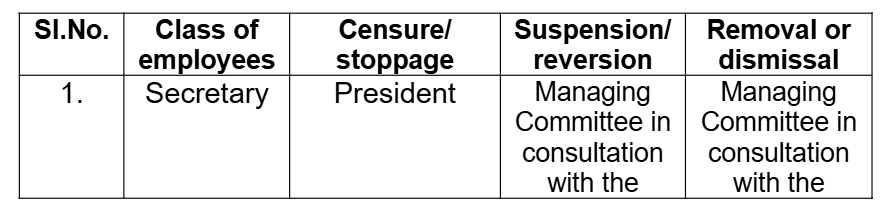
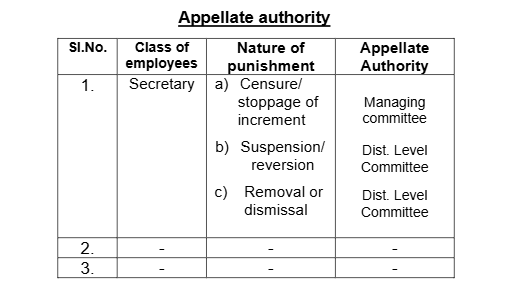
5. Further, respondent No.5 authorities also appointed an Enquiry Officer to cause enquiry and four charges were framed against petitioner No.1. In reply to the said charges, petitioner No.1 submitted an explanation by denying the charges with cogent reasons. Again, petitioner No.1 was removed from service by respondent No.5 authorities, vide orders, dated 18.02.2008. Challenging the said removal order, petitioner No.1 preferred an Appeal dated 03.05.2008 before respondent No.1 i.e., District Level Committee, in terms of Chapter V (8) of the Societies bye- laws.
6. As the said Appeal has not been disposed of, petitioner No.1, after prolonged litigation, filed W.P.No.16531 of 2009 before the common High Court of A.P. at Hyderabad. The said writ petition was disposed of through orders dated 08.02.2016, directing the 1st respondent to pass orders on the appeal within a period of twelve (12) weeks therefrom and also by giving liberty to petitioner No.1 to raise all contentions before the 1st respondent/appellate authority.
7. It is further stated that without adhering to the above orders dated 08.12.2016, the Chief Executive Officer of the 1st respondent addressed a communication by passing orders dated 03.11.2016 basing on the resolution dated 29.06.2016 of the District Level Committee and asked to release the gratuity amount and P.F. amount to the 1st petitioner
8. Aggrieved by the above mentioned orders dated 03.11.2016, petitioner No.1 filed the present writ petition on the ground of violation of principles of natural justice and to declare the same as illegal, arbitrary by granting all consequential benefits in his favour.
Arguments of the learned counsels:
9. Learned counsel for the petitioners summarized his arguments mainly in fivefold. Firstly, he submits that petitioner No.1 was dismissed from service by imposing major penalty by respondent No.5 Society without there being any consultation with respondent No.1, which is the competent au