
 Back
Back





HIGH COURT OF CHHATTISGARH AT BILASPUR
Sanjay K. Agrawal, Sanjay Kumar Jaiswal, JJ.
Hayat Tavil Shahi, S/o Syed Matinulhaq - Appellant
Versus
Smt. Sumaiyya Khatoon, W/o Hayat Tavil Shahi - Respondent
FA(MAT) No. 212 of 2024
Decided On : 16-12-2025
JUDGMENT :
Sanjay Kumar Jaiswal, J.
1. The matter is listed for hearing on admission, but with the consent of parties, the matter is heard finally.
2. Invoking the appellate jurisdiction of this Court under Section 19 of the Family Courts Act, 1984, the appellant herein-husband/ defendant has preferred this appeal calling in question legality, validity and correctness of the impugned judgment & decree dated 10-5-2024 passed by the Judge, Family Court, Manendragarh, District Korea in Civil Suit No.111A/2022, by which the Family Court has allowed the suit filed by the plaintiff/respondent herein and dissolved the marriage between the parties.
3. The aforesaid challenge has been made by the appellant herein/defendant on the following factual backdrop : -
[Parties will hereinafter be referred as per their status shown and ranking given in the suit before the Family Court.]
Facts
4. Marriage of the plaintiff and the defendant was solemnized as per Muslim law on 30-9-2015 at Manendragarh, District Korea and after marriage, the plaintiff/wife started residing with the defendant/ husband at Islampur, Jharkhand. The plaintiff had resided with the defendant only for 15 days and thereafter, family dispute started arising between them and thereafter, on 9-5-2016, the plaintiff went back to her father’s place at Manendragarh. It is the case of the plaintiff that the defendant came to the house of her father at Manendragarh after 15 days and asked about encashment of the fixed deposit of Rs. 10 lakhs which is in the name of the plaintiff. Thereafter, the plaintiff lodged a report against the defendant and his family members for offences punishable under Sections 498A & 506 read with Section 34 of the IPC on 29-1-2017 and also proceeding under the Domestic Violence Act, 2005 was initiated on 17-3-2017 and thereafter, the plaintiff filed application for maintenance under Section 125 of the CrPC. It was lastly pleaded that from the year 2016, the plaintiff is residing separately i.e. for more than two years, therefore, she is entitled for dissolution of marriage solemnized on 30-9-2015.
5. The defendant filed written statement denying the allegations made in the plaint and pleaded that all the members of the family including the defendant have been acquitted by the trial Court on 11-9-2023 of the charges under Sections 498A & 506 read with Section 34 of the IPC and other charges levelled against them and the plaintiff filed application for maintenance on 20-12-2021 in which she has not filed affidavit in prescribed format in respect of her income and property. It has been further stated that the plaintiff belongs to a well to do, happy and prosperous family, she is financially sound and she does not need any amount for maintenance, as such, the application deserves to be rejected.
6. The Family Court by its impugned judgment dated 10-5-2024, framed three issues and answered the same as under: -
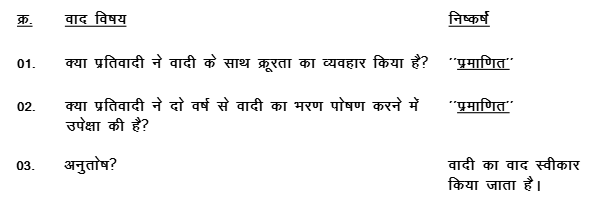
7. In sum and substance, the Family Court has held that the ground under Section 2(ii) of the Dissolution of Muslim Marriages Act, 1939 (for short, ‘the Act of 1939’), that the defendant/husband has neglected or has failed to provide for her maintenance for a period of two years and secondly, Section 2(viii)(d) of the Act of 1939, that the defendant/husband has disposed of her property or prevented her from exercising her legal rights over it, are made out and, therefore, the plaintiff/wife is entitled for dissolution of her marriage with the defendant/husband on the aforesaid two grounds, which is sought to be challenged by the defendant/husband in this appeal.
8. Mr. D.N. Prajapati, learned counsel appearing on behalf of the appellant herein/defendant/husband, would submit that the plaintiff/wife is financially well-off and running a boutique and also a fashion designing course, and she on her own had left the matrimonial home and residing with her father, therefore, she would not be entitled for divorce on the grounds enumerated under Sections 2(ii) & 2(viii)(d
A Muslim wife is entitled to divorce if the husband fails to provide maintenance for two years, regardless of her financial independence.


The dissolution of marriage was warranted due to failure to maintain and established cruelty, aligning with the provisions of the Dissolution of Muslim Marriages Act.

Courts may grant divorce on the grounds of cruelty and desertion, considering the irretrievable breakdown of marriage as valid grounds, particularly when one party expresses a desire to live separate....

The court established that mental cruelty, including neglect and harassment, is sufficient grounds for dissolving a marriage under Muslim law.

The court held that continuous allegations of cruelty and the breakdown of marital relations constitute valid grounds for divorce under the Hindu Marriage Act.

The main legal point established in the judgment is that allegations of cruelty must be proven, and the petitioner must not have condoned the cruelty before a decree of divorce can be granted on the ....

The court upheld the dissolution of marriage based on established grounds of cruelty and desertion, emphasizing the irretrievable breakdown of the marital relationship.
Cruelty and desertion are valid grounds for divorce under the Hindu Marriage Act, particularly when the marriage is irretrievably broken down.

Prolonged separation and lack of cooperation can indicate irretrievable breakdown of marriage, leading to divorce under Hindu Marriage Act.



An indispensable Tool for Legal Professionals, Endorsed by Various High Court and Judicial Officers
Please visit our Training & Support
Center or Contact Us for assistance

Scan Me!
India’s Legal research and Law Firm App, Download now!


For Daily Legal Updates, Join us on :



 Back to top


