Back





2026 Supreme(Online)(CIC) 4186
CENTRAL INFORMATION COMMISSION
Vikash Swarup, Information Commissioner
Saroj Devi – Appellant
Versus
PIO – Respondent
Second Appeal No.:- CIC/MLABE/A/2025/109464
Important Points
Subject
Information Rights - RTI Exemption
Act Referred
Official Secrets Act, 1923
Headnote
That the Respondent Central Public Information Ollicer is posted as Dy. Welfare Commissioner in the office of the Welfare Commissioner, LWO Ranchi.
That the respondent has gone through the contest of the 2nd Appeal and submits reply.
That prior to the reply of the 2nd Appeal the answering respondent briefly say and submit the salicut facts of the case for kind consideration of the Hon'ble Chief Information Commissioner.
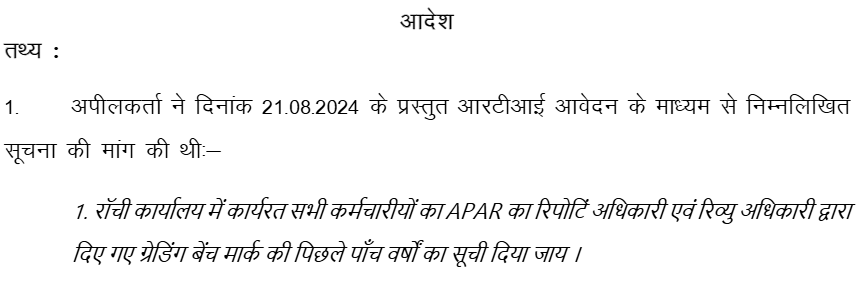
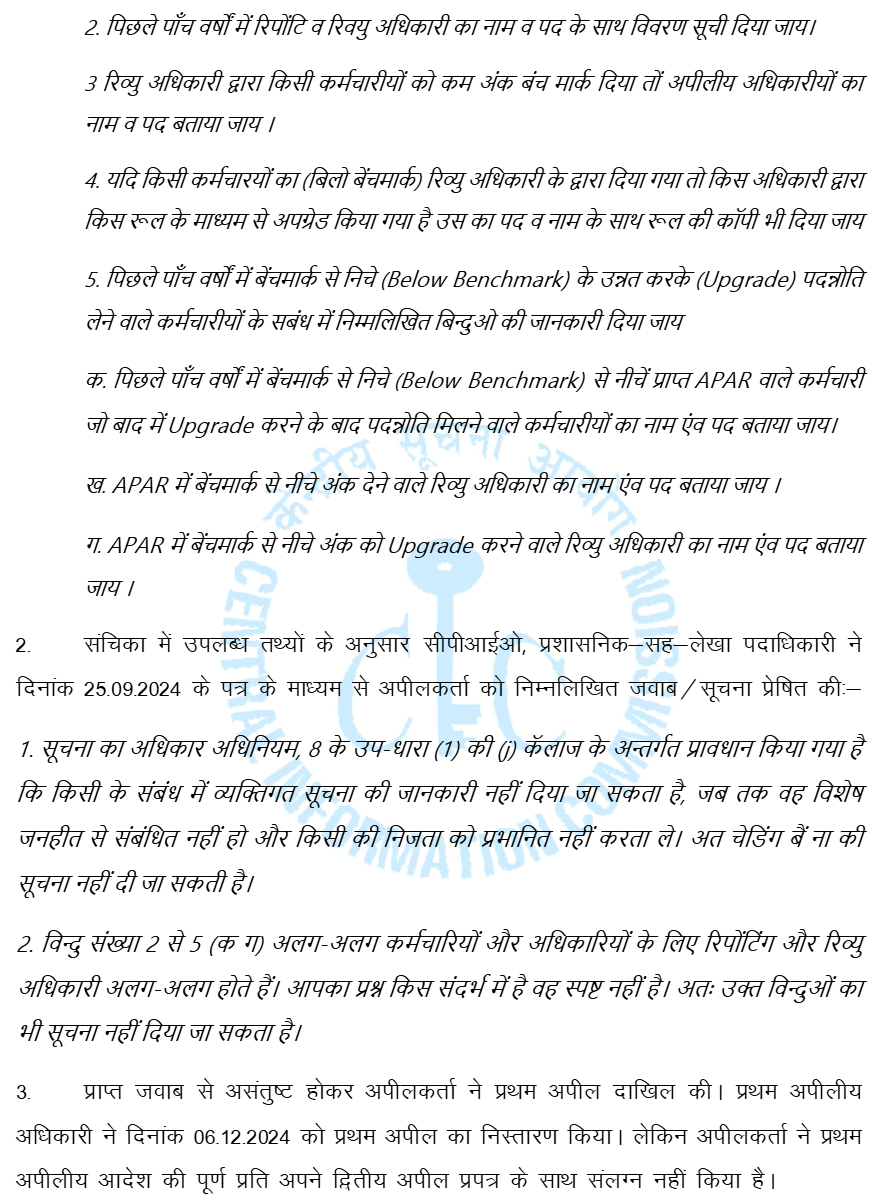
Smt. Saroj Devi, Appellant, requested information about the Grading marks given by the Reporting & Reviewing Officers of all the employees of Ranchi oflice, list of Reporting & Reviewing officer, name of the Reporting & Reviewing officer who upgraded the Grade marks given to an employee, employe who been promoted after gradation of his grade mark etc.
The then Admn-cum-Accounts Officer cum- CPIO, after due application of mind, denied the information vide letter no. Admn. RTI/1(08)2022/. 4115 dt. 25.9.24 under Section 8(1)(j) of the RTI Act, 2005, in response to the RTI application filed by her vide application dt. 21.8.24.(Annex-1)
トThe First Appellate Authority has also upheld the decision of the CPIO, in his onder di 6.12.2024 with remarics "That this information as sought by the appellant was not ton specific and also qualifies to be the 'Personal information' as defined in clanse (j) of Section 8(1) of the RTI Act and the appellant has not been able to convince that disclosure thereof is in larger public interest." (Annex-2)
it is further to he submitted that ACR/APAR contains sensitive assessments of an employer's character, performance, conduct, integrity, and attributes recorded by superior officers in a fiduciary and confidential capacity. It is a document maintained in the course of employer-employee relationship and is not a public record open to third-party scrutiny, Its discloture to any person other than the employee concerned would amount to an unwarranted invasion of privacy.
The Department of Personnel & Training (DoPT), the nodal Ministry for RTI matters, has abo issued specific onder vide OM dt. 21.09.2017.No. 10/20/2006-18) after consultation with the Department of Legal Affairs, regarding disclosure of Annual Confidential Reports under the RTI Act, 2005" and holds that "The public authority is not under obligation to disclose ACRs of any employoo to the employee himself or to any other person inasmuch as disclosure of ACRs is protected by clause (1) of sub- section (1) of Section 8 of the RTI Act; and an ACR is a confidential document, disclosure of which is protected by the Official Secrets Aut, 1923." (Annex-3)
The said OM further clarifies that while the public authority has discretion to disclose in exceptional cases where it is satisfied that larger public interest outweighs the harm, there is no obligation to disclose ACRs.
DOPT has also issued Office Memorandum dated-14/08/2013[File-11/2/2013-IR(Pi))in the similar matter (Annex-4).
The then CPIO has correctly exercised this position and found no larger public interest in the present cuse under In this regard, various verdicts come from the Hon'ble Supreme Court and High Court as R.K. Jain vs. Union of India (2013) 7 SCC 1 (deciiled on 16.04.2013): The Supreme Court held that ACRs of a public officer constitute "personal information and are exempt fruti disclosure to a third party under Section 8(1)(j) of the RTI Act. Relying on ita earlier judgment in Girish Ramchandrs Deshpande vs. Central Information Commissioner (2013) 1 800 212. the Court ruled that information relating to an employee's savice records, including ACRa, is a matter hetween the employee and the employer. Disclosure has "no relationship to any public activity or public interest and would cause "unwarranted invasion of the privacy of the individual". The petitioner cannot claim such details as a matter of right: only the competent authority may disclose in larger public interest. The CIC's order directing disclosure was set aside.
Girish Ramchandra Deshpande vs. CIC (2013) 1 SCC