
 Back
Back





IN THE HIGH COURT OF DELHI AT NEW DELHI
AMIT BANSAL, J.
Madhya Bharat Power Corporation Limited - Petitioner
Versus
Voith Hydro Private Limited - Respondent
O.M.P. (COMM) 452 of 2019 & I.A. 14761 of 2019
Decided On : 26-05-2026
| Table of Content |
|---|
| 1. factual overview of arbitration dispute and procedural history. (Para 1 , 20) |
| 2. petitioner's objections to the arbitral award. (Para 21 , 27) |
| 3. respondent's defense of the arbitral award. (Para 28 , 34) |
| 4. scope of judicial interference under section 34 of act. (Para 35 , 43) |
| 5. assessment of engineering costs in the absence of contract breakdown. (Para 44 , 59) |
| 6. determining compensation for manufactured materials and storage liabilities. (Para 60 , 72) |
| 7. admissibility of erp extracts for determining on-site expenses. (Para 73 , 80) |
| 8. proving loss of profits and off-site overheads calculations. (Para 81 , 92) |
| 9. judicial review of interest rates and cost allocation discretion. (Para 93 , 98) |
| 10. final dismissal of the petition for setting aside award. (Para 99 , 100) |
JUDGMENT :
AMIT BANSAL, J.
1. The present petition has been filed under Section 34 of the Arbitration and Conciliation Act, 1996 (‘Act’) seeking setting aside of the Award dated 31st July, 2019 passed by the Arbitral Tribunal (‘Award’).
2. The petitioner (respondent in the arbitration proceedings) shall hereinafter be referred to as ‘Madhya Bharat’ or ‘the Employer’ and the respondent (claimant in the arbitration proceedings) shall hereinafter be referred to as ‘Voith Hydro’ or ‘the Contractor’.
FACTUAL BACKGROUND
3. Brief facts relevant for the adjudication of present dispute are as follows.
4. Madhya Bharat entered into a Memorandum of Understanding with the Government of Sikkim by which Rongnichu Hydro Project (‘RHEP’) in Sikkim was allotted to Madhya Bharat.
5. Madhya Bharat had split RHEP into five different packages, one of which was for Electro Mechanical Works (‘E&M’). Tender was floated by Madhya Bharat for E&M in respect of which Voith Hydro submitted its bid. A Letter of Intent was issued to Voith Hydro on 21st June, 2011. Thereafter, Voith Hydro was awarded the Contract for Electro Mechanical works for the 96 MGW Rongnichu Hydro Project in the State of Sikkim.
6. On 28th September, 2011, Madhya Bharat and Voith Hydro entered into two Contracts:
(a) Supply Contract for sale of electro-mechanical equipment for the project; and
(b) Services Contract for port clearance, transportation, unloading, storage and erection among other things.
7. The timeline agreed by the parties for the completion of the Contract was a period thirty (30) months from the effective date of Contract. However, within a week of signing of the Contracts, the parties amended the Contract and revised the time of completion from thirty (30) months to forty-two (42) months from the effective date of the Contract.
8. On 27th November, 2013, Voith Hydro issued a notice of suspension to Madhya Bharat. Subsequently on 11th December, 2013, Voith Hydro suspended the Contract in terms of Clause 41.2(b) of the General Conditions of Contract (‘GCC’). Madhya Bharat also formally suspended the Contract on 13th June, 2014.
9. On 5th May, 2016, Voith Hydro issued a notice for settlement of dispute under Clause 6 of the GCC, which did not materialise. Thereafter, Voith Hydro nominated an Adjudicator for resolution of disputes, in terms of Clause 6.1 of the GCC, however, the Adjudicator later on conveyed his unwillingness to adjudicate the dispute.
10. Accordingly, Voith Hydro issued a notice dated 9th March, 2017 invoking the arbitration clause. Both the parties appointed their respective Nominee Arbitrators who mutually appointed the Presiding Arbitrator.
OVERVIEW OF THE PROCEEDINGS BEFORE THE ARBITRAL TRIBUNAL
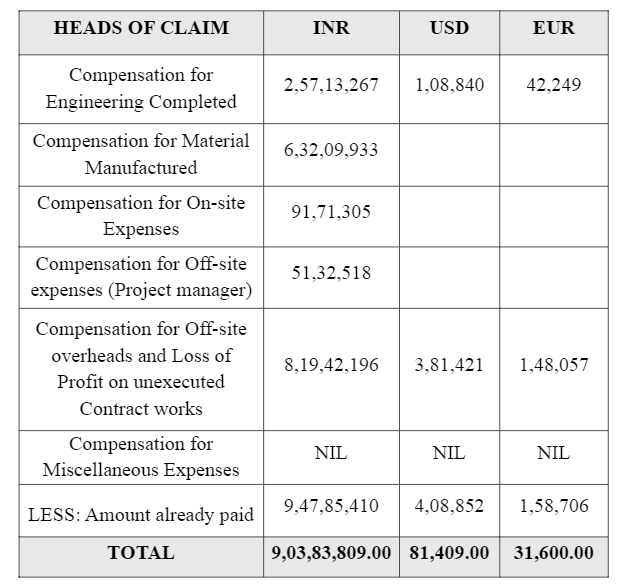
11. Voith Hydro made the following claims in the Statement of Claim filed before the Arbitral Tribunal on 19th July, 2017:
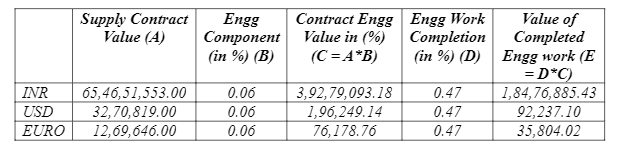
(a) Claim I: Compensation for engineering works completed
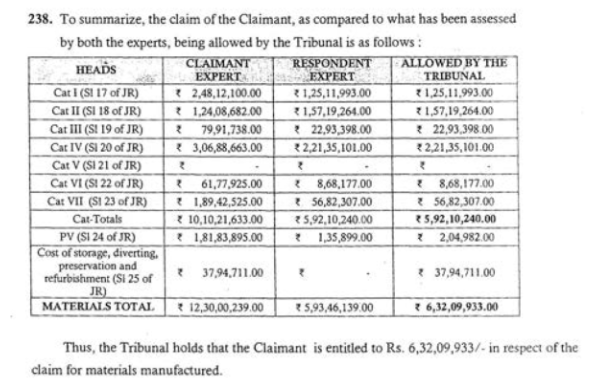
(b) Claim II: Compensation for materials manufactured
(c) Claim III: Compensation for on-site expenses
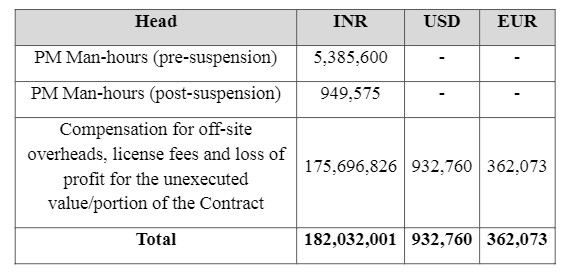
(d) Claim IV: Compensation for off-site expenses and loss of profits
(e) Claim V: Miscellaneous expenses
(f) Pre-award interest at 15% per annum; post award interest at 18% per annum
(g) Costs
12. Statement of Defence along

AI



An indispensable Tool for Legal Professionals, Endorsed by Various High Court and Judicial Officers
Please visit our Training & Support
Center or Contact Us for assistance

Scan Me!
India’s Legal research and Law Firm App, Download now!


For Daily Legal Updates, Join us on :



 Back to top


