Back
Back





2025 Supreme(Kar) 2896
IN THE HIGH COURT OF KARNATAKA, AT DHARWAD
M. Nagaprasanna, J.
Ravichandragouda R. Patil – Petitioner
Versus
Karnataka State Bar Council – Respondent
Writ Petition No. 105477 of 2025 (GM-RES)
Decided On : 03-11-2025
For the Petitioner: Sri.Ravichandragouda R. Patil, Party-In-Person
For the Respondent:Smt. Archana Magdum, Advocate, Sri. Rajashekahar Burji, Advocate
Fees charged in excess of the statutory enrolment fee under the Advocates Act, 1961, are impermissible and unconstitutional.
Headnote:(A) Advocates Act, 1961 - Section 24(1)(f) - Excess enrolment fee - The petitioner seeks refund of amounts collected in excess of the statutory enrolment fee of Rs.750/- - The Court held that collection of enrolment fees beyond the statutorily prescribed amount is impermissible and contrary to law, as reiterated in precedents. (Paras 3, 64, 109)
(B) Delegated Authority - Limitations on power - SBCs and BCI cannot create fees or obligations beyond those expressly provided by the Advocates Act - Fiscal provisions must be construed strictly as per legislative policy. (Paras 72-77)
Facts of the case:
The petitioner claims that the Karnataka State Bar Council was collecting Rs.6800/- as additional fees despite the statutory limit set by the Advocates Act, leading to the petition for mandamus and certiorari. (Para 1)
Findings of Court:
The court clarified that the Bar Council of Karnataka must not collect fees beyond the settled statutory limits and must process any refund requests promptly. (Paras 6-9)
Issues: Whether additional fees can be considered as enrolment fees and if the Bar Council can impose them as a condition for enrolment. (Paras 82.1, 82.2)
Ratio Decidendi: The court affirmed that enrolment fees are strictly regulated under the Advocates Act, invalidating any additional charges and reinforcing compliance with legislative intent. (Paras 64, 109)
Result: Directions issued to cease collection of fees in excess of the stipulated amount and process refunds where applicable.
| Table of Content |
|---|
| 1. petitioner's claims for fee refund. (Para 1 , 3) |
| 2. arguments of the parties regarding fee collection. (Para 2 , 6) |
| 3. judicial interpretation of fee regulations. (Para 4) |
| 4. final orders on compliance and fees. (Para 8 , 9) |
ORDER :
M. Nagaprasanna, J.
1. The petitioner in-person is before this Court seeking the following prayer:
i. To issue a writ of mandamus directing the respondent No.1-Karnataka State Bar Council (KSBC) to refund the amount collected from the petitioner in excess of the statutory enrolment fee prescribed under Section24(1)(f) of the Advocates Act, 1961;
ii. Issue a writ of certiorari or any other appropriate writ, order, or direction quashing the impugned notification/notice issued by the KSBC under office Nos.080-22868712/080-22868561 (Annexure-A) prescribing a sum of Rs.6800/- under the head “other fees” and other purported mandatory fees for enrolment; and further declare that the current system of collecting fees beyond the statutory enrolment fee under section 24(1)(f) of the advocates act, 1961 is ultra vires, illegal, and unconstitutional;
iii. Issue a writ of mandamus or appropriate direction directing the KSBC to forthwith cease the practice of collecting any amount under any head or nomenclature in excess of the statutory limit at the time of enrolment, and further direct the Bar Council of India (BCI) to ensure compliance with the directions of the Hon’ble Supreme Court in Gourav Kumar (supra), in letter and spirit, without delay;
iv. Issue a writ of mandamus, or any other appropriate writ, order, or direction, restraining the respondents from denying the petitioner any benefit, facility, or service otherwise available to other advocates solely on the ground that the petitioner has sought refund of excess enrolment fee;
v. Issue a direction to the respondents to take expeditious steps to digitize and conduct the enrolment application process through a fully functional and accessible online portal in order to reduce logistical burdens, ensure transparency, and facilitate ease of access;
vi. Pass such other or further orders or directions as this Hon’ble Court may deem just, fit and proper in the facts and circumstances of the case and in the interest of justice and equity.
2. Heard the learned counsel Sri.Ravichandragouda R.Patil, party-in-person, learned counsel Smt.Archana Magdum for respondent No.1 and the learned counsel Sri.Rajashekhar Burji appearing for respondent No.2.
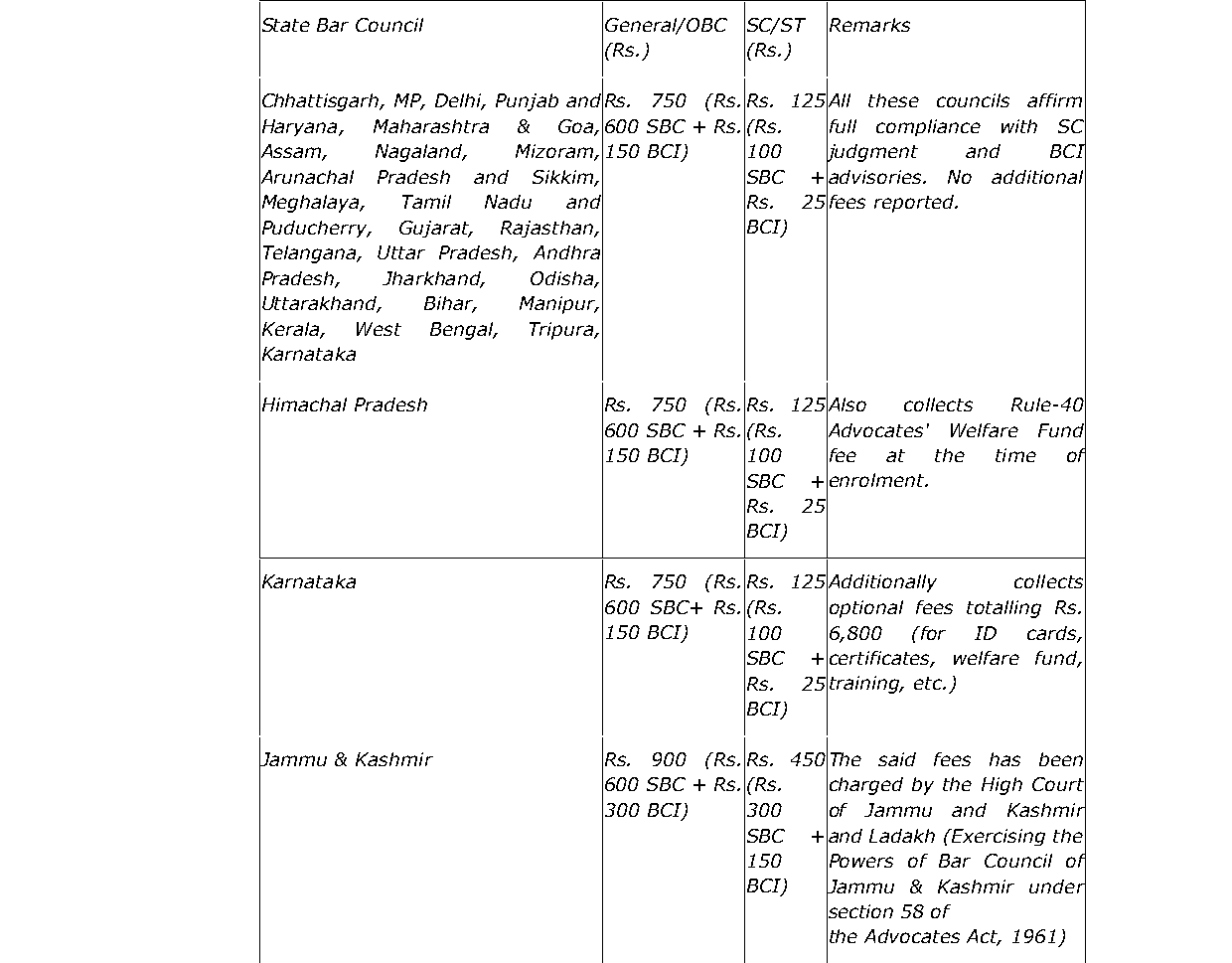
3. The petitioner, appearing in-person, is said to have enrolled as an advocate in the month of October 2024. It is the case of the petitioner that beyond the prescribed statutory fee of Rs.750/-, the respondent No.1-Karnataka State Bar Council has been collecting optional fees of Rs.6800/-. It transpires that Rs.750/- is the only fee that is legally sanctioned for collection in terms of the Advocates Act, 1961. The issue regarding whether the respondents could charge fees beyond what is stipulated under the Statute need not detain this Court for long or delve deep into the matter.
4. The Apex Court in the judgment rendered in the case of GAURAV KUMAR VS. UNION OF INDIA AND OTHERS , (2025)1 SCC 641 considers this issue, and holds that the charging of enrolment fees, in excess of the statutory stipulation, is impermissible in law. The judgment of the Apex Court reads as follows:
“64. While acting as a delegate of Parliament, SBCs and BCI can frame rules under the Advocates Act. However, any rule enacted by SBCs is only ancillary and cannot be so exercised to bring into existence substantive rights, obligations or disabilities not contemplated by the provisions of the parent enactment. [Kunj Behari Lal Butail v. State of H.P., (2000) 3 SCC 40, para 14] Further, the rules must align with the object and purpose of the Advocates Act, namely, the creation of a common Bar and regulation of legal practitioners and their qualifications, enrolment, right to practise, and discipline.
*** *** ***
72. From the above discussion, we can